REVIEW · LUXOR
Dendera Temple Half Day Private Tour from Luxor
Book on Viator →Operated by Nile Holiday · Bookable on Viator
Dendera Temple makes a strong case for going off Luxor’s main path. You’ll get a private guide to explain the stories in one of Egypt’s best-preserved temple complexes, plus easy transport from your hotel in Luxor. Two things I really liked: the chance to see the astronomical ceiling and the option to climb onto the roof and explore the lower crypt areas. The only real consideration is time on the road—this is a half-day trip, and the drive can feel a bit long, even though it’s worth it.
I also like that you can move at a comfortable pace inside the complex. One guide named Hosne was friendly and patient with questions and photo stops, which matters when you’re trying to read walls covered with figures and symbols. The site feels far less crowded than some of the Luxor draws, so you can actually enjoy the details without feeling rushed.
There’s another practical note: parts of the visit involve stairs and narrower passageways, so plan for some walking and stepping up/down as you go from room to room. If you’re not steady on your feet, this is where you should think twice.
In This Review
- Key things to know before you go
- Dendera from Luxor: what this trip really gives you
- Pickup, drive time, and the comfort factor
- Entering the Dendera Temple Complex (and why the first rooms matter)
- The Temple of Hathor: artwork, ceiling details, and what to look for
- Crypt access and the narrow passageways: a different way to see the temple
- Rooftop views and the Ptolemaic story you can walk through
- Timing: how a 5-hour half day stays satisfying
- Price and value: is $39 per person a smart deal?
- Service and organization: the comfort of good timing
- Who this tour fits best (and who should think twice)
- Should you book Dendera from Luxor?
- FAQ
- FAQ
- What’s included in the tour price?
- How long is the Dendera Temple tour?
- Is this tour private or shared?
- Do I need to pay extra for pickup at the Luxor airport?
- Will I have time to explore the rooftop and crypt?
- Is bottled water provided?
- What kind of group discounts are offered?
- What documents do I need to provide before travel?
Key things to know before you go
- Greco-Roman temple experience at a site dedicated to Hathor, with Roman-period additions and Ptolemaic-era elements
- Astronomical ceiling you can see up close, plus a temple roof area with countryside views
- Crypt and rooftop access so you don’t just look from the ground
- Private, air-conditioned pickup and drop-off from Luxor hotels (or the airport with a supplement)
- Entrance fees and bottled water included, keeping the day simple
- A well-paced half day that fits neatly if you want one extra “big” site without losing a full day
Dendera from Luxor: what this trip really gives you
If you’re already in Luxor and your schedule is tight, Dendera is one of those day trips that makes sense fast. It’s about 70 km (44 miles) from Luxor, so you’ll spend a chunk of time traveling—but you’re trading that for a site that feels distinct from what you’ll see closer to the Nile corridor.
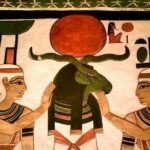
The temple complex is dedicated to Hathor, associated with love, happiness, and joy. That matters because you’ll see the iconography and symbolism built into the spaces, not just random carvings. And Dendera is also a Greco-Roman site, so expect a mix of styles and time periods, not a single “pure” moment in Egyptian history.
For me, the value is the combination of interpretation + access. A private guide helps you understand what you’re looking at, and the visit includes areas that many tours skip. That means you spend your time on the parts that make Dendera special rather than simply getting transported between entrances and exits.
You can also read our reviews of more private tours in Luxor
Pickup, drive time, and the comfort factor
This is set up as a private tour, so you’re not squeezed into a large group schedule. Your guide meets you at your Luxor hotel (or can pick up at Luxor airport for an additional $7 supplement one way). You’ll transfer by a private, air-conditioned vehicle, and you’ll have bottled water during the tour.
The drive usually runs about an hour to an hour and a bit from Luxor. It’s not a deal-breaker, but it can make the half-day feel longer than the calendar suggests. If you hate long rides, plan your day around it—this should be treated as the main event, not something you stack with extra stops.
Comfort-wise, the setup is exactly what you want in Egypt heat: car first, temple second. That alone reduces stress, especially if you’re juggling photos, water, and timing.
Entering the Dendera Temple Complex (and why the first rooms matter)
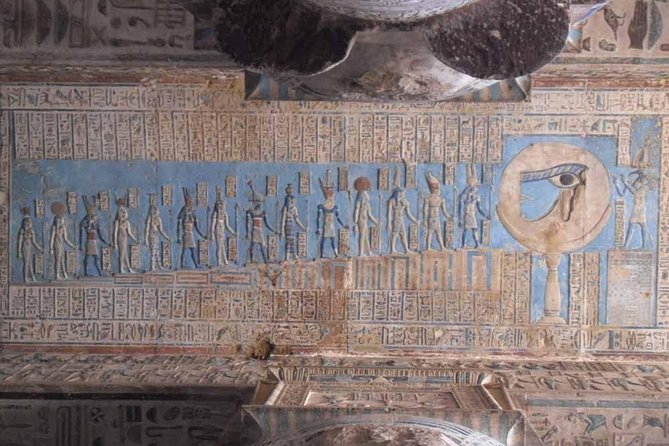
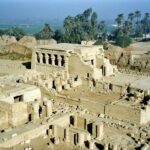
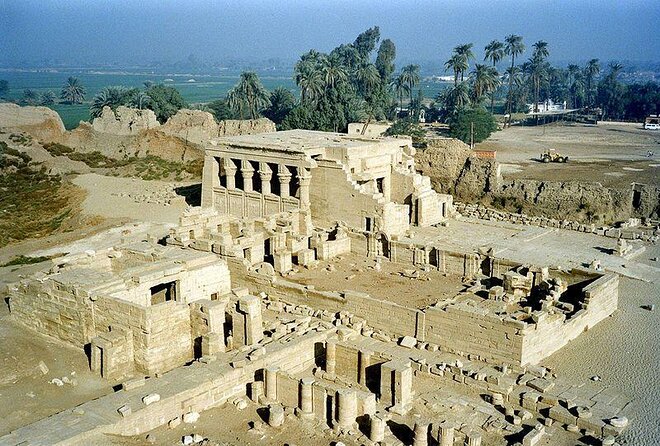
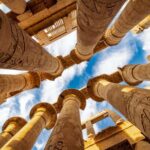
You start with the Dendera Temple complex itself. The site is enclosed by a massive mud-brick wall that covers roughly 40,000 square meters. That gives you a feel for scale right away. Even before you reach the most famous areas, you’re inside a whole sacred layout that was built and rebuilt over time.
Dendera has layers that stretch from early periods all the way into Roman rule. The construction on this location dates back to the Middle Kingdom era, associated with Pepi I (around 2250 BC), and continued in different ways until the time of Roman emperor Trajan (around 117 AD). What you see today includes late Ptolemaic construction under Ptolemy Auletes (around 54 BC) and later Roman additions in the period of Tiberius (14–37 AD), including the hypostyle hall.
Practically, that means your guide can point out why different walls feel different, and why certain architectural choices look Greco-Roman in character. You’re not just walking through one era. You’re walking through a timeline.
One of my favorite ways to experience this kind of site is to start slowly in the first rooms. You’ll have time to notice the colors and the way the ceiling and pillars create an interior “world.” Reports from real visits highlight how still-colorful the space can feel, and that you get a wow factor early rather than later.
The Temple of Hathor: artwork, ceiling details, and what to look for
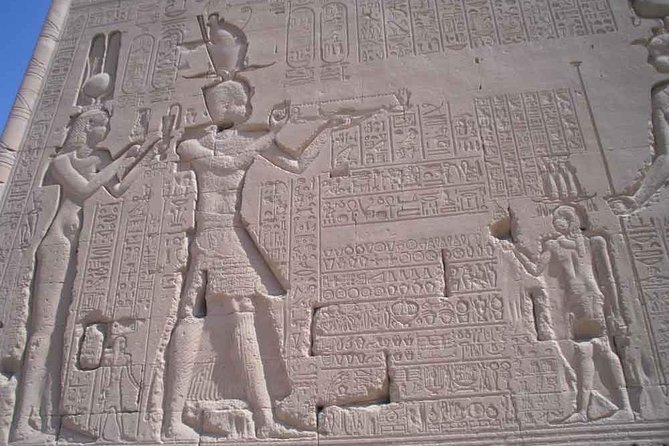
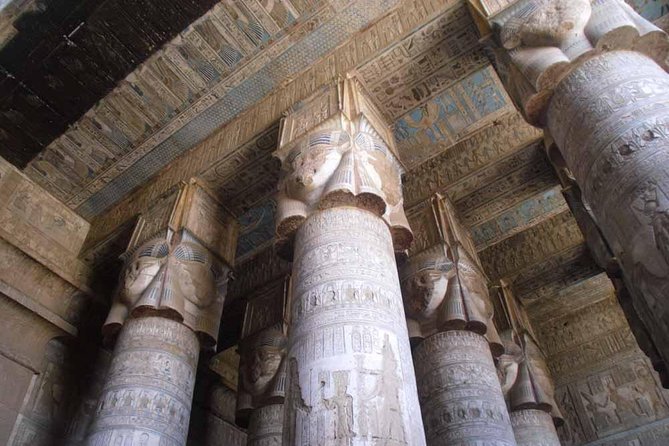
The Temple of Hathor is the heart of this visit. This is also where the site’s unique appeal shows up: Dendera is one of the few Egyptian temple complexes with an intact astronomical ceiling that’s accessible to visitors.
This ceiling is more than a cool overhead decoration. Astronomical ceilings in temples connect ritual space to cosmic themes—so when your guide explains what you’re seeing, you start to understand how the temple “thinks” in symbols. It’s a great place to slow down and let the guide do their job, because the ceiling is not something you’ll interpret correctly just by staring at it for a minute.
You may also notice that the ceiling has been cleaned after soot buildup. That kind of restoration makes the difference between seeing shapes and actually reading details. If you’ve ever visited a temple where everything looks dim and smudged, you’ll appreciate the clearer view here.
So here’s your simple plan inside the Temple of Hathor: pause longer than you think you need at the ceiling area, then follow your guide into the next spaces without rushing. The site is best when you give it a steady pace.
Crypt access and the narrow passageways: a different way to see the temple
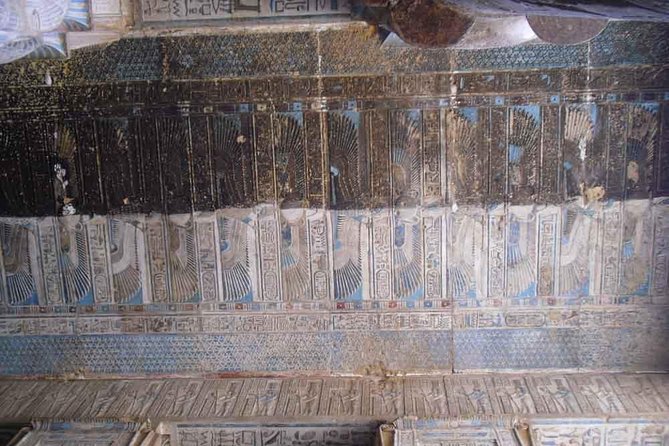
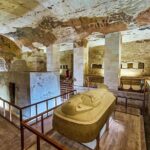
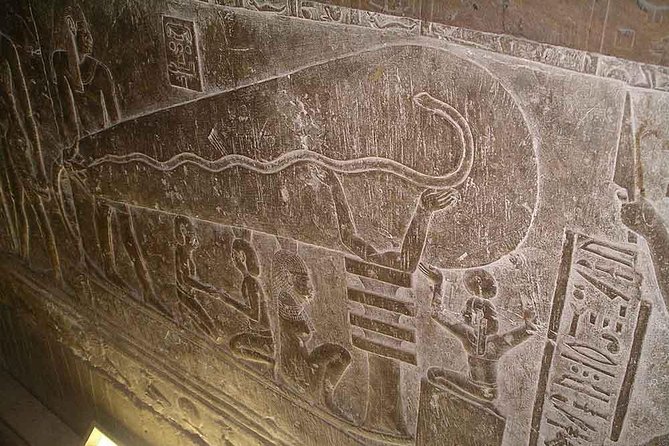
One of Dendera’s strongest “included” moments is that you can go beyond the main floor. You’ll have access to a lower crypt area, and you’ll move through narrow passageways that connect different parts of the complex.
This is a big deal for your experience because it changes your point of view. Instead of only looking at carvings from one stable angle, you experience the temple as a series of connected spaces, including areas that feel more enclosed. That makes the symbolism feel more physical.
It’s also part of why people call Dendera fun to experience. You’re not stuck watching everything from a distance. The structure invites exploration, and rooftop/crypt access turns a “drive and look” visit into something more hands-on.
Do remember: passageways and crypt access typically mean extra steps and careful footing. If you’re traveling with kids, it can still be family friendly, but keep an eye on energy levels. The site is rewarding, but it’s not a gentle stroll.



Rooftop views and the Ptolemaic story you can walk through
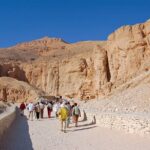
Dendera’s rooftop access is one of the best reasons to choose this tour instead of a bare-bones ticket. From the roof area, you can get fantastic views of the surrounding countryside, which helps you place the temple in real geography.
But the rooftop isn’t just scenery. The tour also focuses on the Ptolemaic period, so you’ll connect what you see in the stone and ceilings to the time when major construction took shape. Your guide should help you connect the symbolism and layout to that period—so you leave with the feeling of understanding, not just “I saw a temple.”
Rooftop time is also a practical gift. It’s a chance to cool off briefly, take photos with better light, and reset before you finish the main indoor sections.
Timing: how a 5-hour half day stays satisfying
The tour runs for about 5 hours. That time includes pickup, transport, and entrance time. In other words, you’re not just getting a ticket to walk around on your own; you’re getting a guided route with the full transfer.
Because it’s half day, you’ll want to treat it as your main activity rather than a side quest. This works best on days when you’re already doing other Luxor priorities—maybe one major temple earlier, then Dendera as the second anchor.
A half-day also helps if you’re trying to balance fatigue. Long days in Egypt can turn into photo regret. Here, the structure of the tour keeps you from wandering too long and missing the key pieces.
Price and value: is $39 per person a smart deal?
At $39 per person, this is not a budget-buster or a luxury splurge. The value mostly comes from what’s included:
- hotel pickup and return from Luxor
- private air-conditioned vehicle
- entrance fees
- bottled water
Entrance fees in Egypt can add up, and transport is often the real hidden cost when you’re planning a DIY day trip. With a private guide, you also avoid the frustration of not knowing what you’re looking at—especially for details like the astronomical ceiling.
So the question isn’t only what you pay. It’s what you get without having to negotiate everything on your own. For many visitors, that turns $39 into a reasonable bargain, especially if you’re only doing one extra site outside Luxor.
Service and organization: the comfort of good timing
One thing that kept coming through in real experiences is that guides and drivers show up on time and act professionally. The car is usually clean and comfortable, and the driver’s job is to get you there smoothly without drama.
The best part is how the guide works with your pace. With Hosne, for example, visitors highlighted friendliness, patience, and a willingness to answer questions—even during photo-taking moments. That matters because Dendera is not a “blink and you’re done” site. If your guide is rushed, you miss the meaning behind the carvings.
If you value an unhurried visit, this is one of those tours where “private” is not just a pricing label. It affects how the day feels.
Who this tour fits best (and who should think twice)
You’ll likely love this tour if:
- you want a second big temple day outside Luxor
- you like understanding what you’re seeing, not just photographing it
- you enjoy sites with Greco-Roman layers and Hathor symbolism
- you want roof and crypt access as part of the experience
It may be less ideal if:
- you strongly dislike driving time and want a quicker itinerary
- you have mobility challenges, since the visit includes stairs, passageways, and moving between levels
Family travelers can do well here. The site is described as family friendly, and the variety of spaces keeps kids interested, as long as everyone takes breaks and stays mindful in tighter spots.
Should you book Dendera from Luxor?
I think this is a strong “yes” for most people visiting Luxor who want one unforgettable ancient site without a full day commitment. Dendera gives you a rare mix: strong preservation, Greco-Roman feel, a ceiling you can actually appreciate, plus rooftop and crypt access.
But make the decision based on your own travel style. If you want a guided day with transport handled, and you’re excited by astronomy ceilings, roof views, and exploring space-to-space, this will click. If you’re only in Egypt for a very tight schedule and hate any drive beyond the obvious, you might choose a closer option.
Either way, Dendera is the kind of place you remember because it feels complete: walls, ceilings, passageways, and views all work together.
FAQ
FAQ
What’s included in the tour price?
The tour includes hotel pickup and return in Luxor, private air-conditioned transfers, bottled water, and entrance fees. All service charges and taxes are included too.
How long is the Dendera Temple tour?
It runs for about 5 hours (approx.).
Is this tour private or shared?
This is a private tour/activity. Only your group participates.
Do I need to pay extra for pickup at the Luxor airport?
Yes. There’s a US$7 supplement per person for Luxor airport pickup or drop-off (one way).
Will I have time to explore the rooftop and crypt?
Yes. The experience includes access to the temple rooftop and the lower crypt areas, plus narrow passageways through the complex.
Is bottled water provided?
Yes. Bottled water is included during the tour.
What kind of group discounts are offered?
The tour description notes group discounts, though the exact discount amount isn’t specified in the details provided.
What documents do I need to provide before travel?
You’ll need to provide a photocopy of all travelers’ passports, sent max 24 hours before the travel date. Confirmation is received at booking.