REVIEW · LUXOR
Valley of Kings Day Tour
Book on Viator →Operated by travelconnection001 · Bookable on Viator
Two stops, both unforgettable in Luxor.
I like how this tour pairs the Valley of the Kings on the west bank with Karnak Temple, all in a tight 3 to 4 hour window. You also get admission included for the main visits, so you’re not wasting time hunting tickets or figuring out entry rules.
The second big plus is the guide—Ayman comes up in the experience details as the kind of person who can link Ancient Egypt history and culture with practical on-the-ground guidance, even adding astrology as part of the way the story gets explained. That mix helps the places feel less like names on a brochure and more like a working worldview.
One thing to consider: the schedule is short, so if you have another morning plan or you tend to move slowly through ruins, you’ll want to keep your expectations realistic. This is a highlights trip, not a day-long deep linger.
In This Review
- Key things to know before you go
- Luxor’s West Bank: what the Valley of the Kings really means
- 2 hours at the tomb valley: how to make time work
- Karnak Temple: why the scale hits you fast
- Pickup and small-group size: logistics that actually matter in Luxor
- Price and value: what $190 covers in practice
- Who should book this Valley of Kings + Karnak tour?
- Should you book it? My practical recommendation
- FAQ
- Where does this tour take place?
- How long is the tour?
- What time does it start?
- Are admission tickets included?
- Does the tour include pickup and a mobile ticket?
- What is the cancellation policy?
Key things to know before you go
- Two major sites, each with admission included for the visit time you get.
- West Bank tomb setting: the Valley of the Kings sits opposite Thebes in the Theban Necropolis area.
- East Valley and West Valley context: the guide can frame the wadi as two valley areas inside the larger valley system.
- Small group limit (max 10), which usually means fewer bottlenecks at entrances.
- Pickup offered + mobile ticket to reduce logistics stress in Luxor.
- Start time at 10:00 am, so plan around the heat and midday crowds.
Luxor’s West Bank: what the Valley of the Kings really means
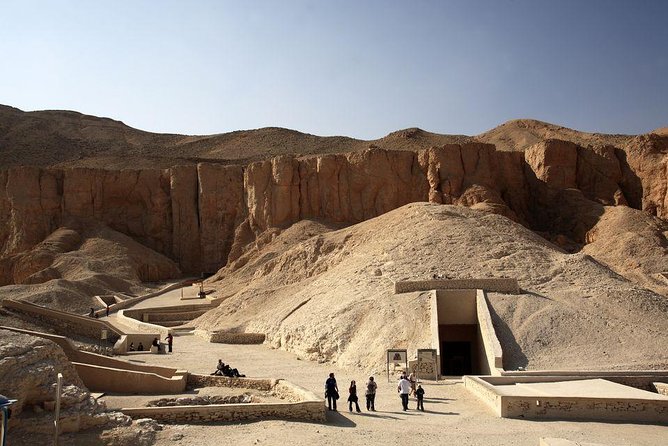
The Valley of the Kings is one of those places where the setting matters as much as the structures. It’s on the west bank of the Nile, directly opposite Thebes (modern Luxor), inside the wider Theban Necropolis. That geography is part of the story. You’re not just walking through stone halls—you’re in a landscape tied to the way power and belief were expressed in the New Kingdom era.
The tour’s background matters too: for nearly 500 years, from the 16th to the 11th century BC, rock-cut tombs were excavated for Pharaohs and powerful nobles of the New Kingdom (the 18th through 20th Dynasties). Even if you’ve never memorized dynasties, this gives you a key frame: this wasn’t a one-off project. It was a long-running tradition of building, carving, and honoring leaders through burial.
One practical way to enjoy it more is to think like a time traveler. When you enter the Valley, try to picture the work and planning it would have taken to carve tombs into rock. The time span alone makes the site feel more human—people worked there across generations, using the terrain and burial customs they inherited and adapted.
You’ll get about 2 hours here. That’s enough time to get your bearings and absorb what you’re seeing, as long as you don’t spend half the visit just waiting at points where everyone slows down for photos. Wear comfy shoes and keep water handy—Luxor’s sun has a habit of making short days feel shorter.
You can also read our reviews of more tours and experiences in Luxor.


2 hours at the tomb valley: how to make time work
In a place like the Valley of the Kings, the biggest challenge is not access—it’s attention. With only around 2 hours, you need to focus on the things your brain can remember later, not just what your camera can record.
Here’s how I’d approach the timing. First, let the guide set the context: what the New Kingdom meant, why these tombs were cut into rock, and how the valley system is organized. The wadi is made of two valleys: East Valley and West Valley. Even knowing that split helps. It keeps you from feeling lost when you’re surrounded by stone paths and entrances that all look similar at a distance.
Then, prioritize inside-the-tomb moments. Rock-cut spaces tend to be cooler and quieter than the bright outdoor walkways, and that contrast is part of the experience. Give yourself permission to slow down once you’re inside, even if the outside pace feels fast.
Possible drawback? If you prefer a long, unhurried explore—where you sit longer, read every sign, and go back to compare details—2 hours can feel like a sprint. The upside is that the tour is structured, so you’re not left guessing what matters most. Think of it as a strong first visit: you’ll leave with clear impressions, and you’ll know what you’d want to see more of next time.
Also, note the tour’s start time: 10:00 am. That’s helpful because you’re not starting in the deepest late-day heat, but it still means the middle of the day can catch you during travel and walking. Keep an eye on sun exposure and plan to take brief shade breaks when you can.
Karnak Temple: why the scale hits you fast
After the Valley of the Kings, you move to Karnak Temple, and the shift is dramatic. The Valley is tight and rock-heavy; Karnak is about scale. The tour description is clear on why: Karnak Temple is the largest religious building ever constructed. That’s a bold claim, and you’ll feel it as soon as you’re in the complex.
You’ll have about 2 hours here, plus admission included. That time window is a sweet spot if you want a real look without burning the whole day. Karnak can be overwhelming at first because there’s so much to notice—so the guide’s job becomes essential. A good guide helps you avoid the common trap: staring at everything and remembering almost nothing.
What to focus on? Start by letting the size and layout register. Then use the visit to connect the dots between burial beliefs and religious architecture. You’re going from the west bank’s tomb landscape to the east bank’s temple world, and that pairing gives you a fuller sense of how the New Kingdom expressed authority—both in death and in worship.
One practical tip: Karnak’s open areas can be more exposed. If you’re someone who gets tired from heat quickly, plan for short breaks. It’s better to pause for 3 minutes, cool down, then keep going, than to push through until you’re done for the day and miss the best parts.
Pickup and small-group size: logistics that actually matter in Luxor
Luxor can move you around quickly, but it can also wear you down with waiting and wandering if you’re doing everything independently. That’s where the tour structure helps.
This experience offers pickup, and it uses a mobile ticket. In plain terms: fewer steps between you and the first entrance. With a small group capped at 10 travelers, you’re also less likely to get swallowed by a crowd at key points. Even when a site is busy, smaller groups can keep the flow smoother—especially when time is limited and the tour is built around two main stops.
The duration is listed as about 3 to 4 hours. That’s not long, but it’s long enough to feel you’ve had a real experience at each place. If you’re in Luxor for a short stay, or you want to cover the top hits without locking your entire morning, this compact format makes sense.
Group size also changes the feel of questions. When there are fewer people, you can usually get answers that are more relevant to what you care about. And given that this tour includes history and culture context (with guide Ayman noted for adding astrology into the explanation style), you get a more personalized layer to the visit rather than just a list of dates.
Price and value: what $190 covers in practice
At $190 per person, this is not the cheapest way to tour Luxor. But the price makes more sense once you look at what’s bundled.
You’re paying for:
- A guided format that helps you understand what you’re seeing.
- Pickup offered, which saves time and reduces stress.
- Admission tickets included for both the Valley of the Kings stop and Karnak.
That last part matters. When admission is included, you don’t have to spend your valuable limited tour time negotiating entry rules or searching for the right ticket. And because the total day span is short, efficient logistics become part of the value, not an afterthought.
Also consider the small-group cap. Max 10 travelers can mean less time stuck behind other groups at entrances and fewer “herding” moments. Even if you love museums on your own, in places like these the guide can help you focus on what’s most meaningful.
Is $190 right for everyone? Not if you’re traveling on a strict budget or if you enjoy learning mostly through self-guided signs. But if you want a clean, guided highlights route without extra planning headaches, this price is easier to justify.



Who should book this Valley of Kings + Karnak tour?
This is a great match for you if:
- You want a high-impact Luxor morning with two top-class sites.
- You’re traveling with limited time and want everything handled in one go.
- You like history explanations tied to what you’re standing in front of (and not just basic facts).
It’s also sensible if you’re doing other activities around Luxor and need a plan that fits a 3 to 4 hour window. One practical consideration from the experience details: the schedule can feel tight after another early morning plan, so leave buffer if you can.
If you’re the type who plans to spend hours reading every plaque and comparing details slowly, you may find the time constraints limiting. But that’s not a flaw—it’s a trade. This tour is built for the first pass. For a second trip to Egypt, you’d know exactly what you want to revisit.
And since it notes that most travelers can participate, it’s a reasonable pick for many visitors, assuming you’re comfortable with walking through major temple and archaeological areas.
Should you book it? My practical recommendation
Yes, you should book it if you want the best of Luxor without turning your day into logistics. The pairing of Valley of the Kings (tomb landscape tied to the New Kingdom) with Karnak Temple (the largest religious building ever constructed) is a strong one-two. Add in admission included, pickup, and a small group size, and the trip becomes a smart use of time.
Skip it only if you know you dislike guided tours, you need longer than 2 hours at either site, or you’re building your schedule around an early morning that could make the timing stressful. In that case, you’d be happier with a more flexible plan.
FAQ
Where does this tour take place?
It takes place in Luxor, Egypt, with visits focused on the west bank area of the Nile where the Valley of the Kings is located, plus a visit to Karnak Temple.
How long is the tour?
The tour runs about 3 to 4 hours.
What time does it start?
The start time is 10:00 am.
Are admission tickets included?
Yes. Admission tickets are included for both the Valley of the Kings and Karnak Temple.
Does the tour include pickup and a mobile ticket?
Pickup is offered, and you receive a mobile ticket.
What is the cancellation policy?
You can cancel for a full refund up to 24 hours in advance of the experience start time. If you cancel less than 24 hours before, the amount paid is not refunded.