REVIEW · LUXOR
Day Tour Luxor West Bank
Book on Viator →Operated by D.Done travel Egypt · Bookable on Viator
Six hours on Luxor’s West Bank starts early. This tour is a smart way to hit major monuments on one side of the Nile, with hotel pickup and an air-conditioned vehicle that keeps the day manageable in the heat. I also like that the itinerary lists admission as free at each stop, which helps you control your total costs.
You’ll visit Valley of the Kings, Deir el Bahari and Hatshepsut’s temple, the Colossi of Memnon, and then Medinet Habu. The one possible drawback is timing: pickup runs from 6:00 AM to 7:00 AM, so if you’re not a morning person or you hate a set schedule, plan for an early start.
In This Review
- Key things to know before you go
- Entering Luxor West Bank at Dawn: the 6:00–7:00 AM Advantage
- Valley of the Kings: the tomb world of Tutmosis I and III
- Deir el Bahari and Hatshepsut’s terraces: Senenmut’s royal architecture
- Colossi of Memnon: Amenhotep III facing the river
- Medinet Habu: a south-Thebes stop with lots to wander
- Price and logistics: what $9 really buys you
- Practical tips for your West Bank day (so you don’t feel rushed)
- Who this tour fits best
- Should you book this Luxor West Bank day tour?
- FAQ
- What time does the tour start?
- How long does the Luxor West Bank day tour take?
- Is this tour private?
- What’s included in the price?
- Are entrance/admission tickets included?
- Can you arrange a guide in my language?
- Do I get a mobile ticket?
- What if the weather is bad?
- What is the cancellation policy?
Key things to know before you go
- Early pickup window: starts between 6:00 AM and 7:00 AM.
- Private format: only your group participates.
- Four major West Bank stops: arranged as a smooth, one-day circuit.
- Language-flexible guide: the team can provide a guide in the language you want (for an extra price).
- Mobile ticket: you get a mobile ticket for the tour.
- Good value at the listed price: $9 per person, with optional add-ons clearly separated.
Entering Luxor West Bank at Dawn: the 6:00–7:00 AM Advantage
This tour is built around an early start, with pickup offered in the 6:00 AM to 7:00 AM window. That matters in Luxor. Morning light is better for photos, and you’re less likely to feel like you’re sightseeing in a sun-baked sprint.
It also helps you get into the main sites before the day fully heats up. Since the tour duration is listed as 3 to 8 hours, your exact pace will depend on how much time you spend inside each location and whether you choose to add a guide.
Because it’s private, you’re not stuck with someone else’s pace. That’s a real plus on the West Bank, where walking distances and museum-style lines can add up quickly.
You can also read our reviews of more tours and experiences in Luxor.


Valley of the Kings: the tomb world of Tutmosis I and III
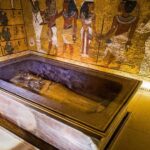
The day begins at the Valley of the Kings, with hotel pickup and a visit focused on the grand burial architecture used for royal tombs. The itinerary highlights kings such as Tutmosis I and Tutmosis III, which is a nice anchor if you want to understand what you’re looking at instead of just wandering from door to door.
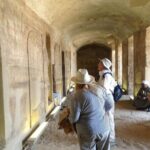
This is the kind of place where context pays off. Even if you only get a short time inside a few tombs, you’ll start to recognize the themes: the idea of eternal passage, the symbolic wall scenes, and the way the Valley was engineered for burial over generations. It’s also where you’ll feel the scale of royal ambition—these weren’t casual monuments.
One practical note: the itinerary lists admission as free here, so have your booking confirmation handy and be ready to show whatever proof you were provided. At the entrances, procedures can vary by site.
Expect this stop to take about 2 hours. That’s enough time to see the main highlights without turning the whole morning into a marathon.
Deir el Bahari and Hatshepsut’s terraces: Senenmut’s royal architecture
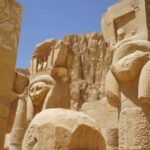
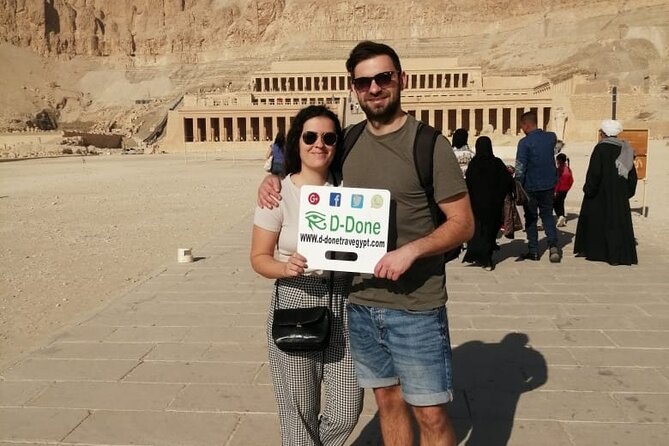
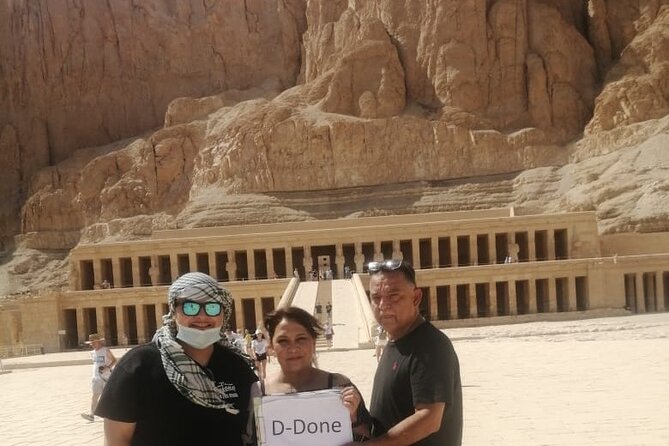
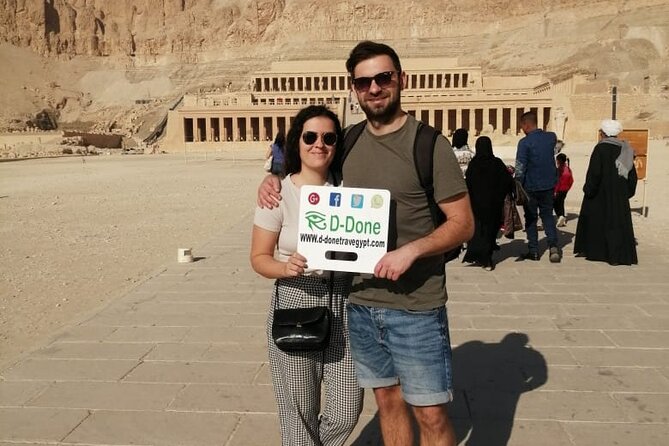
Next up is the Temple of Hatshepsut at Deir el Bahari, one of the most visually striking sections of the West Bank. The tour frames it with the key historical figures tied to the building: Senenmut, Hatshepsut’s chancellor and the royal architect overseeing the construction.
What you’re really going to notice here is the temple’s structure. The itinerary notes the temple uses a long, colonnaded terrace and differs from an earlier model connected to Mentuhotep II. Even without a deep lecture, you can see the change in design as the layout steps upward.
A standout detail: there are three layered terraces, reaching about 29.5 meters (97 feet). Standing in front of those terraces, you get a clear sense of why this site is so associated with power and permanence. It wasn’t just a burial place. It was a statement.
This stop is listed as about 1 hour 30 minutes. If you want good photos and some slower walking to catch the geometry, it’s a good idea to save a bit of your energy here, not at the very end of the day.
As for admission: it’s again listed as free in the itinerary. If you’re traveling without an added guide, you may still want to ask staff basic questions at the entrance, because the architecture can feel more meaningful when you connect it to what each section was meant to do.
Colossi of Memnon: Amenhotep III facing the river
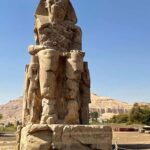
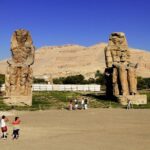
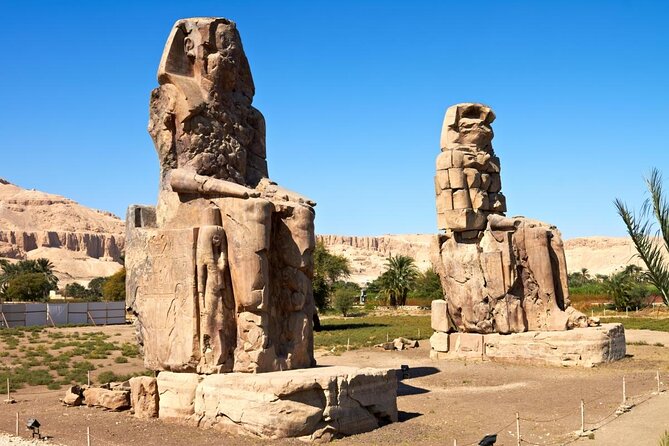
After the terraces, you’ll head to the Colossi of Memnon—two large seated statues that depict Amenhotep III. The itinerary notes details that help you “read” the statues: his hands resting on his knees and his gaze directed eastward (the modern bearings being ESE), facing the river.
This stop works well as a reset. It’s shorter—about 30 minutes—and it gives you a big, open view without the same level of walking or enclosed movement as the tombs and terraces.
The itinerary also includes smaller but meaningful figures carved into the throne: Tiye (wife) and Mutemwiya (mother). Even if you don’t know every term, you can see that the sculptors weren’t just making one statue. They were building a royal family portrait into the stone.
It even mentions that side panels depict the Nile. That detail matters because it reinforces what the West Bank sites are doing overall: tying royal identity to geography, water, and the long timeline of Egypt’s worldview.
Medinet Habu: a south-Thebes stop with lots to wander
The final scheduled stop is Temple of Medinat Habu (Medinet Habu). This is an archaeological area on the West Bank, located south of the Thebes necropolis. In other words, you’re not just finishing with a quick photo stop—you’re ending in a site that can feel less rushed.
The itinerary gives the big picture: it contains many important monuments, and it’s part of the broader West Bank sacred zone. If you’ve seen the “most famous” parts already (and you will have, by then), Medinet Habu can feel like a quieter chapter that rewards a slower pace.
This stop is listed as about 2 hours. That’s a lot of time for a last stop, and that’s good news if you like to linger. It means you can take in the shapes, the ruins, and the way the temple area sits within the West Bank setting.
Admission is again listed as free in the itinerary, so keep your proof ready. And if you choose to add a guide, this is a great place to use that extra explanation time, since the architectural story here may be harder to decode on your own.

Price and logistics: what $9 really buys you
At a listed price of $9.00 per person, this tour stands out as an affordable way to string together four major sites with pickup and a private vehicle. The included items are straightforward: private transportation and an air-conditioned vehicle.
There is one major optional cost to understand up front: a guide can be ordered at an extra price. That matters because the written descriptions for sites like Hatshepsut and the Valley of the Kings are rich with names and architectural terms. If you want the full meaning, a guide helps you connect those details to what you see.
Also note the itinerary lists “Admission Ticket Free” at each stop. That’s excellent if it holds at the gate with your booking. Still, it’s smart to double-check what “free” means in practice for your specific date, and make sure you have the right ticket or document on your phone.
The tour also uses a mobile ticket, and confirmation is received at booking. It’s booked on average 12 days in advance, which suggests you should reserve early if you’re traveling during a busier season.
Finally, the tour ends back at the meeting point. That saves you stress at the end of the day, especially since the West Bank can be busy with transport options once the morning crowds shift.
Practical tips for your West Bank day (so you don’t feel rushed)
The big things to plan around here are heat, walking, and early hours.
First, wear shoes that handle uneven ground. West Bank sites can be rocky and irregular. Second, bring sun protection. Even with an air-conditioned vehicle waiting between stops, you’ll still spend time outdoors at temples and open areas.
Third, decide your guide strategy early. If you’re paying extra for a guide, you’ll get the most value by choosing a guide for the stops where you’ll benefit from interpretation—usually Hatshepsut’s temple and the tomb valley.
Also, because pickups run in a narrow 6:00 AM to 7:00 AM window, make sure you’re awake and ready before the first possible pickup time. If you’re sharing a room or coordinating with friends, build in a cushion.
If your tour includes a local driver or guide, it’s wise to confirm any extra services before you set off. One key lesson from past service experiences in the area is simple: don’t rely on vague promises. Agree clearly on what’s included, especially if anyone suggests add-ons.
Who this tour fits best
This tour is a strong match if you want:
- A focused West Bank day with major sites grouped logically
- Private transport with hotel pickup and dropoff
- A budget-friendly way to cover a lot of ground without spending the whole day on transfers
It’s also a good choice if you’re traveling with family or a small group that appreciates set timing. Since it’s private, you can move at a pace that works for your group.
If you prefer slow travel with no early start, this may feel like a structured day. The itinerary is time-based, and the pickup window is early by design.
Should you book this Luxor West Bank day tour?
I’d book it if you want a value-forward route that hits the big West Bank names in one morning-to-afternoon flow, with air-conditioned transport and a private setup. The combination of stops—Valley of the Kings, Deir el Bahari, Colossi of Memnon, and Medinet Habu—covers a lot of what makes the West Bank special without forcing you into long inter-city moves.
Choose it especially if you’re budget-conscious and still want a smooth plan. But do take seriously the early pickup window and the optional guide cost. If you want the meaning behind the art and architecture, plan for extra interpretation time rather than assuming you’ll automatically get it on your own.
If that sounds like your style, this is a practical way to spend your Luxor West Bank day.
FAQ
What time does the tour start?
Pickup is scheduled in the 6:00 AM to 7:00 AM window, Monday through Sunday.
How long does the Luxor West Bank day tour take?
The duration is listed as approximately 3 to 8 hours.
Is this tour private?
Yes. It is a private tour/activity, and only your group participates.
What’s included in the price?
The included items are private transportation and an air-conditioned vehicle, with pickup offered.
Are entrance/admission tickets included?
The itinerary lists admission tickets as free for Valley of the Kings, Temple of Hatshepsut, Colossi of Memnon, and Temple of Medinat Habu.
Can you arrange a guide in my language?
The experienced tourism team can provide a guide in any language you want. Ordering a guide is available for an extra price.
Do I get a mobile ticket?
Yes. The tour includes a mobile ticket.
What if the weather is bad?
This experience requires good weather. If it’s canceled due to poor weather, you’ll be offered a different date or a full refund.
What is the cancellation policy?
You can cancel for a full refund up to 24 hours before the experience’s start time. If you cancel less than 24 hours before, the amount paid won’t be refunded.