REVIEW · GIZA
Day Tour to Alexandria from Cairo
Book on Viator →Operated by Egypt Tailor Made Day Tours · Bookable on Viator
One long day, and Alexandria hits hard. This is a private, door-to-door way to see the big-name sites without sleeping over, with round-trip transfers from Giza and an expert Egyptologist guiding you through Roman Alexandria, the modern library, and more. You get a full schedule packed into about 12 hours, capped with time at the Bibliotheca Alexandrina and photo stops along the way.
I especially like the mix of major monuments and “slow down and look” moments—sea-view lunch included in the day makes it feel less like a checklist. The itinerary also works well if you want both the famous sights and a few architectural details, like how the modern library’s layout echoes the scale of the original. The main drawback to plan for is the long transit day: you’re looking at roughly 3.5 hours driving each way, so you’ll want to pace yourself and accept that it’s not a slow, wandering style of sightseeing.
In This Review
- Key things I’d watch for before you book
- From Giza to Alexandria: the “12-hour” reality
- Kom el Shoqafa catacombs: the Roman burial world you can feel
- Roman Alexandria at Kom el-Dikka: terraces, theatre, and a rare Egypt find
- Pompey’s Pillar: the tall red marker that frames the city
- Qaitbay’s Citadel: a fortress connection to the Lighthouse of Alexandria
- Bibliotheca Alexandrina: modern architecture built to echo an older library
- Lunch with Mediterranean views: the day’s reset button
- Price and value: is $70 a fair deal?
- Who this tour suits best (and who might want something else)
- Small-group feel: the guide makes the difference
- Should you book this Alexandria day tour from Cairo?
- FAQ
- How long is the Alexandria day tour from Cairo?
- What does pickup include, and where can I be picked up?
- Is the tour private or shared?
- What’s included in the ticket price?
- Does the tour include lunch?
- Which sites do I visit, and are entrances included?
- What’s the cancellation policy?
Key things I’d watch for before you book
- Door-to-door transfers from Giza (and select Cairo areas) help you avoid the “how do I get there” headache
- Catacombs of Kom el Shoqafa are the day’s standout stop, with Greco-Roman burial architecture you can really see
- Main entrance fees are included, so you’re paying once and moving through sites without constant ticket hassles
- Qaitbay’s Citadel is a photo stop, and admission there isn’t included, so don’t count on a full fortress visit
- Guide quality affects the vibe; when communication is strong, the day clicks, and when it’s not, the information delivery can feel flat
From Giza to Alexandria: the “12-hour” reality
This is built as a full-day circuit, starting early and running long. If you’re in Giza (including Downtown, Dokki, or nearby pickup zones), you’ll get picked up and driven in an air-conditioned private vehicle. The day is scheduled to include round-trip transfers from Alexandria back to Cairo, so you’re not left figuring out transport after you’ve finished sightseeing.
Timing matters here. The itinerary mentions an around 7:00 am departure and about 3.30 hours to reach Alexandria, which means you’re committing to a real day out. That also shapes the pacing: you’ll spend solid time at the main sites, but you won’t have the kind of free-roaming you’d get if you were staying overnight in Alexandria.
One practical note: this is private. That’s helpful because your group stays together and the guide can answer your questions without dealing with a bus full of interruptions. You’ll also get a mobile ticket, which usually means less paper fuss at entrances.
You can also read our reviews of more tours and experiences in Giza.



Kom el Shoqafa catacombs: the Roman burial world you can feel
If you’re choosing just one “must-see” stop from this day tour, make it the Catacombs of Kom el Shoqafa. The catacombs are described as the largest known Roman burial site in Egypt, with a design that moves across three tiers of tombs. The scale is the big headline here: the site’s layout could accommodate up to 300 corpses, which is exactly why it’s considered one of the standout historical places outside the usual pyramid-and-temple circuit.
What makes this stop click is the style mix. The architecture mirrors Greco-Roman influences, and that matters because it explains why the catacombs don’t feel like one single “Roman only” look. You start to see how Alexandria sat at a cultural crossroads, not just geographically but artistically, too.
The tour’s structure also helps. You get escorted in an air-conditioned vehicle from Cairo to Alexandria, then you meet your guide in Alexandria for this opening segment. Starting with the catacombs is smart because you’re fresh, and it gives your day an atmosphere that’s different from bright façades and waterfront photo stops.
Wear good shoes. The catacombs are built for walking through tomb levels, and you’ll want traction and comfort because it’s not a “quick glance” kind of place. Also, if you prefer more explanation rather than quick stops, ask your guide to pace the story—this is where your questions can turn the visit into something memorable.
Roman Alexandria at Kom el-Dikka: terraces, theatre, and a rare Egypt find
After the catacombs, the itinerary moves into Roman Alexandria mode with the Roman amphitheatre at Kom el-Dikka. This is not a generic roadside ruin. The description calls it the only known Roman amphitheatre in Egypt, which immediately makes it worth paying attention to.
What you’ll notice is the layout: the amphitheatre is described as a well-preserved structure with thirteen terraces, built in a traditional Greek style. Even if you’re not a “Roman architecture expert,” the terraces give you an easy way to understand how the space was built to hold and move spectators.
This stop is also valuable because it shows you Alexandria beyond the library branding. It’s a reminder that the city was a Roman-era hub with entertainment, residential spaces, and built environments that were designed for daily life, not just ceremonial moments.
Don’t rush this one. The amphitheatre is compact compared to some mega-ruins, but you’ll get more out of it if you take a moment to trace the terrace lines and visualize how it would have looked in use. Good lighting for photos can be tricky depending on the time of day, so use your guide’s timing cues and don’t rely on perfect conditions.
Pompey’s Pillar: the tall red marker that frames the city
Next up is Pompey’s Pillar, described as a towering red granite column standing about 25 meters tall. It’s said to likely have been built to honor Emperor Diocletian, and it’s also noted as the tallest ancient monument in Alexandria.
I like this stop for a very specific reason: it’s easy to orient yourself. When you can point to one towering vertical landmark, Alexandria’s geography starts to make sense faster, even if you’re only in town for the day.
You’ll have around an hour allotted here, and that time is useful. Don’t treat it like a photo-only stop. Use it to ask your guide what this area meant in the Roman and early Byzantine urban layout, and how monuments functioned like wayfinding anchors in ancient cities.
If your group likes details, ask what the pillar’s current location and material tell you about the city’s layering. Alexandria has had a lot of history—and it tends to show up in what’s still standing, what’s been repurposed, and what’s only visible if you know where to look.
Qaitbay’s Citadel: a fortress connection to the Lighthouse of Alexandria
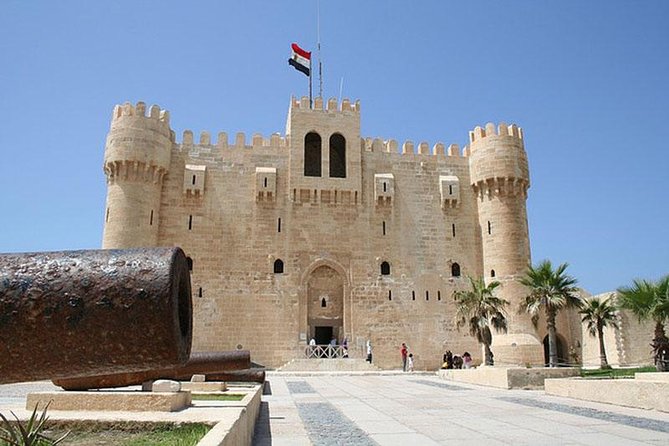
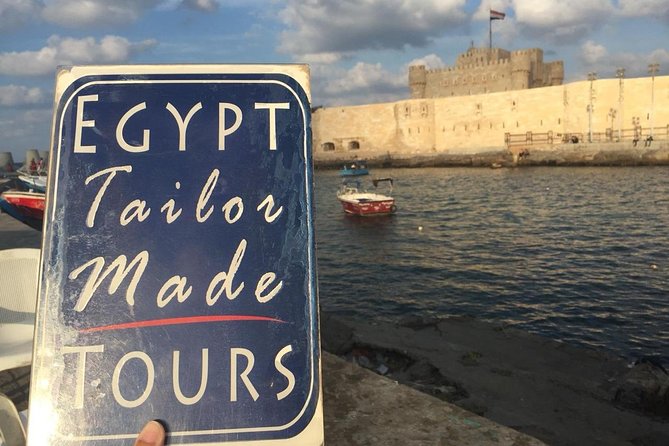
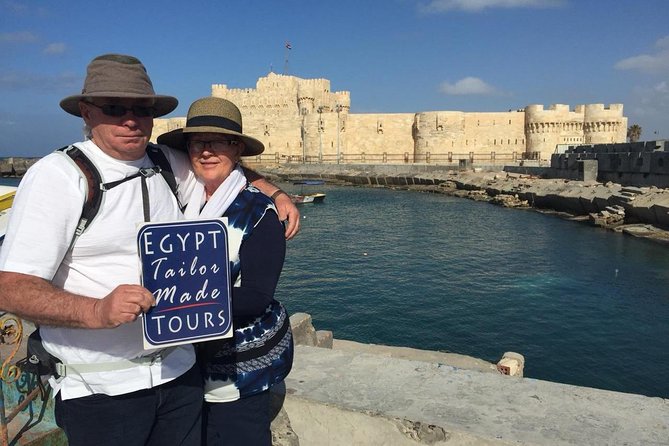
You’ll get a photo stop at Qaitbay’s Citadel. The itinerary describes it as one of the most important defensive strongholds along Egypt’s Mediterranean coast, tied to the fortification system of Alexandria in the 15th century A.D..
Here’s the part that makes the stop more than just a view: the citadel was erected on the exact site of the famous Lighthouse of Alexandria, one of the Seven Wonders of the Ancient World. Even if you’ve seen pictures of the lighthouse in books, this connection helps you understand why the site kept its strategic importance. It wasn’t only about symbolism; it was about control of the harbour approach.
Plan for this as a quick stop. Admission there is not included, and the schedule lists it as about 30 minutes primarily for photos. If you want a deeper exploration of the fortress interiors, this tour might feel time-tight compared to doing it as a separate visit with longer planning.
Still, even a short stop works if you treat it as a historical “bridge.” You go from Roman remains and burial architecture into a later period of maritime defense—and Alexandria’s story becomes more continuous instead of segmented.




Bibliotheca Alexandrina: modern architecture built to echo an older library
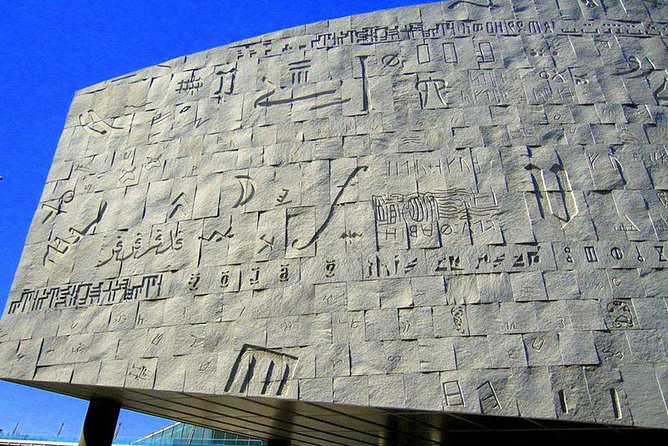
The final stop is the Modern Alexandria Library, the Bibliotheca Alexandrina. It’s described as a key site where you visit the open court and also access free museums, with about one hour allotted for the stop. The reason this matters is simple: the library is not just a building. It’s a physical statement about what Alexandria meant in the ancient world and what Egypt wants to remember now.
The tour notes that the old library was famous for its huge capacity of books across different sciences and literature. It also highlights that it was damaged several times during the Greco-Roman period until it vanished, and that reconstruction efforts began in the late 1980s.
What you may enjoy here is the architectural logic. The description explains that the modern library’s design includes four underground stores and six upper stores, with the overall shape considered a special architectural concept. That kind of detail turns your visit from “we took pictures at a library” into “we saw how a modern building tries to communicate an ancient scale and ambition.”
Use your hour well. If you’re the kind of person who likes to understand what you’re looking at, ask your guide to connect the library’s design to Alexandria’s broader history. Even if your knowledge is basic, the story becomes clear quickly because the site is built to teach.
And yes, this is a good end point. It’s calmer than the catacombs and less physically intense than the Roman terraces, which helps you decompress before the drive back.
Lunch with Mediterranean views: the day’s reset button
This tour includes lunch at a restaurant with sea views. Even with a packed schedule, that’s a big value add, because it turns the day into a “spent together, not just rushed through” experience.
I like that it’s not just food—it’s setting. Alexandria’s Mediterranean atmosphere tends to make a lunch stop feel like a real break, especially after morning visits in enclosed spaces like the catacombs. It also helps keep the group comfortable on a long day when the driving and walking add up.
In the best-run version of this tour, your lunch experience comes with good timing and a viewpoint that keeps you smiling. If your group is sensitive to schedule tightness, you’ll want your guide to confirm when you’re eating so you’re not starving while waiting for the next pickup window.
Price and value: is $70 a fair deal?
At $70 per person for an Alexandria day tour from Cairo, the real question is what you’re getting for the money. This price comes with a lot of practical coverage: an Egyptologist tour guide, an air-conditioned private vehicle, round-trip transfers, bottled mineral water, main entrance fees, and fuel/taxes. You’re also covered with tourism police permission included.
For a day that runs about 12 hours, includes multiple major sites, and avoids the need for you to arrange transport on your own, the value can be strong—especially if you’re travelling with just a small group and you want it to feel organized.
Do the math on what you’d otherwise pay. A guide for a full day plus private transfers plus multiple admissions usually adds up fast. Here, those costs are bundled, which reduces “surprise expenses” anxiety. The only variable is tipping, since that’s not included.
One more value point: the rating is very high, with about 4.8 and 96% recommended. That lines up with the experiences described where the driver and guide are prompt and professional, and where entrance fees and lunch timing all run as expected.
Who this tour suits best (and who might want something else)
This tour fits you if you want a clear, guided “greatest hits” day in Alexandria without dealing with logistics. It’s especially good if you care about Roman Alexandria, want to stand inside a Roman burial site, and also want the story of the modern library tied to the ancient one.
It’s also a good fit if you like structure. The itinerary gives you a logical sequence from morning catacombs to Roman sites to harbour-area photo stops to the library at the end. That structure can help if you’re only in Egypt for a short time.
If you’re the type who hates long drives, this might feel like a grind. Alexandria is far enough from Cairo that the day will feel like “out and back” even with air-conditioned comfort. In that case, you might consider an overnight stay instead, so you can slow down and enjoy the city after the day tour ends.
Small-group feel: the guide makes the difference
A private tour is only as good as the communication and pacing. The positive experiences tied to the day talk about guides who keep things moving and explain clearly, and the driver being prompt and professional.
There’s also a caution built into the information: one account mentions a guide who seemed disinterested and didn’t communicate well, even while the driver was great. That tells you something important: if you want a strong narrative, treat your guide like part of the plan. Ask questions. If your group wants more time at a stop, it helps to say so calmly when you’re on-site.
The good news is that the tour format leaves space for adjustments. In the best cases, the team can handle small timing changes, like adding an extra stop at the end if it fits the day’s schedule.
Should you book this Alexandria day tour from Cairo?
Book it if you want a one-day Alexandria plan that covers Kom el Shoqafa, the Roman amphitheatre at Kom el-Dikka, Pompey’s Pillar, a harbour-area look at Qaitbay’s Citadel, and a satisfying finish at Bibliotheca Alexandrina—with door-to-door transfers and main entrance fees included.
Skip it or look harder if you’re sensitive to long travel days, because the driving time is a major part of your total day. Also, if you’re hoping for a deep, slow visit to Qaitbay’s Citadel interiors, remember that here it’s presented as a photo stop without admission.
Overall, this is a strong value if you want Alexandria without the hassle of planning it from scratch. The site mix is smart. The pacing is full, but it’s the kind of full that gets you real highlights, not just roadside stops.
FAQ
How long is the Alexandria day tour from Cairo?
The tour runs for about 12 hours.
What does pickup include, and where can I be picked up?
Pickup and drop-off are included from hotels in Giza (Downtown, Zamalek, and Dokki are listed). You also get round-trip transfers between Cairo and Alexandria.
Is the tour private or shared?
It’s private. Only your group participates.
What’s included in the ticket price?
An Egyptologist guide, air-conditioned private vehicle, main entrance fees, bottled mineral water, round transfer, tourism police permission, fuel surcharge, and tax are included.
Does the tour include lunch?
Yes. The tour includes lunch at a restaurant with a sea view.
Which sites do I visit, and are entrances included?
You visit the Alexandria Library, Pompey’s Pillar, the Roman Amphitheatre, Catacombs of Kom el Shoqafa, and you have a photo stop at Qaitbay’s Citadel. Admission tickets are included for the library, Pompey’s Pillar, the Roman amphitheatre, and the catacombs. Qaitbay’s Citadel is listed as a photo stop without admission included.
What’s the cancellation policy?
You can cancel for a full refund if you cancel at least 24 hours before the experience starts. If you cancel less than 24 hours before, the amount paid isn’t refunded.