REVIEW · GIZA
Attractions Tours At Giza Pyramids And Sphinx
Book on Viator →Operated by Upper Egypt Services · Bookable on Viator
The pyramids feel close at Giza. This tour is a smooth, guide-led way to see the Giza Pyramids complex and the Great Sphinx area without wrestling transport on your own. I especially like the fact you get a qualified Egyptologist guide and a comfortable, air-conditioned ride with snacks included.
The itinerary also keeps the focus on the big visual payoff: you’ll see Cheops (Khufu), Khafre, and Menkaure mainly from the outside, plus the Sphinx and nearby Valley Temple area. One thing to consider is that the package is built around outside viewing, so optional pyramid interior entrance fees can add to the cost if you want to go inside.
In This Review
- Key points to know before you go
- Price and logistics: what you really get for $30
- Hotel pickup and a chauffeured ride that actually matters
- Stop 1: Pyramids of Giza complex, the outside-view “wow” zone
- Stop 2: The Great Pyramid of Cheops (Khufu) and what to notice
- Stop 3: Khafre’s Pyramid—Sphinx connections in the layout
- Stop 4: Menkaure’s Pyramid—short stop, good contrast
- Stop 5: The Great Sphinx and the Valley Temple area
- Camel ride: an included option, so plan your comfort
- Inside pyramids vs outside viewing: choose based on your budget
- Timing and pacing: why four hours feels just right
- Who should book this tour (and who might want a different plan)
- A note on reliability: one no-show report, and how to protect yourself
- Should you book this Giza pyramids and sphinx tour?
- FAQ
- How long is the Giza pyramids and sphinx tour?
- Does the tour include hotel pickup and drop-off?
- Are pyramid entrance fees included?
- Is a camel ride included?
- Is this a private tour?
- What is the cancellation policy?
Key points to know before you go

- Hotel pickup and drop-off help you start and finish with less Cairo hassle
- Qualified Egyptologist guide keeps the monuments meaningful, not just photogenic
- Camel ride included as an option during the day
- Outside viewing is the core plan, with optional entry fees for interiors
- Private group means you’re not shuffled with strangers
- Mobile ticket makes day-of logistics simpler
Price and logistics: what you really get for $30
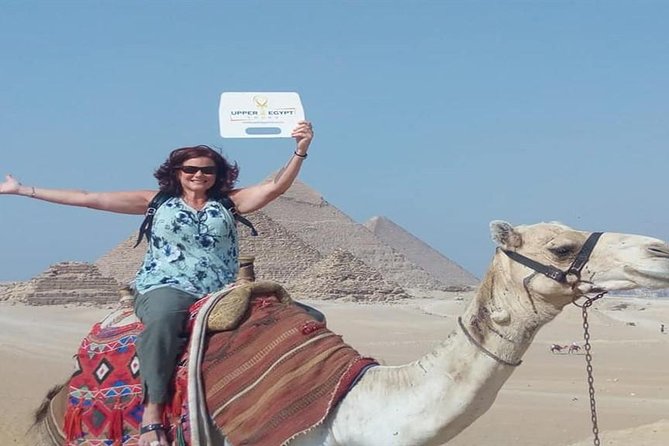
This tour costs $30 per person for about four hours in the Giza area. For that price, you’re not just buying access to monuments—you’re paying for hotel pickup, a guided experience, and an air-conditioned vehicle that gets you from point to point efficiently.
What makes the value better is that you get snacks plus a camel ride opportunity. If you’ve ever tried to assemble these pieces yourself in Cairo, you know the “hidden” time and stress add up fast.
The one cost variable you should plan for is pyramid interiors. If you decide you want to go inside any of the pyramids, entrance fees are not included and are paid separately.
You can also read our reviews of more tours and experiences in Giza.


Hotel pickup and a chauffeured ride that actually matters
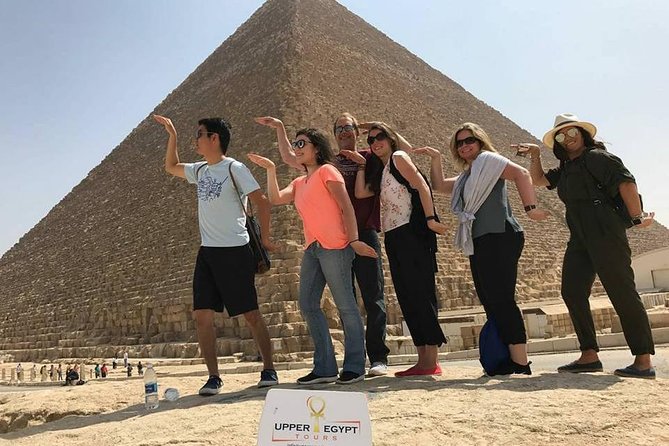
The biggest practical win here is hotel pickup and drop-off. Giza is far enough from central Cairo that the day can feel rushed if you’re dealing with buses, taxis, and finding the right meeting point.
The tour includes an air-conditioned vehicle, which is more than a comfort perk in Egypt’s heat. You’ll also get a mobile ticket, so you’re not scrambling for paperwork at the gate.
And because this is described as a private tour for your group, you’re less likely to feel like the day is controlled by someone else’s schedule. In practice, that can make pacing easier—especially when you’re dealing with crowds.
Stop 1: Pyramids of Giza complex, the outside-view “wow” zone
Your first stop is the Pyramids of Giza complex, with about three hours on site for the main viewing. This is where you’ll get the sweeping, iconic view of the Great Pyramid of Cheops (Khufu), Khafre’s Pyramid, and the smallest of the three—Menkaure’s Pyramid.
Your guide keeps it grounded with context as you look. Even if you mainly care about photos, having explanations in real time helps the shapes and layout click into place instead of staying as just background.
One practical note: since the tour is focused on outside viewing, you’ll likely spend most of the time walking, positioning for views, and moving between viewpoints. If your goal is to race through and tick boxes, this structure still works, but you’ll get more out of it if you slow down for angles and observations.
Stop 2: The Great Pyramid of Cheops (Khufu) and what to notice
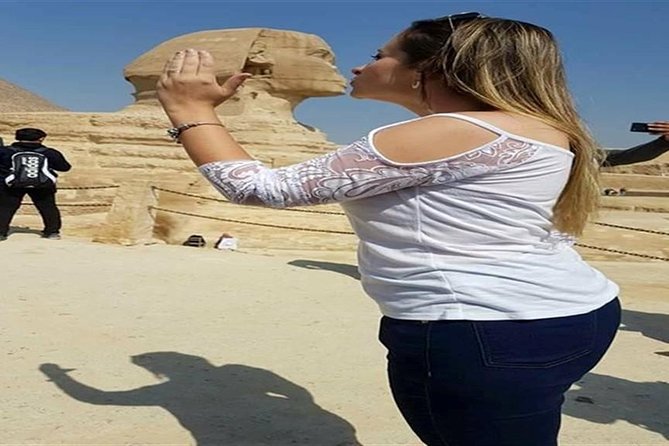
You’ll then spend about one hour at the Great Pyramid of Cheops (Khufu). The guide’s framing here matters because it helps you notice the idea of the whole complex, not just the pyramid shape.
In the information provided for this stop, Khufu’s pyramid complex is described as including a valley temple (currently buried beneath the village of Nazlet el-Samman) and features like diabase paving and nummulitic limestone walls that have been found, even though the site hasn’t been excavated. That matters because it reminds you the pyramid you see is only one part of a bigger designed space.
For your experience, this is the stop where you’ll feel the “scale” the most. Take time to compare vantage points rather than staring straight up from one spot. The pyramid’s proportions and edges will look different depending on where you stand and how close you are to the base area.
Stop 3: Khafre’s Pyramid—Sphinx connections in the layout
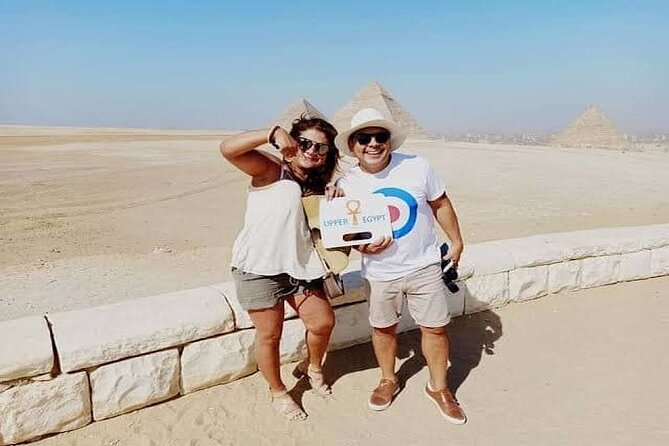
Next up is about 30 minutes at Khafre’s Pyramid. This is one of the spots where the complex layout starts to feel like a story, because Khafre’s pyramid complex is described as including a valley temple, the Sphinx temple, a causeway, a mortuary temple, and the king’s pyramid.
The info also notes that the valley temple yielded statues of Khafre, and that several were found in a well in the floor of the temple by Mariette in 1860. That name is useful if you like anchoring your visit with specific people—Mariette shows up as part of the modern excavation thread tied to the monument area.
Why this stop is worth your attention: Khafre’s complex is the bridge between the pyramid and the Sphinx area. Even if you’re not going deep into archaeology, the layout helps your brain connect why these monuments weren’t built in isolation.


Stop 4: Menkaure’s Pyramid—short stop, good contrast
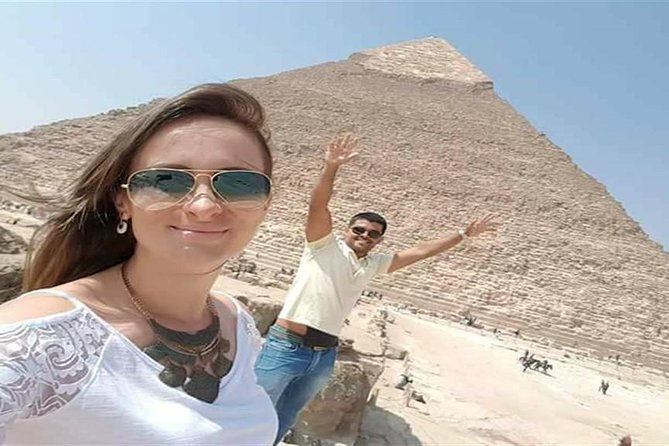
You’ll get about 30 minutes at the Menkaure Pyramid area. The time is shorter than Khufu’s and Khafre’s stops, but it can still be satisfying because it gives you contrast. You’ll see the same “pyramid language,” but with a smaller scale and a different feel to the complex spaces.
The description provided notes Menkaure’s pyramid complex includes a valley temple, causeway, mortuary temple, and the king’s pyramid. It also mentions that during the 5th Dynasty, a smaller ante-temple was added to the valley temple.
If you like to understand how sites evolve, this is the kind of detail your guide can help you picture while you’re standing there. Don’t rush it—use those 30 minutes to compare what you see with what you remember from Khufu and Khafre.
Stop 5: The Great Sphinx and the Valley Temple area
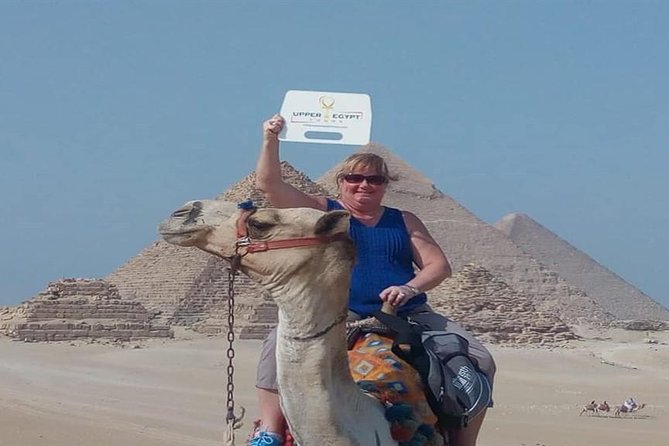
The final major monument time is about 30 minutes at the Great Sphinx. The information you’re given ties the Sphinx’s dating to the reign of king Khafre, and it also points out that during the New Kingdom, Amenhotep II dedicated a new temple to Hauron-Haremakhet, with the structure later added onto by later rulers.
Those names—Khafre and Amenhotep II—give the Sphinx a timeline, not just a face in the sand. If you’ve ever found yourself staring at the Sphinx wondering what you’re supposed to be seeing, the historical layers help you look more deliberately.
The tour also includes a stop to see the Valley Temple area. Even if you don’t go deep into the stones themselves, the pairing makes sense: pyramids and Sphinx aren’t just separate photo backdrops here. They’re presented as connected parts of one Giza story.
Camel ride: an included option, so plan your comfort
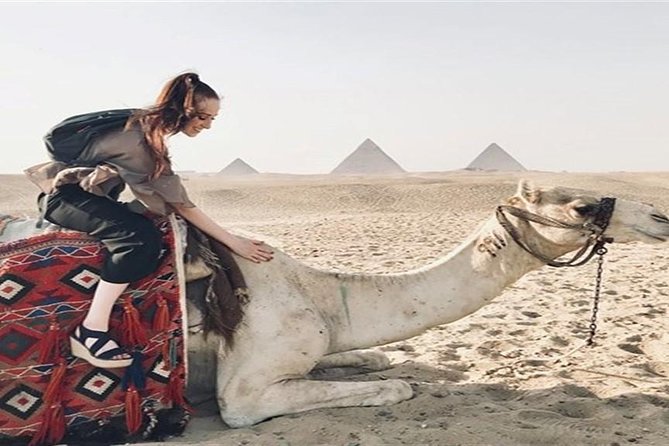
A camel ride is included, and the overview also frames it as an optional choice. This means you’re not locked in no matter what—so if you’re cautious about riding, you can decide based on how you feel when you’re there.
Here’s how I’d think about it: a camel ride can be the kind of memory you remember longer than a few extra photos. But it’s also a moment that can affect how long you’re willing to walk afterward, especially if you’re sensitive to sitting posture or motion.
If you do ride, keep your expectations realistic. This is a short add-on inside a day that’s mainly about monument viewing. After the ride, give yourself time to stretch and reset so you can still enjoy the pyramid and Sphinx viewpoints.
Inside pyramids vs outside viewing: choose based on your budget
The tour is set up mainly for seeing the pyramids from the outside. The information also makes it clear that entrance fees are at your own expense if you want to go inside.
That’s a smart approach for many visitors because outside viewing still delivers the big impact. You get the overall plan of the site—how the pyramids relate, where the Sphinx fits in, and how the complexes spread out.
But it’s also your chance to decide your priorities. If going inside is a must for you, budget extra and consider whether you’ll be able to handle the time and ticketing at the moment you’re there. If your priority is the big “Giza moment” and you don’t care about interiors, you’ll likely be very happy with the outside-focused flow.
Timing and pacing: why four hours feels just right
The total duration is about four hours. That’s not enough time to treat Giza like a multi-day project, but it’s enough for a guided overview that hits the strongest monuments.
The pacing is built like this:
- A longer first chunk at the complex so you can establish the big picture
- Then shorter segments at Khufu, Khafre, Menkaure, and the Sphinx so you don’t feel trapped in one corner
For you, this matters because it’s easier to stay focused in heat, crowds, and moving schedules. If you’re the type who likes to get oriented first and then decide where to spend extra time, this structure helps.
Who should book this tour (and who might want a different plan)
This is a strong fit if you’re in Cairo and want a guided Giza highlight without spending hours arranging transport. It’s also a good choice if you like learning while you walk—having an Egyptologist guide can turn “three pyramids” into an actual set of connections.
You’ll especially enjoy it if you want the classic view of Khufu, Khafre, and Menkaure and you’re open to a camel ride. The private-group setup also suits people who prefer not to be folded into someone else’s pace.
I’d think twice if you already know you want long time inside pyramids. Since interior entry fees are extra and not included, your day could feel more expensive than you expected once you commit to entrances.
A note on reliability: one no-show report, and how to protect yourself
There is at least one serious negative review mentioning a no call no show situation. That’s the kind of thing that can ruin a tight travel schedule.
So here’s the practical safeguard I’d use: confirm your pickup details clearly and get any last-day contact info in place. If your plans are strict, consider building in a small buffer for departure time and keep your expectations grounded in real-world logistics.
It’s still worth saying the tour averages a 4.4 rating across 14 reviews, which suggests many other experiences were smooth. Just don’t ignore the outlier—verify details before you head out.
Should you book this Giza pyramids and sphinx tour?
I’d book this tour if you want an easy, four-hour Giza visit with pickup, a qualified Egyptologist guide, and the right mix of outside pyramid viewing plus the Sphinx area. For $30, the biggest value is what’s included: transport, guidance, snacks, and an included camel ride opportunity.
Skip it (or plan differently) if going inside the pyramids is your top priority or if you need a longer, more flexible day. Also, because of that one no-show report, I’d treat confirmation and pickup details as part of your preparation, not an afterthought.
FAQ
How long is the Giza pyramids and sphinx tour?
The tour runs about 4 hours.
Does the tour include hotel pickup and drop-off?
Yes. Hotel pickup and drop-off are included.
Are pyramid entrance fees included?
No. Entrance fees are optional and are at your own expense if you want to go inside the pyramids.
Is a camel ride included?
Yes, a camel ride is included as part of the experience.
Is this a private tour?
Yes. It’s a private tour/activity, and only your group participates.
What is the cancellation policy?
Free cancellation is available up to 24 hours in advance for a full refund. If you cancel less than 24 hours before the start time, the amount paid is not refunded.