REVIEW · GIZA
Discover Alexandria’s Wonders: Full-Day Private Tour from Cairo
Book on Viator →Operated by Travel Door Tours · Bookable on Viator
Alexandria in one long day? Worth it. A private tour with an Egyptologist guide turns the Cairo-to-Alexandria drive into part of the adventure, then strings together big-hitter sites so you are back in Cairo by evening.
I like this format because it is built for focus: clear stops, guided context, and hotel pickup and drop-off so you do not waste time coordinating rides.
What I really loved is the people behind it. My Egyptologist guide Wael was genuinely sharp on Alexandria’s layers, not just the names of monuments, and the lunch was a standout: a Fish Market meal with a full Mediterranean sea view.
That combination—good storytelling plus a satisfying pause—makes the long day feel like it has a point, not just transportation.
One drawback to plan for: it is an 11-hour outing with roughly a 3-hour drive each way, and admission for several sites is not included (entrance fees are optional depending on how you book). Also, parts of the coast can look rough, so do not expect perfect postcard conditions everywhere you see water.
In This Review
- Quick hits before you go
- Why this Alexandria day trip works from Cairo
- From Cairo to Alexandria: long drive, predictable comfort
- Kom el Shoqafa Catacombs: Roman architecture with Egyptian afterlife
- Pompey’s Pillar: the famous legend you were told wrong
- Qaitbay Citadel on Pharos: a fortress with a real coastal job
- Bibliotheca Alexandrina: modern library, ancient research logic
- Lighthouse stop: Pharos of Alexandria and Ptolemaic power
- Ancient Roman amphitheater: spectacles built into the city
- Lunch and timing: how to avoid a travel hangover
- Who should book this private Alexandria tour?
- Should you book this Alexandria wonders day trip?
- FAQ
- FAQ
- Is hotel pickup and drop-off included?
- How long is the Alexandria tour?
- How much does the tour cost?
- Is this a private tour?
- What sites are included in the itinerary?
- Are entrance fees included?
- Do they provide transportation?
- Is there a mobile ticket?
- When should I book?
- What is the cancellation policy?
Quick hits before you go
- Private, just your group: less waiting around than you get on big buses.
- Egyptologist guidance: you get the why behind Kom el Shoqafa’s mix of Roman and earlier traditions.
- Big Roman stops in one sweep: Pompey’s Pillar, the Roman amphitheater, and more in a single itinerary.
- Citadel + sea coastline views: Qaitbay’s fortress position adds a dramatic sense of location.
- Bibliotheca Alexandrina context: you see modern renewal ideas tied to ancient research culture.
- Lunch is flexible: meal stops are part of the flow, but you still want to check what is included for you.
Why this Alexandria day trip works from Cairo

Cairo is loud, fast, and full. That is exactly why a day trip to Alexandria can feel like a smart reset: you swap one city’s pace for another’s sea-air mood. This tour takes you by air-conditioned minivan with hotel pickup and drop-off, which matters more than it sounds when your day starts with a long highway drive.
The itinerary is also well-chosen for a one-day hit list. You are not bouncing between random viewpoints; you are moving through monuments that connect by theme—afterlife and death rituals (catacombs), imperial power and mythology (Pompey’s Pillar), maritime defense (Qaitbay), and Alexandria’s scholarship identity (Bibliotheca). That makes each stop feel like it belongs to a bigger story.
Value is the big question with a private day. At $68 per person, the price is easier to justify because the tour includes transport, bottled water, taxes/service charges, and the core logistics that normally cost time and headaches. If your group is small, you still get the advantage of being on your own schedule and not waiting on strangers.
You can also read our reviews of more private tours in Giza


From Cairo to Alexandria: long drive, predictable comfort
Plan for real time on the road. The route uses a highway drive of about 3 hours each way, and the total day runs about 11 hours. That is not a “quick hop.” It is a full commitment day.
The good news is how the tour handles it. You get pickup from your hotel in Cairo/Giza, bottled water on board, and air-conditioned transportation. In practice, that keeps the day from feeling like a suffer-fest—especially in warmer weather when you want to conserve energy for the walking and stairs at the sites.
Tip: pack for sun and stone. Even if you are not doing heavy hiking, Alexandria monuments are outside and the day runs long. Comfortable shoes are a must, and a light layer helps if you bounce between open air and cooler interior spaces.
Kom el Shoqafa Catacombs: Roman architecture with Egyptian afterlife
This stop is one of those places where you see history do something clever. The Catacombs of Kom el Shoqafa are a necropolis made up of tombs, statues, and archaeological objects tied to Pharaonic funeral cult traditions—then layered with Hellenistic and early Imperial Roman influences.
What makes it fascinating is the mixing. Roman features show up alongside older Egyptian afterlife symbolism, so it does not feel like a single-culture exhibit. Instead, it feels like a real city cemetery where different eras left their fingerprints.
The practical catch: admission is not automatically included at this stop, so depending on your booking setup, you may pay tickets on-site. Also, catacombs typically involve stairs and tight passages (so you will want to pace yourself and stay comfortable in enclosed areas).
Pompey’s Pillar: the famous legend you were told wrong
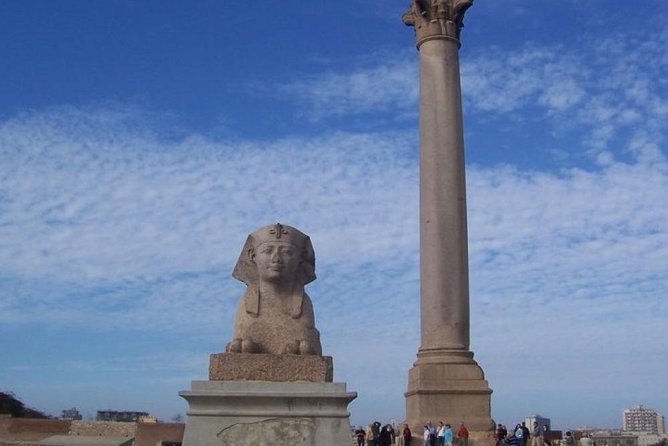
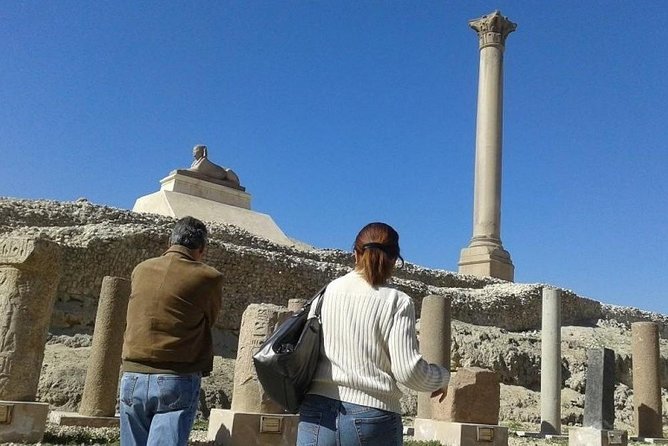
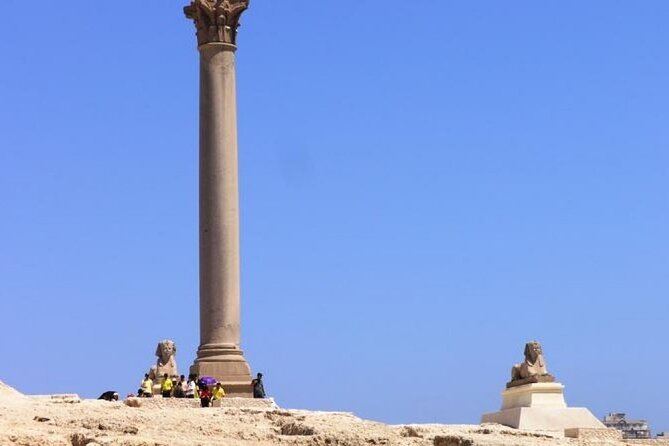
Pompey’s Pillar is one of Alexandria’s best “wait, what?” moments. The name is misleading. The story links the pillar to Roman consul and general Gaius Pompey, Julius Caesar’s rival—yet the pillar is not connected to him in the way the legend claims.
Where the confusion comes from: Crusaders thought the 100-foot (about 30 meter) red Aswan granite pillar marked Pompey’s burial site. In reality, the monument is described as a triumphal column erected around 300 AD for a Roman Emperor.
This is the kind of stop that only works well with a guide. Without context, it is easy to treat it like a random column. With the explanation, you get how legends form and how archaeology corrects the story.
Like the catacombs, this stop lists admission as not included, so check what your tour has covered for you before you arrive.
Qaitbay Citadel on Pharos: a fortress with a real coastal job
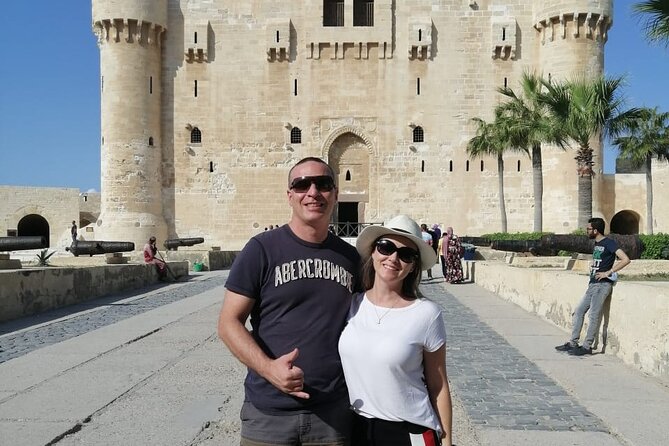
Next comes the Citadel of Qaitbay (Fort of Qaitbay), a 15th-century defensive fortress on the Mediterranean side of Alexandria. It was established in 1477 AD by Sultan Al-Ashraf Sayf al-Din Qa’it Bay.
Even if you only spend about an hour here, the location does the work. The citadel sits on the eastern side of the northern tip of Pharos Island at the mouth of the Eastern Harbour. That description matters: it means you are looking at the kind of geography that makes a fortress practical, not just impressive.
Possible drawback: plan for coastal light and wind. You will be outside, and conditions can change quickly. If you are sensitive to strong sun or chilly breezes, bring something that covers your shoulders and helps you stay comfortable.
Admission is not automatically included for this stop either, based on the way the stops are listed.
A few more Giza tours and experiences worth a look






Bibliotheca Alexandrina: modern library, ancient research logic
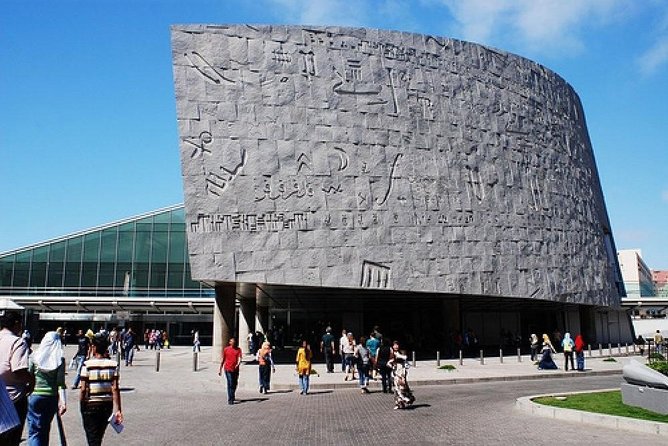
This is the stop that often surprises people. The Bibliotheca Alexandrina is famous in a modern sense, but the tour framing keeps it anchored to ancient Alexandria’s big ideas.
You learn that the ancient library was part of a larger research institution called the Mouseion, dedicated to the Muses. The concept of a universal library in Alexandria is described as being proposed by Demetrius of Phalerum to Ptolemy I Soter, with actual construction plans likely happening under Ptolemy II Philadelphus.
The practical point you should care about: Alexandria was not just a city of monuments. It was a place with research infrastructure. The library’s papyrus scroll growth is linked to the Ptolemaic kings’ aggressive, well-funded policies for obtaining texts.
This stop is listed as about 2 hours, which feels right. You get time to see the library setting and absorb the backstory without rushing. Admission is noted as not included, so again, confirm what you are paying versus what the tour includes.
Lighthouse stop: Pharos of Alexandria and Ptolemaic power
The itinerary includes a stop for the Lighthouse of Alexandria, sometimes called the Pharos of Alexandria. The tour notes that it was built by the Ptolemaic Kingdom during the reign of Ptolemy II.
Even if you already know it by reputation, this stop helps connect the lighthouse to a broader worldview: Alexandria’s rulers invested in symbols of control and navigation. In other words, it was not only a structure—it was a public statement.
Because this is a one-hour stop, you are not getting deep museum-style time here. It is more about orientation and big-picture context, especially when it is tied to the other Roman and coastal stops.
As with several other stops, admission is listed as not included, so plan your budget accordingly.
Ancient Roman amphitheater: spectacles built into the city
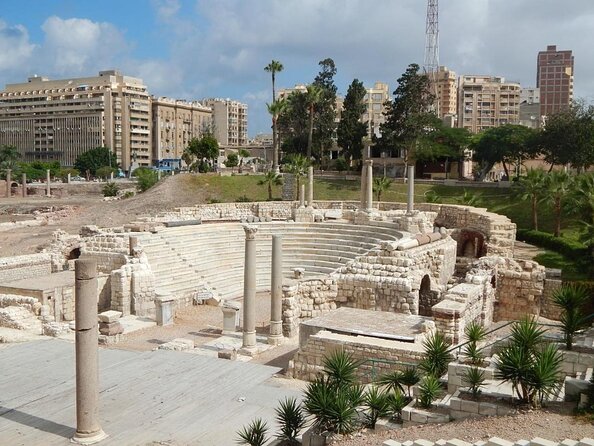
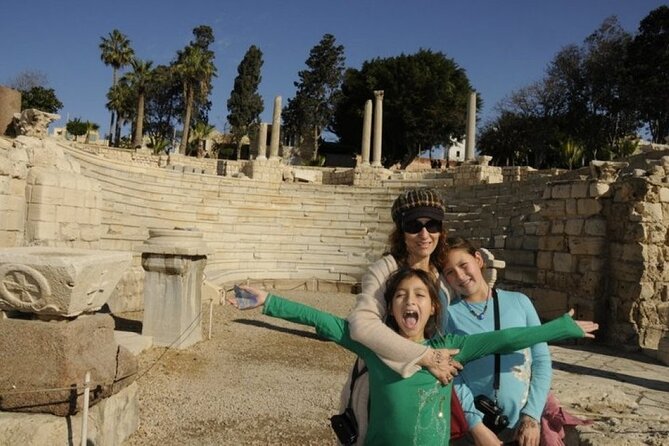
Your final cluster is the Ancient Roman Amphitheater, another “you can feel the purpose” stop. Roman amphitheaters were large open-air venues used for public entertainment: gladiator combats, venations (animal slayings), and executions.
The tour also gives useful context about how common this amphitheater type was across the Roman Empire—about 230 have been found in the Roman world—and how amphitheaters became more monumental during the imperial era. That helps you understand the local site as part of a wider Roman pattern, not just a single random ruin.
Practical consideration: the amphitheater is open air, so heat and glare can be issues. The good part is that it is a clear end-of-day theme shift: from scholarship and libraries back to spectacle and civic life.
Admission is listed as not included for this stop as well.
Lunch and timing: how to avoid a travel hangover
Lunch is listed as optional. In one of the best moments of the day, Fish Market lunch is described as delicious, paired with a clear Mediterranean sea view. That kind of meal break is not just nice—it helps you reset after hours of driving and walking.
Because several sites have admission tickets that may not be included, I recommend you budget for small add-ons. The tour also notes guaranteed skip the lines, which can save you time at busy entrance points. Still, you may pay ticket fees depending on your selected inclusion.
Timing tip: the day is structured so you see a lot, but not every stop is equally “hands-on.” Think of it like a greatest-hits album with context: some locations demand slower attention (catacombs, Bibliotheca), while others are more orientation-based (lighthouse, pillars, citadel viewpoints).
Who should book this private Alexandria tour?
This tour is a strong match if you want a one-day Alexandria experience without playing logistics roulette from Cairo. You get hotel pickup/drop-off, air-conditioned transport, and a private format that keeps the pace on your side.
It also suits you if you like structured history. The route moves between cemeteries, imperial monuments, maritime defense, and scholarship, so you end the day with a set of connected themes rather than separate facts.
You might think twice if you hate long drives or you prefer very slow travel days. This is a full itinerary, and between the roughly 3-hour highway commute and the time in multiple sites, the schedule is tight enough that you will feel it.
Should you book this Alexandria wonders day trip?
Yes, if you value organization and want to see the highlights in one shot. The price makes sense for a private day with pickup, transport, bottled water, and guided context, and the stop selection gives you Alexandria’s mix of Roman, medieval, and scholarly identity.
Book it if you are the type who wants explanations as you walk, not just photos. And book ahead: it is typically reserved about 10 days in advance on average, so waiting can leave you with fewer available slots.
Pass or adjust your expectations if you are extremely sensitive to crowded conditions or you expect spotless coastal scenery everywhere. Alexandria is a real working city, and not every sea-side view is postcard-clean.
If you do go, do it for the story arc. Catacombs to columns to a fortress by the harbor to the library idea—this route is designed to make Alexandria feel like one city, not a list of stops.
FAQ
FAQ
Is hotel pickup and drop-off included?
Yes. The tour includes hotel pickup and drop-off in Cairo/Giza.
How long is the Alexandria tour?
It runs about 11 hours (approx.).
How much does the tour cost?
The price is $68.00 per person.
Is this a private tour?
Yes. It is private, and only your group participates.
What sites are included in the itinerary?
You visit the Catacombs of Kom el Shoqafa, Pompey’s Pillar, the Citadel of Qaitbay, the Bibliotheca Alexandrina, the Lighthouse of Alexandria (Pharos), and the Ancient Roman Amphitheater.
Are entrance fees included?
Entrance fees are listed as optional. The itinerary notes admission tickets are not included for the individual stops, so you should check what is covered for your booking.
Do they provide transportation?
Yes. You travel by air-conditioned minivan and bottled water is provided.
Is there a mobile ticket?
Yes, the tour includes mobile ticket access.
When should I book?
On average, it is booked 10 days in advance.
What is the cancellation policy?
Free cancellation is available. You can cancel up to 24 hours in advance for a full refund.