REVIEW · ALEXANDRIA
Mirette Tour in Alexandria from Alexandria hotels and Alexandria Port
Book on Viator →Operated by Mirette Tours · Bookable on Viator
A full Alexandria day in 6 to 8 hours. You get a private air-conditioned vehicle plus an Egyptologist guide, so you’re not just collecting photos—you’re getting the why behind the sites. I like that snacks and bottled water are handled, and the major entrances are built into the price. One caution: the day can run long, and places like the catacombs involve uneven stairs, so it’s smart to gauge your comfort level ahead of time.
This tour is designed as a best-of sweep: Roman Alexandria (catacombs, amphitheater), Greek and Egyptian symbolism at the library complex, plus a reset in the gardens with ocean views. You’ll start at the Citadel of Qaitbay, right where the ancient Lighthouse of Alexandria once stood, then keep moving through the city’s layers. If you’re traveling on a Friday, plan for an adjustment because Bibliotheca Alexandrina is closed that day.
In This Review
- Quick hits: what makes this Mirette Alexandria tour work
- A private route built around Alexandria’s big questions
- Citadel of Qaitbay: the Lighthouse of Alexandria, rebuilt as a fortress
- Kom el Shoqafa Catacombs: a Roman cemetery with Egyptian fingerprints
- Bibliotheca Alexandrina: Alexander and Ptolemy meet modern museum space
- Saint Mark’s Coptic Orthodox Cathedral and Mansheya’s Italian memorial
- Stanley Bridge and Montazah Gardens: ocean air and a royal reset
- Ancient Roman Amphitheater at Kom el Dekka: a discovery that changed everything
- Price and what you’re really paying for at $92
- Who should book this tour, and who should think twice
- Should you book Mirette Tours in Alexandria?
- FAQ
- Is this tour a private experience?
- How long is the Mirette Alexandria tour?
- What’s included in the price?
- Is lunch included?
- Is Bibliotheca Alexandrina open every day?
- Can I cancel and get a refund?
Quick hits: what makes this Mirette Alexandria tour work
- Qaitbay Fort sits on the Lighthouse of Alexandria site, with views over the harbor and Pharos-area coastline
- Kom el Shoqafa catacombs are a major Roman cemetery with Egyptian and Roman tomb inscriptions
- At Bibliotheca Alexandrina, you’ll see statues of Alexander the Great and Ptolemy the First, plus museum time
- Snacks and bottled water are supplied, so you’re not hunting food mid-route
- The day mixes big-ticket history with a softer finish at Stanley Bridge and Montazah Gardens
- You can travel from Alexandria hotels or the port, with return transport included
A private route built around Alexandria’s big questions
Alexandria can feel like three cities at once: ancient legends, Roman grit, and modern coastal life. What I like about this tour is that it doesn’t treat the sites as isolated stops. It strings them together by theme—power, burial, learning, and coastal identity—so your brain can make sense of the geography.
The format helps. You’re in a private group vehicle, and pickup and return transport are part of the package. That means less time herding people and more time listening to your guide as you walk through places that actually shape the city’s story.
Still, be realistic about the pace. This is a 6 to 8 hour day, and you’ll be transferring between multiple neighborhoods. If you hate time in a car, you’ll want to bring patience—and water, especially in warm weather.
You can also read our reviews of more tours and experiences in Alexandria.


Citadel of Qaitbay: the Lighthouse of Alexandria, rebuilt as a fortress
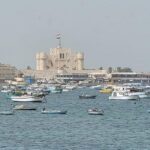
Your day kicks off at Fort Qaitbay (Citadel of Qaitbay), on the same site where the ancient Lighthouse of Alexandria once stood. The fort is a key defensive stronghold along the Mediterranean coast, and it was erected in the 15th century AD as part of Alexandria’s harbor fortification system.
Here’s why this stop is more than a quick photo: your guide can connect the modern fort to the lost landmark. The Lighthouse continued to function until the time of the Arab conquest. Standing at the fort’s edge, you get a feel for why this exact location mattered—control of ships coming through the eastern harbor.
What to expect: about an hour here, with admission included. You’ll likely move around viewpoints and ramparts, so comfy shoes matter.
A practical consideration: Fort sites can be windy and exposed. If you’re sensitive to sun or breeze, bring a light layer and sunglasses.
Kom el Shoqafa Catacombs: a Roman cemetery with Egyptian fingerprints
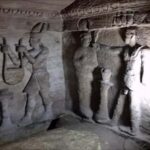
Next comes one of Alexandria’s most atmospheric stops: the Catacombs of Kom el Shoqafa. This is the largest Roman cemetery in the area, and it’s not purely Roman in style. You’ll see burial art and inscriptions that reflect more than one culture—ancient Egyptian elements mixed with Roman tomb inscriptions.
The story of how they were found adds drama. In 1900, a donkey accident led to the discovery of carved tombs and burial chambers in a cave. That detail turns your walk from a static sightseeing moment into a “how did we miss this?” experience.
What to expect: plan around 45 minutes. Admission is included. The space is carved and enclosed, so you’ll probably be listening closely to your Egyptologist guide to catch symbolism in the carvings.
The one watch-out: catacombs often involve uneven steps and narrow passages. If you have mobility issues or claustrophobia, this is where you should be honest with yourself.
Bibliotheca Alexandrina: Alexander and Ptolemy meet modern museum space
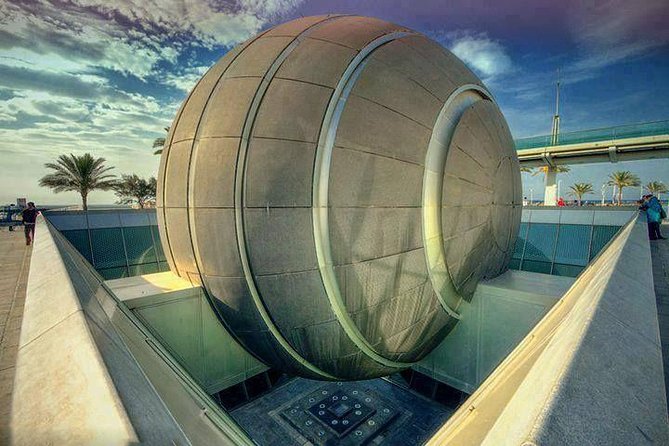
If you want one stop that ties ancient rulers to modern Alexandria’s identity, it’s Bibliotheca Alexandrina. You’ll spend about an hour here, and the highlights start in the open court.
You can view statues depicting Alexander the Great and Ptolemy the First, then you’ll move through museum space inside the library complex. Your visit includes time in the Sadat Museum and the Impressions of Alexandria Museum.
Why this matters: Alexandria has always been a city where learning and power overlap. This stop helps you see that connection in a way that feels less like textbook history and more like a curated city message.
Important timing note: Bibliotheca Alexandrina is closed on Friday. If your schedule lands on a Friday, confirm how the day adjusts so you don’t end up with a “half-history” gap.
What to do: go with your curiosity. If your guide points out how the statues frame the story of the city, ask questions. This is one of those places where a little interpretation makes the visuals click.
Saint Mark’s Coptic Orthodox Cathedral and Mansheya’s Italian memorial
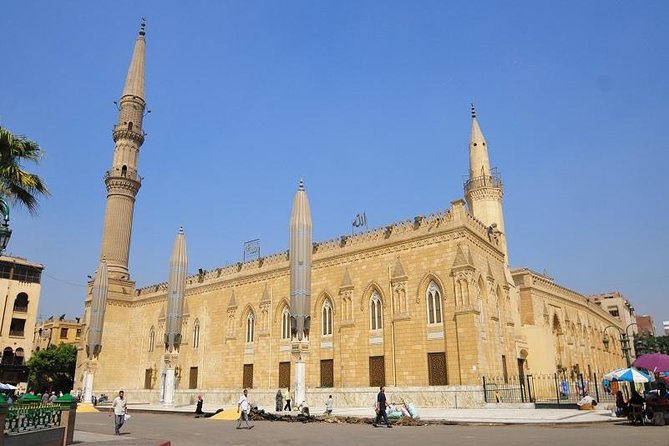
After the library, you shift to religion and downtown architecture with a visit to Saint Mark’s Coptic Orthodox Cathedral. The tour includes entry time, and the cathedral is described as the oldest church in Africa. That’s a big claim, so it helps to slow down here and look beyond the headline. Older buildings often carry layers—styles, community use, and long continuity of faith.
On the drive, you’ll also pass through old downtown with architectural details noted as Baroque-style designs plus Italian and French properties. It’s a nice break from pure ruin-history. You get to see how Alexandria looked as a European-influenced Mediterranean city in more recent centuries.
There’s also a stop in the Mansheya area connected to an Italian community presence there. The tour description frames it as a tribute to Khedive Ismail for his role in development and urban renaissance between 1863 and 1879, and as a tribute to Egypt for hosting the deposed Italian king Victor Emmanuel III in Alexandria. The design is noted as similar to the memorial of the Unknown Soldier in Venice Square in Rome.
What to expect: the time here is shorter (you’re not spending hours), but it’s useful for context. It helps you understand Alexandria as a crossroads, not just an ancient stage.

Stanley Bridge and Montazah Gardens: ocean air and a royal reset
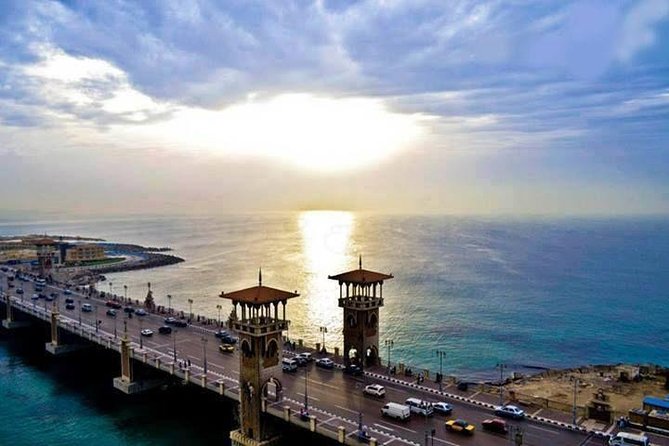
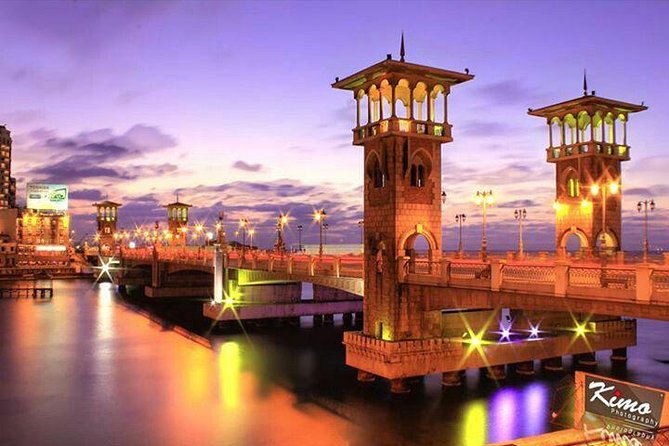
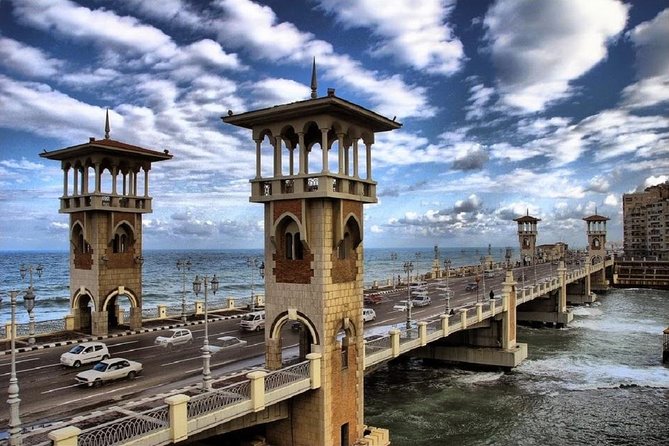
After the heady stops, the tour brings you toward the coast. Stanley Bridge is included as a nature-and-views moment, overlooking the ocean. This is the kind of stop that’s easy to skip if you’re rushing, but it’s exactly where you should take a breather. The sea makes the city feel real, not just historical.
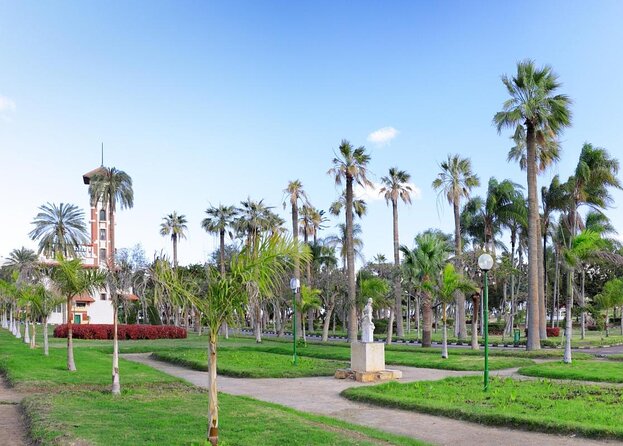
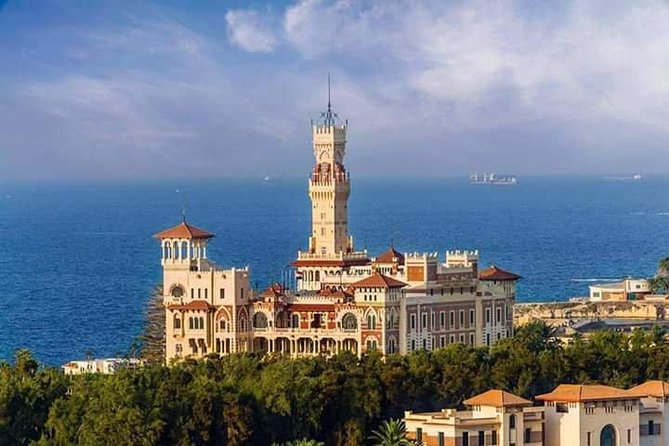
Then you head to Montazah Gardens, described as royal gardens. Even if you’re not a “gardens person,” this is where you recover from walking and let your brain digest what you just learned.
Why it’s good value in a single day: history stops can pile up. A scenic pause keeps the day from turning into museum fatigue. Plus, you’ll see how Alexandria lives at street level—coastal mood, outdoor paths, and a calmer pace than tombs and fortifications.
Practical tips: bring a hat or sunscreen. Gardens are open-air. Also, these are excellent spots to ask your guide for quick orientation—where you are in relation to the harbor, what to look for from the bridge, and how Montazah fits the city’s seaside story.
Ancient Roman Amphitheater at Kom el Dekka: a discovery that changed everything
The late-day history fix comes with the Ancient Roman Amphitheater at Kom el Dekka. This is one of those stories that makes you respect how much archaeology depends on timing and chance.
It was discovered in 1960 by coincidence during construction work: as the Egyptian government prepared to set up a building in the area, a worker found a solid column under dust and sand. An excavation team investigated, and what they found turned into a major 20th-century discovery.
Here’s the kind of detail that makes this stop worthwhile: the amphitheater is said to have been built since the 4th century AD, and it stayed in use until the 7th century, passing through Roman, Byzantine, and Islamic eras. That long timeline helps you see Alexandria as a place that kept reinventing itself instead of freezing in one period.
What to expect: about 30 minutes, with admission included. You may not feel like you’ve “seen everything” quickly. That’s normal. The value is in the context and interpretation your guide gives you while you stand in place.
Price and what you’re really paying for at $92

At $92 per person, this tour can feel either like a bargain or a splurge depending on what you expect from the day. Here’s how I’d frame the value based on what’s included.
Included highlights:
- Egyptologist guide
- Air-conditioned vehicle and private transportation
- Bottled water plus snacks
- All fees and taxes
- Admission tickets are included for each listed main stop
Also, the tour notes group discounts, which can make the per-person cost drop further if you’re traveling with friends.
What’s not included:
- Lunch (so don’t count on it unless you confirm)
- Tips/gratuities
- If you want a guide in French, Spanish, or German, there’s an extra $10 per person
One more budgeting point: the day is scheduled for 6 to 8 hours, so you’re paying for time, transport, and guides—not just entrance tickets.
If you’re coming from a hotel or the port, this kind of all-in transport setup is often where private tours justify themselves. Less friction. Fewer logistics headaches. More time on the ground.
Who should book this tour, and who should think twice
This is a strong fit if:
- You want an Egyptologist-led day with cultural and historical interpretation
- You like a structured route that hits major Alexandria landmarks
- You’re short on time and want a one-day sweep instead of piecing things together
- You’d enjoy a mix of tombs, monuments, learning space, and seaside gardens
I’d think twice if:
- You have limited mobility or you’re not comfortable navigating cave-like spaces (the catacombs are the biggest concern)
- You’re very picky about pace. This is a day that moves.
One small piece of advice that’s worth repeating: your pickup matters. Before the tour starts, make sure your meeting point and time are clear in writing. A good day can be ruined by a missed handoff.
Also, Bibliotheca’s Friday closure is real. If your schedule is fixed for a Friday, confirm the plan for that stop so your day doesn’t stall.
Should you book Mirette Tours in Alexandria?
If your goal is to see Alexandria’s key layers in one day—fort by the harbor, Roman catacombs, the library complex with Alexander and Ptolemy, and then a sea-and-gardens reset—I think this is a smart booking.
I also like the human side of it. In past bookings tied to this company, guides such as Jean, Jan, and Mohamed have been praised for being friendly and for explaining history clearly, and drivers like Prince have been noted for making pickup-and-transport feel smooth. That combination—guide + logistics—matters on a day like this.
Book it if you want a guided story, not just a checklist. Skip it or adjust expectations if you need a low-walking day or a flexible schedule around Fridays.
FAQ
Is this tour a private experience?
Yes. This is listed as a private tour/activity, with only your group participating.
How long is the Mirette Alexandria tour?
The duration is approximately 6 to 8 hours.
What’s included in the price?
The tour includes an Egyptologist guide, an air-conditioned vehicle, private transportation, bottled water, snacks, and all fees and taxes. Admission tickets are included for the stops listed.
Is lunch included?
No. Lunch is listed as not included.
Is Bibliotheca Alexandrina open every day?
No. Bibliotheca Alexandrina is closed on Fridays, so your visit may be affected if your tour falls on that day.
Can I cancel and get a refund?
Yes. You can cancel up to 24 hours in advance for a full refund. If you cancel less than 24 hours before the start time, the amount you paid is not refunded.