REVIEW · CAIRO
Cairo private city tour Museum ,Coptic Cairo ,Citadel and Bazaar
Book on Viator →Operated by Egypt Tours Experience · Bookable on Viator
Cairo packs a century into one day. This private city tour strings together the Egyptian Museum, Coptic Cairo, the Citadel, and Khan El-Khalili, with an Egyptologist guide and a smooth, air-conditioned ride so you can focus on the sights, not logistics. I love the Egyptologist guide for making big events feel clear, and I also like the included comfort details like snacks and bottled water during long walking stretches. The main consideration is simple: it’s about a 10-hour day, so you’ll want an early start mindset.
You’ll also appreciate the built-in value: entry fees for the stops are included, and you get hotel pickup plus WiFi on board. Still, this is a sightseeing-heavy route—if you want slow museum browsing or long bazaar wandering, you may feel a little rushed at certain points.
In This Review
- Key things that make this tour work well
- Egyptian Museum first: seeing Tutankhamun’s world without getting lost
- Coptic Cairo: Christianity’s chapters in Old Cairo
- Cairo Citadel: Saladin’s fortress and Muhammad Ali’s grand finishing touches
- Khan El-Khalili: make the most of one hour in the souk maze
- Service and comfort: why this feels easier than doing it yourself
- Price and value: what you’re paying for at $85.72 per person
- Who this private Cairo day suits best
- Should you book this Cairo private city tour?
- FAQ
- What is the duration of the Cairo private city tour?
- What time does the tour start?
- Is hotel pickup included?
- Are entrance fees included for the stops?
- Does the tour include refreshments during the day?
- Is WiFi included during transportation?
- Is the tour private and only for my group?
Key things that make this tour work well
- Egyptologist guidance, not just ticket-stamping: you’ll get context as you move from prehistory to later periods.
- Comfort on a long day: air-conditioned vehicle, bottled water, and snacks help you stay steady.
- Coptic Cairo with real landmarks: Babylon Fortress, the Hanging Church area, and Abu Serga tie Christianity to the city.
- Citadel history in layers: Saladin’s fortification story connects to Muhammad Ali’s palaces and mosque.
- Khan El-Khalili time that’s yours: one hour to wander and choose your own browsing pace.
Egyptian Museum first: seeing Tutankhamun’s world without getting lost
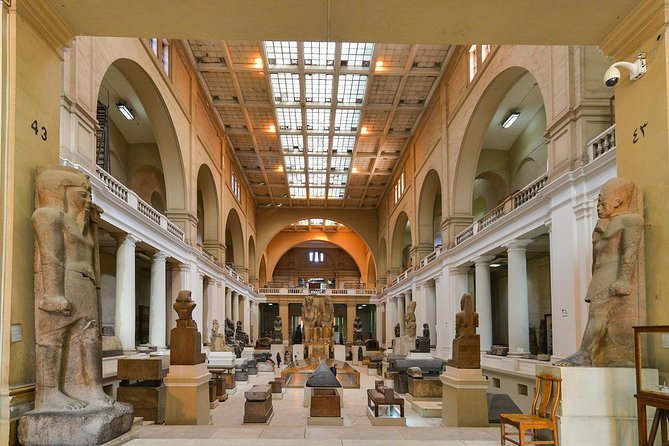
Starting in the morning at the Egyptian Museum is smart. Your brain is fresher, the crowds are often more manageable early, and you’ll get the broad timeline of ancient Egypt before you move to later Cairo neighborhoods. The museum is described as one of the oldest and most important museums worldwide, built in 1901. What I like about starting here is that it gives you a reference point for everything you’ll hear later—Pharaonic power, then shifting eras as Egypt changed hands.
Inside, you’re not just looking at isolated objects. You’re seeing a sweep from prehistory through the Greek-Roman period, with about 120,000 antiquities mentioned for the collection. The scale matters because the guide can help you understand what you’re actually looking at—without turning the visit into a random walk past vitrines.
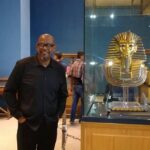
And yes, the Tutankhamun connection is a big reason people come. The tour highlights that Howard Carter found the Tutankhamun tomb in 1922 in the Valley of the Kings, and that the treasure collection includes more than 3,500 masterpieces of antiquities. Even if you already know the name, the guide’s job is to put the story into context: what it meant at the time, why the discovery was so significant, and how the artifacts reflect the beliefs and political world of ancient Egypt.
A practical note: museum time can evaporate fast. The schedule allows about 3 hours at the Egyptian Museum, which is enough to see major highlights when you’re not stuck figuring out what matters. If you tend to get detail-absorbed, you might want to pick a few priorities in advance—otherwise you’ll spend your energy trying to see everything.
You can also read our reviews of more city tours in Cairo


Coptic Cairo: Christianity’s chapters in Old Cairo
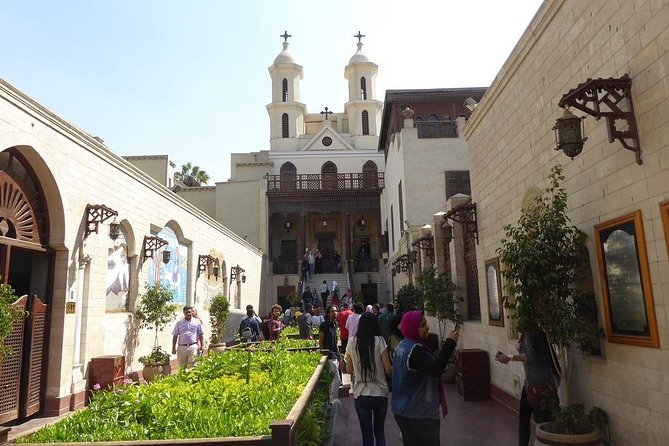
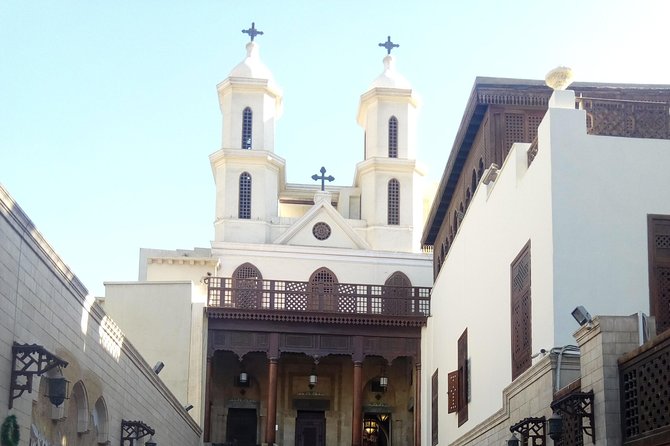
After the museum, the day shifts from pharaohs to faith traditions in Old Cairo, and that change is exactly what makes this tour feel like a real timeline, not separate tourist stops. Coptic Cairo is presented as a key part of Old Cairo, tied to sites such as the Babylon Fortress and prominent churches like the Hanging church and the Greek church of St. George.
One of the most interesting parts is how the tour connects place to story. In Christian tradition, the Holy Family visited this area and stayed at sites associated with saints Sergius and Bacchus, also known as Abu Serga. Even if you don’t treat religious tradition as history in the modern academic sense, the point for you as a visitor is still valuable: these locations show how communities anchored meaning in the physical city.
You’ll also hear that Coptic Cairo was a stronghold for Christianity in Egypt until the Islamic era. The tour notes that while some traditions trace very far back, many of the current church buildings in Coptic Cairo were built after the Muslim conquest in the 7th century. That detail matters because it helps you interpret what you’re seeing today—church architecture as a living record of time, not a single moment frozen in place.
The stop is about 1 hour with admission included. That duration is short enough to keep energy for the rest of the day, but it means you should expect to focus on the most recognizable landmarks and the guide’s explanation, rather than a deep, quiet study of every corner.
If you’re the kind of traveler who likes to look, listen, and make sense of a place, this stop will click. It’s also a good balance after the museum, because it’s more walking and observing than reading labels.
Cairo Citadel: Saladin’s fortress and Muhammad Ali’s grand finishing touches

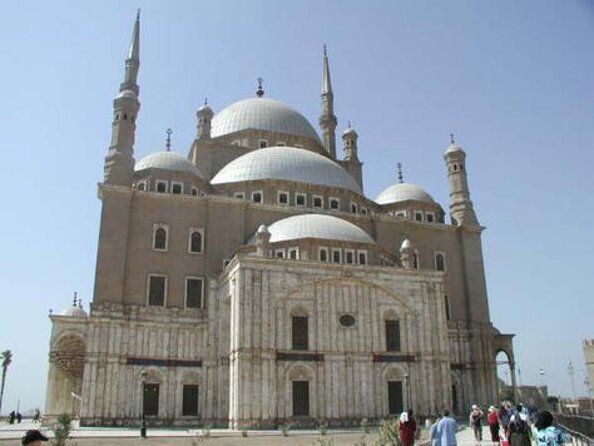
Next comes the Cairo Citadel, and the tour sets you up to read it like a timeline. The Citadel was built by order of King Saladin, described as the largest fort and castle of the medieval period, covering about 153,000 square meters, constructed between 1176 and 1183 CE. The goal was protection of Cairo from Crusaders. Once you know that, the Citadel’s position on the summit makes more sense. This wasn’t a random viewpoint spot—it was military planning made stone.
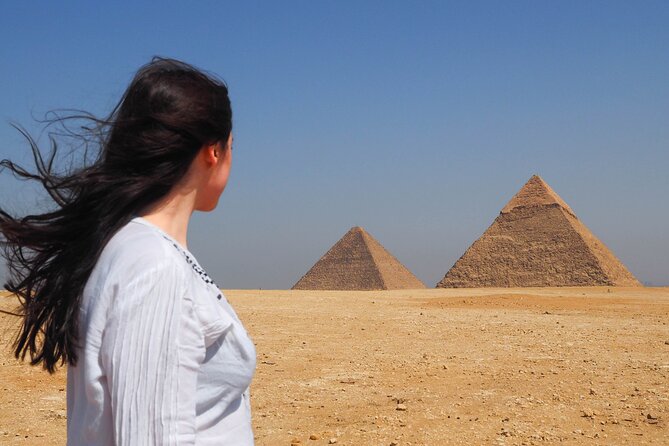
There’s also a detail that turns this stop from architectural to dramatic: the tour says Saladin recycled stones from the Giza Pyramids to speed up construction after defeating the Fatimids. That’s the kind of fact that can feel unbelievable until you hear it explained as part of how empires reused materials and resources. Whether you’re into military history or not, it adds a real edge to your visit.
After Saladin, the Citadel becomes something else: a royal court. The tour describes it as serving from the era of Al-Nasir Muhammad ibn Qalaoun through to Muhammad Ali Pasha. Then Muhammad Ali’s influence lands in the form of palaces and the famous mosque. The schedule highlights the Salamlik Haremlik palaces and the Muhammad Ali Alabaster Mosque, built between 1828 and 1848 CE.
This is the stop where you’ll likely appreciate having time to look around. You get about 2 hours here, which is helpful because it’s not just one building. It’s a whole compound with views and changing sightlines. The Citadel also rewards your “pause” habit—you’ll want a few slow minutes to take in the layout and imagine it in earlier centuries.
One consideration: there’s walking involved, plus steps and uneven surfaces. If your legs need a break, this is where that happens. It’s also a spot where you should bring water seriously—your stop earlier includes snacks and bottled water, but keep pace with the heat and sun.
Khan El-Khalili: make the most of one hour in the souk maze
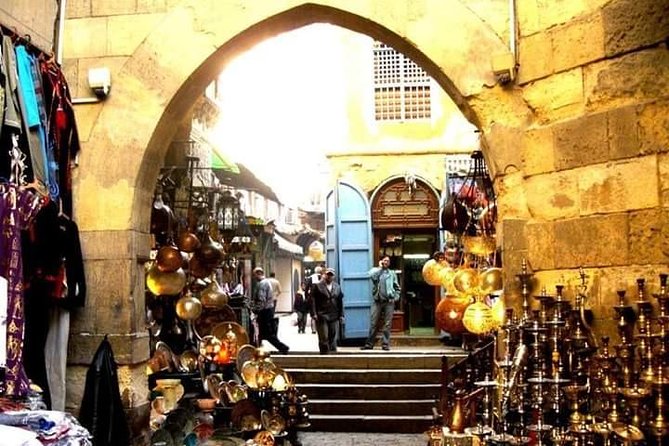
After the Citadel, the tour ends at Khan El-Khalili, and it’s set up as your free time. This is a major souk in the historic center of Islamic Cairo, and it’s described as a key attraction for both tourists and Egyptians. The best part of this structure is that you’ve already done the major “history reading” stops. Now you can switch to the fun mode: sights, smells, small purchases, and people-watching.
The time window is about 1 hour. That’s not a lot if you wander randomly, so I’d use it like this: walk a loop first to get your bearings, then slow down near whatever catches your eye. If you’re shopping, decide what you want before you enter the densest lanes. Souks can be great, but they can also be exhausting when you’re trying to decide what you came for while crowds push past.
Because you’re ending the day, you may also feel how the pace changes. Earlier stops are guided and structured. At Khan El-Khalili, it’s about your choices. A one-hour window is ideal for quick souvenirs and snacks, and for photos that tell the story of Cairo street life.
Service and comfort: why this feels easier than doing it yourself
Cairo can be a lot. Traffic, waiting, ticket lines, and the constant question of where to go next can turn a “simple day” into a headache. This tour is built to reduce friction.
First, pickup is offered, and you start at 8:00 am. The route is planned so you hit the Egyptian Museum early, then move through Coptic Cairo and the Citadel, before finishing with Khan El-Khalili. Second, you ride in an air-conditioned vehicle with WiFi on board. WiFi isn’t just a nice-to-have; it helps you reset mentally, check maps if you want, and manage energy during travel between neighborhoods.
Third, included details keep you steady: bottled water and snacks are part of the day. That matters because you’ll be out for around 10 hours, with walking at each stop. These small items can be the difference between enjoying the day and counting down the time.
Finally, there’s the human factor. The tour is guided by an Egyptologist speaking your language, and one highlight from the kind of service you can expect is the caring assistance paired with a driver. In one example, a driver named Sherif was described as especially helpful, and the guide Ra was praised for how much they explained. You can’t assume every group will have the same people, but the key point for you is that the service style is guided, not rushed.
You can also read our reviews of more private tours in Cairo





Price and value: what you’re paying for at $85.72 per person
At $85.72 per person, this tour isn’t positioned as a bargain “just transfer you to landmarks” deal. You’re paying for a package that includes a private vehicle, an expert Egyptology guide, entrance fees for every stop on the itinerary, plus snacks, water, and WiFi.
So the value question is: does that bundled structure save you money and stress? Usually, yes—because the Egyptian Museum alone is often one of those places where you’d either need a guide to make sense of what you see, or you’d spend time sorting out your own plan. By bundling entry fees and guided context, you spend less time bargaining with tickets and more time understanding what you came for.
Another value point: it’s a private tour/activity, meaning only your group participates. That tends to improve the flow when you want the guide’s attention, especially in churches or larger sites where the direction matters.
If you’re cost-comparing, look at what’s included: entrance fees, guide time, and transport. If you were to piece those out on your own, you’d likely end up paying for more than just transportation.
Who this private Cairo day suits best
This tour is a good fit if you want a guided sampler of Cairo’s major historical layers without juggling schedules. I’d say it’s especially worth it if:
- You like understanding the why behind a site, not just taking photos.
- You want a mix of museum highlights, Christian history in Coptic Cairo, medieval fortification, and a final souk wandering block.
- You’d rather ride comfortably in an air-conditioned vehicle than coordinate multiple transport segments.
It’s less ideal if you prefer slower museum time or deep, self-led exploration. The schedule is well-paced for a day tour, but the stops are still stops, not all-day study sessions.
Should you book this Cairo private city tour?
Yes, if your goal is a well-organized, guided day that covers four major areas you’d otherwise struggle to connect. The biggest reasons I’d book it are the mix of Egyptian Museum → Coptic Cairo → Citadel → Khan El-Khalili, the included entrance fees, and the comfort details that matter on a roughly 10-hour day.
Before you decide, think honestly about your pace. If you can handle a full, structured day with guided stops and one hour for souk browsing, you’ll likely feel like you got your money’s worth. If you want a lighter schedule or lots of free time inside the museum or inside churches, you may prefer a shorter or more flexible tour.
FAQ
What is the duration of the Cairo private city tour?
It runs for about 10 hours (approx.).
What time does the tour start?
The start time is 8:00 am.
Is hotel pickup included?
Pickup is offered in Cairo.
Are entrance fees included for the stops?
Yes. Entrance fees for all sights mentioned in the itinerary are included.
Does the tour include refreshments during the day?
Yes. You’ll have bottled water and snacks during the tour.
Is WiFi included during transportation?
Yes. WiFi is provided on board the vehicle.
Is the tour private and only for my group?
Yes. It’s a private tour/activity, so only your group will participate.