REVIEW · CAIRO
VIP Giza Pyramids, Sphinx, Lunch,Camel Ride & inside 3rd pyramid
Book on Viator →Operated by Hesham Egypt tour guide · Bookable on Viator
Four hours, and ancient Egypt feels right there. This VIP-style half-day tour focuses on the Giza Plateau highlights with private transport, a proper lunch break, and enough time for photos without feeling rushed. You’ll also get the extra punch of an inside visit to the 3rd pyramid (Menkaure) as part of this experience.
I like how it runs like a private plan, not a cattle-car version of Giza. Guides such as Ehab and Karim show up on time, explain what you’re seeing, and help you dodge the worst of the aggressive sales energy, which makes the whole thing feel calmer.
The main thing to watch is the fine print on entry. The stops are set up so you can view monuments, but admission fees can depend on your exact option, and you may also have brief shop stops en route (for example a papyrus museum), which some people find less fun.
In This Review
- Key things that make this tour work
- VIP by design: how this private format saves your energy in Cairo
- Price and value: why $14 can be a great deal, and what to check first
- The Giza loop: Great Pyramid, Khafre, Menkaure, and why the order matters
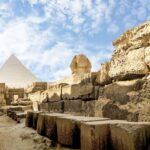
- Stop 1: Pyramids of Giza (the big first look)
- Stop 2: Great Pyramid of Khufu (Cheops)
- Stop 3: Khafre’s Pyramid (and the illusion)
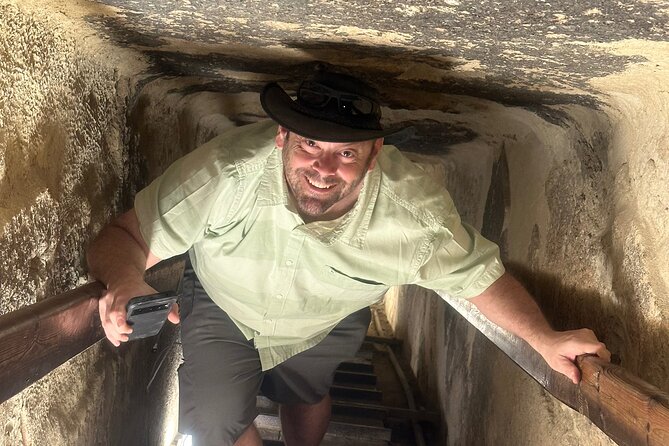
- Stop 4: Menkaure’s Pyramid (the one you can go inside)
- Panoramas and the Valley Temple: getting context before the Sphinx
- The Great Sphinx: the star that never stops staring
- Koshary lunch and camel ride: the part that feels local
- How to manage crowds and sales pressure at Giza
- Guides and drivers: why names matter here
- Who this tour fits best (and who should rethink it)
- Should you book this VIP Giza experience?
- FAQ
- Is this a private tour?
- How long is the tour?
- What’s included in the price?
- Are entrance fees included?
- Does hotel pickup happen?
- Is the Sphinx visit included?
- What is the cancellation policy?
Key things that make this tour work
- Door-to-door pickup from Cairo or Giza hotels with private vehicle transport and bottled water
- VIP-style access focus, including the inside Menkaure pyramid option for this offering
- Lunch is real Egyptian street food: koshary, plus time to reset before the Sphinx
- Camel ride for photos and fun, a short ride that keeps the schedule realistic
- Guides who manage the crowds, with tips to reduce time fighting for attention
- Giza in a tight loop, so you see Khufu, Khafre, Menkaure, and the Sphinx in one go
VIP by design: how this private format saves your energy in Cairo
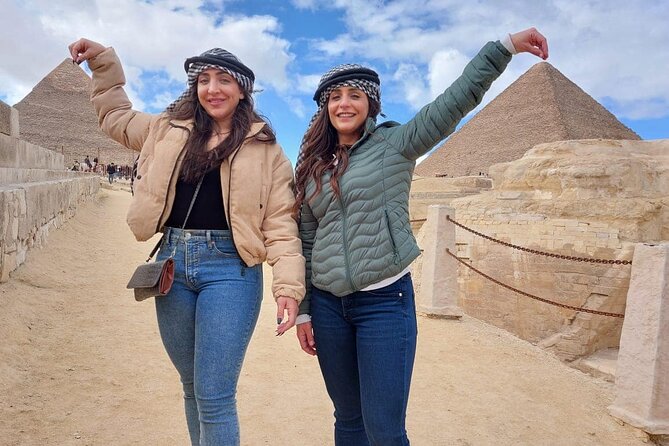
Cairo traffic can turn a simple half-day into a long test of patience. This tour targets that problem directly with private door-to-door pickup and a private vehicle, so you’re not juggling shared shuttles or waiting around while other people slowly wake up.
You also get a real group of one. Since it’s private, you’re able to move at a rhythm that fits you. In the reviews, drivers and guides are repeatedly described as punctual and professional, including Ahmed as a driver who made people feel comfortable and safe, plus guides like Ehab, Ibrahim, and Bisho who paced the tour with plenty of patience.
And because the tour is only about four hours, it doesn’t try to cram every possible Giza moment into one day. That’s a big deal if you have limited time in Cairo or you’d rather spend your energy looking at monuments than standing in lines all afternoon.
A few more Cairo tours and experiences worth a look

Price and value: why $14 can be a great deal, and what to check first
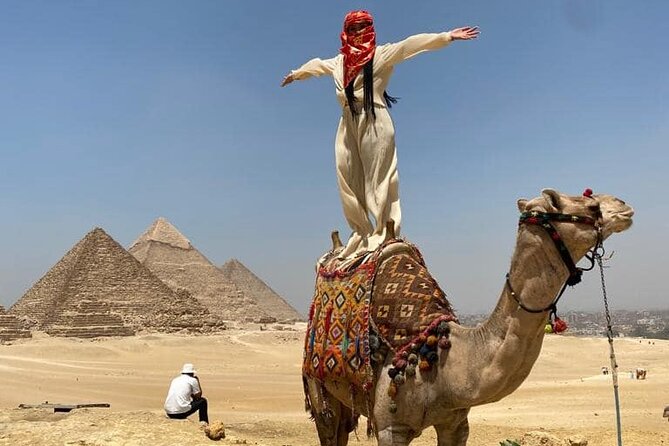
At first glance, the listed price sounds almost too good for Giza. The value comes from the logistics: private transport, bottled water, and a guide-led plan that helps you see the big three pyramids plus the Sphinx in one smooth block of time.
But here’s the balance point you should know: admission fees are not automatically included for every stop. The tour notes admission tickets aren’t included for multiple pyramid viewing stops, and that usually means entry costs can be extra unless your chosen upgrade covers them. The Sphinx stop is marked as free in the schedule, which can help your budget.
So the smart move is this: treat the ticket price as the transportation + guiding portion, then verify whether your chosen option includes pyramid entrance fees and the inside visit you want. If it does, you get a strong package for a relatively low base cost.
The Giza loop: Great Pyramid, Khafre, Menkaure, and why the order matters
The itinerary is designed around the Giza Plateau’s flow. You start with an overall orientation around the pyramids site, then you move into the three main pyramids and finish with a panoramic view before the Sphinx. That order helps you build a mental picture fast, so each pyramid doesn’t feel like an isolated photo stop.
Stop 1: Pyramids of Giza (the big first look)
This is your orientation hour. You’re not just taking one quick look—you’re circling the site and getting your bearings before you zoom into specifics. If you’ve never been to Giza, this “first sweep” is what makes the later stops click.
A drawback to know: the plateau can feel busy and chaotic. A good guide makes a difference here by keeping you moving, steering you away from the most aggressive sales moments, and explaining what you’re actually seeing.
Stop 2: Great Pyramid of Khufu (Cheops)
This is the giant. The Great Pyramid is the biggest, tallest, and most intact pyramid at Giza. It was one of the Seven Wonders of the Ancient World, and it’s also noted for being the tallest building on earth for about 4,300 years—until the Eiffel Tower in 1889.
You’ll see why people get emotional in front of it. Even the details are impressive: it’s described as being built entirely of limestone, with around 1,300,000 blocks that range roughly from 2.5 tons up to 15 tons. The base is about 13 acres, and the sides face the cardinal points with a 52-degree angle.
If you’re hoping for a “standing in front of a monument that feels impossible” moment, this is where you get it.
A few more Cairo tours and experiences worth a look


Stop 3: Khafre’s Pyramid (and the illusion)
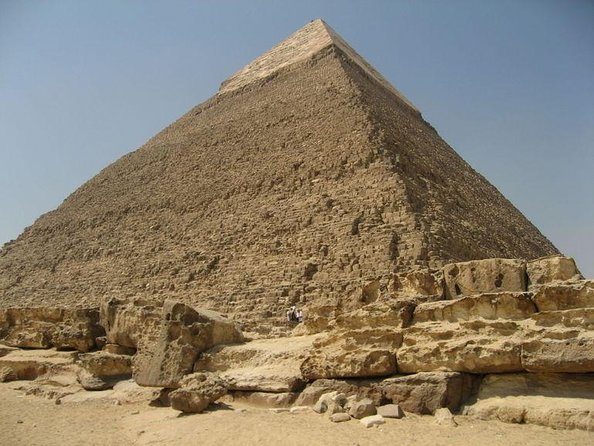
Khafre’s pyramid looks like it’s taller than Khufu’s, but it’s mainly an optical illusion. The tour explanation highlights that Khafre sits on a higher part of the plateau, and that’s why it reads as taller even though its stated height is about 136m.
The clue is in the casing stones near the summit that remain. Those stones give you that slightly sharper silhouette compared to what you might expect. The angle is described as about 53 degrees, and it’s also part of why people keep photographing it from slightly different angles.
Stop 4: Menkaure’s Pyramid (the one you can go inside)
Menkaure’s pyramid is the smallest of the three, and that’s exactly why it’s a smart contrast. You’ll see it described as around 65.5m tall historically (now around 62m), with an angle of about 51.3 degrees.
For this VIP version, the main added value is the inside experience focus. Even if you’re not chasing every museum detail, going inside one of these pyramids changes your relationship to the scale. From the reviews and tour design, the inside option is part of the reason people call this a must-do if you want more than surface-level photos.
A practical note: inside pyramid time can be physically demanding for some people, especially if you’re not used to tight or stair-like access (the tour data doesn’t spell out conditions, so you’ll want to consider your comfort level and ask what the route involves if you’re booking an option that includes entry).
Panoramas and the Valley Temple: getting context before the Sphinx
After the main pyramid trio, you get time for a panoramic view. This matters more than it sounds. When you’ve been close to one structure and then another, your brain tends to compress everything. A panoramic moment helps you separate what you’re seeing from what you think you’re seeing.
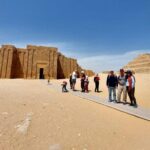
The tour overview also includes the Valley Temple, which is part of the broader Giza story. Even if you only get a limited amount of time there, it adds context: these weren’t random stone piles—they were part of a larger complex with rituals, pathways, and meaning tied to the landscape.
The Great Sphinx: the star that never stops staring
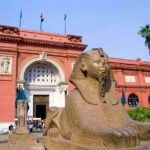
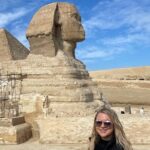
Then you arrive at the Great Sphinx, which is one of the most recognizable faces in the world. The tour description gives you the classic identifiers: it’s carved from soft sandstone, and it’s associated with the name Shesep Ankh, meaning the living image.
The facts are the kind that make your eyes widen. The body is described as about 60m long and 20m tall. The face is around 4m wide, with eyes roughly 2m high. The Sphinx also faces the rising sun, and a temple was built in front of it.
What makes this stop feel worthwhile is pacing. If you rush, you just snap photos. If you slow down even for a few minutes, you notice how the Sphinx dominates the plateau like a fixed idea you can’t escape.
Also, in the schedule, the Sphinx admission is marked as free, so it’s a straightforward win on your time and budget.
Koshary lunch and camel ride: the part that feels local
This is where the tour stops feeling like a photo checklist and starts feeling like a Cairo day. Lunch is included, and it’s Egypt’s favorite street food: koshary noodles, served as part of your tour plan.
Koshary isn’t fancy. That’s the point. It’s filling, it’s comforting, and it tastes like something real people eat on normal days. In reviews, people describe the lunch as authentic and tasty, even if it’s not a five-star spread. Think of it as fuel, not a culinary award.
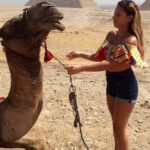
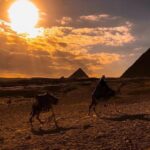
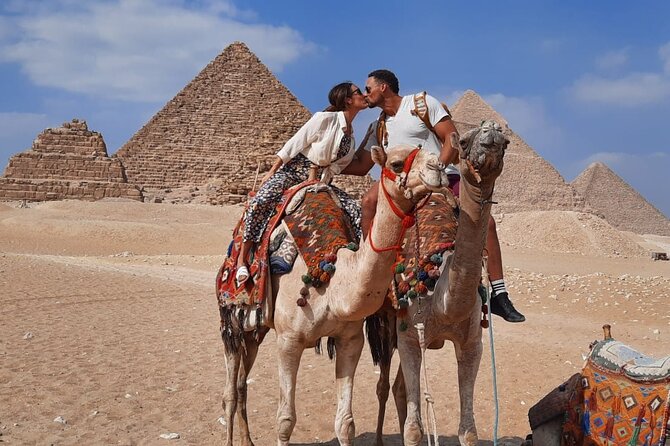
Then comes the short camel ride. You get the fun of sitting up for the Giza photos without turning the entire afternoon into a long detour. Reviews mention that the camel ride can feel relaxing, and it’s also a great way to get photos from slightly different angles.
Quick realism: camel rides are a comfort and safety topic. The best sign is how the guide and driver handle things. In reviews, people repeatedly mention feeling safe and cared for, which matters here more than bragging rights.
How to manage crowds and sales pressure at Giza
Giza isn’t calm. The plateau has people selling things, and that can drain your focus if you let it. The good news is this tour is built to reduce that hassle.
One of the most praised elements in the reviews is guide support with timing and crowd behavior. People talk about getting there early to avoid the biggest crowds, and that’s a solid strategy. If you have the choice, aim for the earliest departure time you can handle. It usually means better photos and less time being jostled.
Another tip comes straight from guide behavior: guides such as Ehab and Kareem are described as actively helping you avoid aggressive salespeople. That sounds like a small detail, but at Giza it’s the difference between enjoying the pyramids and spending your mental energy responding to interruptions.
Also watch for optional stopovers en route. One review mentions a papyrus museum stop as part of the program. If you dislike shop stops, you’ll want to set expectations before you go and be clear with your guide if you’d rather spend more time at the monuments.
Guides and drivers: why names matter here
At Giza, the guide is the difference between seeing buildings and actually understanding what you’re looking at. Reviews highlight repeated strengths: patience, clear English explanations, and practical help with photos and crowd navigation.
Some names that come up include:
- Ehab, praised for being patient and knowledgeable and for answering questions clearly
- Kyrllos, noted for making the experience easy and fun
- Ibrahim, described as experienced and explaining stories well
- Imad, called thorough and patient
- Karim, recognized for both knowledge and photo help, plus advice to avoid pushy sellers
- Bisho, praised for explaining the story in a friendly way
- Khaled, mentioned specifically in a go-early success story
Drivers are also repeatedly described as clean-car professionals. Ahmed is one name that appears in a safety comfort context. That matters because getting to Giza and back is its own mini-adventure, and you’ll feel it more when you’re tired.
Who this tour fits best (and who should rethink it)
This VIP half-day plan fits best if you want:
- A tight itinerary that hits the big three pyramids and the Sphinx without a whole-day commitment
- Private, door-to-door transport to reduce stress in Cairo
- A mix of sights plus comfort stops like lunch and camel photos
- A guide who helps you handle the real-world chaos of Giza
It may be less ideal if you want zero shop interruptions or you hate the idea of adding any upgrade checks for entrance fees. Because entrance costs can depend on the option you choose, you’ll also want to confirm what’s included before you get there.
Should you book this VIP Giza experience?
If you’re choosing between DIY and a guided plan, I think this is one of the easier wins for first-timers. The biggest strength is value for time: private pickup, fast focus on the core monuments, and enough structure to make the day feel smoother than it would on your own.
Book it if you want a balanced mix: pyramids up close, a proper lunch, a short camel ride for fun, and the extra payoff of an inside pyramid visit (Menkaure) in the VIP version. That inside component is the type of upgrade that turns a good trip into a memorable one.
Hold off or ask more questions if your priority is purely uninterrupted time at the pyramids, because brief stopovers en route can happen and admission fees are not guaranteed in every base scenario. If you confirm entrance details ahead of time, though, this turns into a very solid Cairo half-day plan.
FAQ
Is this a private tour?
Yes. It’s listed as a private tour/activity, meaning only your group participates.
How long is the tour?
The duration is about 4 hours (approx.).
What’s included in the price?
Included items are a private tour, fuel surcharge, bottled water, and transport by private vehicle. A koshary lunch and a short camel ride are part of the overall experience described for this tour.
Are entrance fees included?
Not automatically. The schedule indicates admission ticket not included for several pyramid stops. There are upgrade options to include entrance fees.
Does hotel pickup happen?
Pickup is offered from Cairo or Giza hotels via the private vehicle. It also notes that airport pickup and hotels in some areas are not included.
Is the Sphinx visit included?
Yes. The itinerary includes the Great Sphinx, and it’s marked as free in the schedule.
What is the cancellation policy?
Free cancellation is available up to 24 hours in advance for a full refund. If you cancel less than 24 hours before the start time, the amount you paid is not refunded.