REVIEW · CAIRO
Private tour Giza Pyramids&egyptian Museum&khan khalili bazaar
Book on Viator →Operated by Egypt Traveler · Bookable on Viator
One day in Cairo feels like time travel, and Giza is the proof. This private outing pairs Giza’s three pyramids with the Sphinx plus a museum stop you can tailor, then finishes with old-street browsing at Khan el-Khalili. It’s a smart way to see the big sights without feeling like you’re stuck in a line-only day.
I love that the tour runs with hotel or airport pickup and a private Egyptologist guide. You get a focused route, air-conditioned comfort, and drinks along the way—small things that matter when you’re dealing with heat and long viewing stops.
The main drawback to plan for: entrance tickets and lunch aren’t included. You’ll want to budget a bit more and decide which museum you really want, since the day packs a lot in.
In This Review
- Key things to know before you go
- A private schedule that respects your time in Cairo
- Giza Pyramids: how Khufu, Khafre, and Menkaure feel up close
- Khufu’s Great Pyramid: the one you’ll likely see first
- Khafre’s Pyramid: where preserved cladding changes the look
- Menkaure’s Pyramid: smaller, but with surviving sculptural detail
- Sphinx and the temple area: your best photo and story stop
- Picking your museum: 3 options, one tightly packed day
- Why the Grand Egyptian Museum can be the best fit
- If you’re more interested in specific names: Tutankhamun angle
- Khan el-Khalili after Giza: Papyrus and perfume breaks in old Cairo
- Guides and drivers: where the best days are made
- Value and timing: is $28 per person a real deal?
- Practical tips so the day feels easy (not exhausting)
- Should you book this Giza, museum, and Khan el-Khalili private tour?
Key things to know before you go
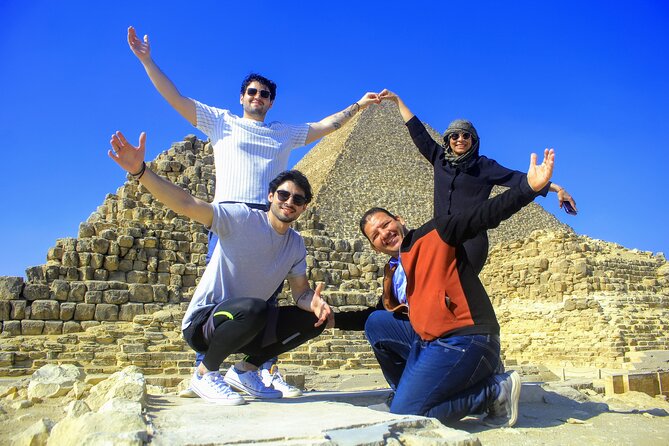
- Private, just your group: No mixing with strangers, which keeps the pacing calmer.
- Three pyramid stops, built for contrasts: Khufu, Khafre, and Menkaure each feel different once you’re there.
- Sphinx is a full photo moment: You’ll have time to view it in multiple angles and get to the nearby temple area.
- Museum choice among 3 options: You can pick what fits your interests, from Tutankhamun-related highlights to the Grand Egyptian Museum.
- Khan el-Khalili connects the day: After Giza, you get the older Cairo vibe through Papyrus and perfume spots.
- Guide quality shows up fast: People specifically praise guides like Ahmed and Magdi for explaining what you’re seeing.
A private schedule that respects your time in Cairo
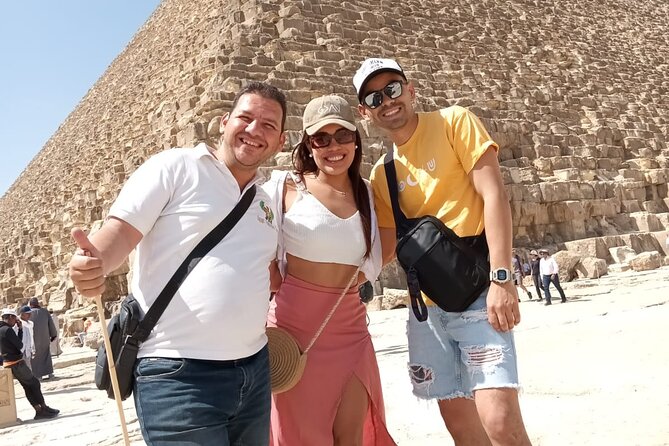
Cairo can be chaotic if you wing it, but this tour keeps things organized from the first pick-up. You start with a driver and an Egyptologist guide, then you move as a group through Giza and back to your Cairo/Giza hotel or the airport.
The duration is listed as about 7 hours, which is a workable window for first-timers. You’re not just collecting stamps. You’ll actually slow down at key monuments and get context that makes the views make sense instead of feeling like random big rocks.
The private format also helps with photo timing. The pyramids don’t photograph the same way twice, depending on where you stand and how the light hits. When you’re not waiting for a huge group to shuffle forward, you can take your time.
You can also read our reviews of more private tours in Cairo


Giza Pyramids: how Khufu, Khafre, and Menkaure feel up close
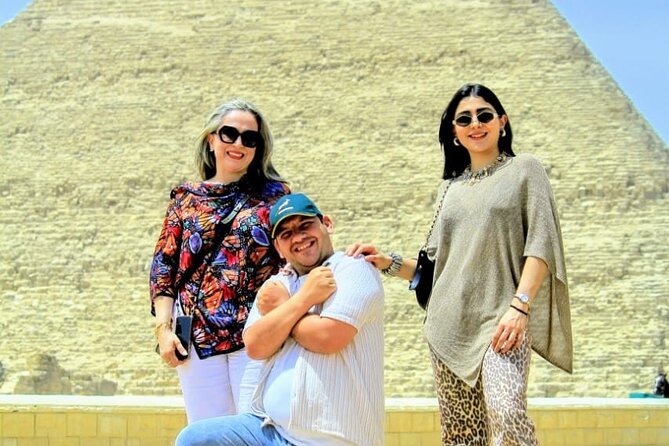
Giza is one of those places where your brain keeps trying to measure it. The scale is hard to accept until you’re standing on the plateau and the pyramids are no longer pictures, but structures.
Khufu’s Great Pyramid: the one you’ll likely see first
The tour includes time at the Great Pyramid of Cheops (Khufu). This is the pyramid most people picture—especially if you arrive from the main approach road. It’s considered one of the Seven Wonders of the Ancient World and it’s still standing today.
A few details help you “read” it:
- It was completed around 2560 BC.
- Originally it was taller than what you see now; the current height is listed as about 138 meters due to the removal of external elements.
- It represents advanced geometry and engineering for its era.
On a practical level, the stop length is short enough that you’ll want to pace yourself. Walk slowly, look up, and don’t spend your whole time just photographing. Spend some time noticing the shape and edges, then step back for the bigger view.
Khafre’s Pyramid: where preserved cladding changes the look
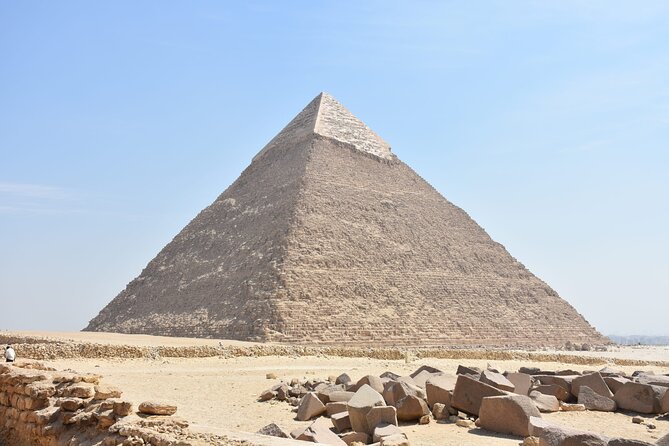
Next is Khafre’s Pyramid, the second-largest on the plateau. A key difference is that the upper portion preserves more of the original cladding, so the pyramid’s top section looks different than Khufu’s.
The complex is also described as better preserved than others. The tour explains that it ties into temple functions connected to the resurrected god-pharaoh after funerary rituals.
This is a nice stop if you’re the type who likes comparisons. Khafre feels slightly more “complete” visually, and it gives you an easy way to see how small changes in preservation affect the overall impression.
Menkaure’s Pyramid: smaller, but with surviving sculptural detail
Then you’ll reach Menkaure’s Pyramid. It’s the smallest of the three, listed at about 65 meters, but the tour framing emphasizes that its complex preserved striking examples of sculpture from Egyptian history.
Even if you don’t care about carvings as much as you care about pyramids, this stop is useful because it reminds you that Giza isn’t just three big shapes. It’s a burial complex built to include temple life, rituals, and art.
One caution: because admission tickets are listed as not included, you’ll want to make sure you have what you need for the specific entry areas. The schedule notes some items as free in the day’s plan, but you should still expect to pay for official access tied to your chosen sites.
You can also read our reviews of more museum experiences in Cairo

Sphinx and the temple area: your best photo and story stop
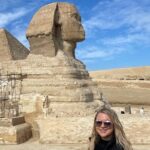
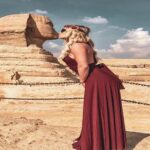
The day doesn’t stop at the pyramids. You’ll also visit the Great Sphinx and the temple area where the body was mummified.
It’s described as a mythological creature—lion’s body with a human head—and it’s important in Egyptian and Greek art and legend. That matters because the Sphinx is one of those symbols people argue about without always explaining the why. When you’re there with an Egyptologist, you get the story that turns the stone into meaning.
The tour plans about an hour here and highlights photo time from different positions. That’s exactly what you should do. Take a few photos up close, then walk back and shoot the Sphinx with the horizon. You’ll notice how your brain keeps trying to place it relative to the pyramids behind you.
If you only do one “long looking” stop, make it the Sphinx. It’s where the day shifts from monuments-as-objects to monuments-as-icons.
Picking your museum: 3 options, one tightly packed day

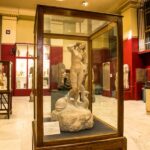
After Giza, you move to a museum choice. The tour description says you can choose among three museums, which is a huge benefit if you have strong preferences.
Here are the options listed:
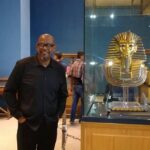
- The Egyptian Museum: described as holding the ruins of Tutankhamun.
- Museum of Civilization: described as featuring 50 mummies.
- Grand Egyptian Museum (GEM): described as having over 100,000 artifacts, including treasures from Tutankhamun’s tomb, and offering modern exhibits plus views of the pyramids.
The itinerary text specifically names the Grand Egyptian Museum with a listed time of about 2 hours. So depending on what you select, your day may look slightly different—but the theme is the same: you’ll leave with more than just a surface glance.
Why the Grand Egyptian Museum can be the best fit
If you’re choosing and you want a museum experience that feels modern and expansive, GEM is the one with the highest “artifact count” promise. It’s also described as having interactive exhibits and guided tours led by Egyptologists, plus workshops and cultural performances.
That helps you understand why the pyramids weren’t isolated. The museum framing connects artifacts to people and belief systems, and it gives context for what you just saw outside.
Just remember: admission tickets to the museum aren’t included. Also, lunch isn’t included, so plan a snack strategy or budget time to eat near your chosen route.
If you’re more interested in specific names: Tutankhamun angle
Two of the options focus on Tutankhamun-related highlights: the Egyptian Museum and the Grand Egyptian Museum. If that single pharaoh is your main interest, you’ll likely want to lean into the option that emphasizes his treasures most directly.
If you’re more curious about human remains and how ancient Egyptians handled bodies, the Museum of Civilization’s 50-mummy description is the better match.
Khan el-Khalili after Giza: Papyrus and perfume breaks in old Cairo
By the time you reach Khan el-Khalili, you’re done with the massive outdoor landmarks and ready for the human-scale city. The tour takes you to the bazaar area described as the oldest and most important bazaar in the world, plus time exploring parts of the old city.
The museum-style stops inside the bazaar zone are specifically named:
- Papyrus Museum
- Perfume Museum
This is a smart pairing with Giza because it swaps “stone age awe” for “everyday Cairo crafts.” Papyrus and perfume both connect to old Egyptian materials and traditions. Even if you don’t buy anything, the displays give you something to look at beyond souvenir clutter.
Keep your expectations practical: Khan el-Khalili is a shopping-and-streets setting. You’ll want comfortable shoes, and you should expect navigating crowds. This portion of the day works best if you treat it like wandering with purpose rather than trying to see every corner.
Guides and drivers: where the best days are made
This is one of those tours where the guide isn’t an optional extra. People repeatedly praised their guides by name, and you can feel what that means for your day.
Ahmed shows up in multiple reviews as friendly and great at explaining details. Magdi is praised as the best tour guide for making the day feel like a dream through detailed explanations. John is mentioned alongside a capable driver as knowledgeable and clever, tied to a well-organized experience. Mohamed is also singled out as a fabulous driver.
I’m not saying you’ll get the same person, but I am saying this: the tour is built around a guide who can translate the monuments into clear stories. If you’re the kind of traveler who wants the why behind the wow, you’ll appreciate that focus.
Private tours also tend to run smoother when the driver understands pacing and where to reduce stress. In this case, the day includes several major stops in a single outing, so driver experience matters.
Value and timing: is $28 per person a real deal?
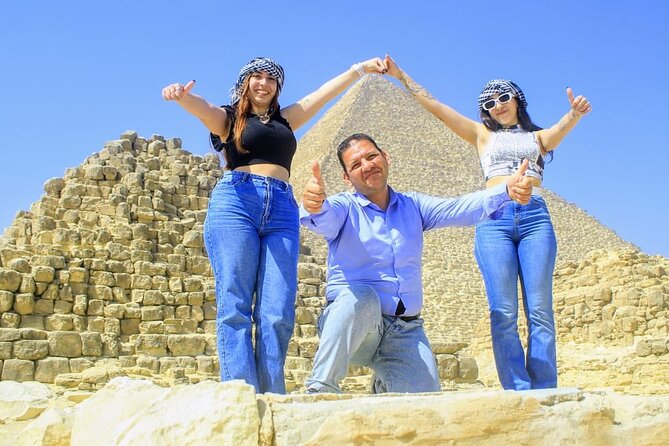
The price listed is $28 per person, which is unusually low for a private day out that includes pickup, drop-off, an air-conditioned vehicle, and a professional Egyptologist guide. That’s the key value hook: you’re paying for guidance and logistics, not just transportation.
That said, the value equation changes based on two costs you’ll likely add:
- Entrance tickets for the pyramids area and the museum
- Lunch, since it isn’t included
So the smartest way to think about it is: you’re buying a plan. If you were to hire guides, arrange transfers, and coordinate entry yourself, this kind of structure usually ends up more expensive or more stressful.
Also, because it’s private for your group, the value can improve if you’re traveling with friends or family and can split the total cost.
Practical tips so the day feels easy (not exhausting)

A day with pyramids + Sphinx + museum + bazaar is not a walk-in-the-park schedule. The good news is the tour gives you comfortable vehicle time and drinks, but you still need to prep.
Here’s what I’d do to make it smoother:
- Wear light, breathable clothes and bring something for sun coverage. You’ll be outside for the big monuments.
- Use comfortable shoes. Giza paths and the bazaar streets don’t feel like museum floors.
- Bring a refillable water bottle if you prefer to control your intake. The tour includes drinks, but you may want extra depending on the weather.
- Plan your museum choice before you go. If you like Tutankhamun themes, pick the museum option that matches that interest.
- Expect to pay for entrance tickets and keep your schedule flexible in case you spend extra time at photo points (the Sphinx especially).
One more heads-up: the tour summary says it can start from Cairo hotels or the airport, and the start time is listed as 12:00 am. That’s an odd time on paper, so treat it as a placeholder and double-check the actual pickup time you receive at confirmation.
Should you book this Giza, museum, and Khan el-Khalili private tour?
Book it if you want a structured day with pyramids + Sphinx + a museum choice, and you’d rather have an Egyptologist guide handle the order and explanations. It’s especially worth it for first-timers who want their big photos but also want meaning behind them.
Skip it or rethink it if:
- You hate planning for extra costs and prefer packages where tickets are included.
- You want a slower day with more time in each place. This tour is designed to cover a lot in about 7 hours.
If you’re flexible about entrances and lunch and you care about understanding what you’re seeing, this is a strong value way to experience Giza, then see Cairo’s old bazaar side afterward.