REVIEW · CAIRO
Overnight safari White & Black Desert and the Crystal Mountains
Book on Viator →Operated by Tamer Safari · Bookable on Viator
Stars beat jet lag out here. This 2-day Cairo desert run takes you from Bahariya Oasis to the black volcanic hills, then on to quartz-studded Crystal Mountains and the white “sculpted” desert for an overnight camp with tea and star views, usually guided by Tamer Safari staff like Tamer with help from Reda and Amjad.
I love how the trip stays private with an English-speaking guide, so you’re not trapped in a big coach herd. I also love the camp details: hot mint tea around the fire, plus a desert dinner that’s clearly built to keep the group happy. One drawback to plan for is the early 7:00 am start and the long, packed driving-and-walking days that come with seeing multiple desert zones in just two days.
In This Review
- Key Highlights You’ll Feel Immediately
- Cairo to Bahariya Oasis: The Big Picture Setup
- Black Desert First: El Haez Hot Spring and Volcanic Hills
- Crystal Mountains: Quartz Formations in a Fast, Useful Stop
- Valley of Agabat: Mushroom-Like Towers and Flower Stone
- New White Desert Overnight: Dunes, Stars, and Campfire Mint Tea
- Day 2 Morning in the Old White Desert: Wadi El Khiam and the Acacia Tree
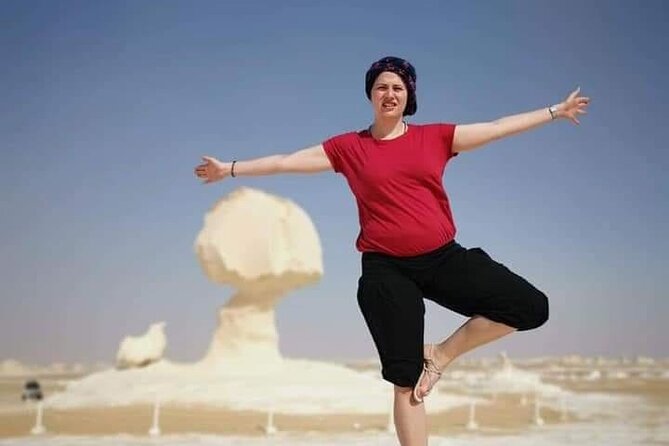
- Wind-Carved Stones: Mushroom, Horse, Chicken, Ice Cream
- Price and Value: What You’re Actually Paying For
- Who This Safari Fits Best (And Who Might Want Something Else)
- Should You Book the Tamer Safari Black and White Desert Overnight?
- FAQ
- What time does the tour start?
- Is pickup included?
- How long is the experience?
- Is this tour private?
- What language is the guide?
- Are entrance fees included?
- Does the tour include meals?
- Is there an overnight stay?
- What is not included in the price?
- Can I cancel for a full refund?
Key Highlights You’ll Feel Immediately
- A true overnight desert camp moment with hot mint tea around the fire and dinner that people remember
- Private, English-speaking guiding (Tamer Safari) instead of a mixed-language group scramble
- Black Desert volcanic hills for that dramatic, dark-rock contrast against surrounding sand
- Crystal Mountains quick-hit stop where quartz formations are the star attraction
- White Desert rock shapes you’ll recognize fast (mushroom, horse, chicken, and ice cream forms)
- Valley of Agabat towers with wind-carved limestone shapes and a golden-sand feel
Cairo to Bahariya Oasis: The Big Picture Setup
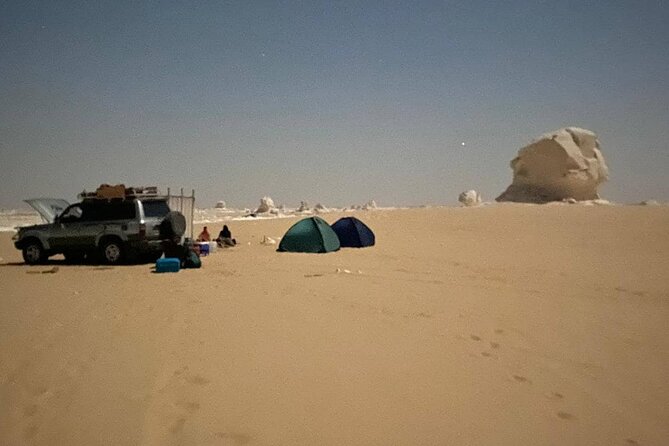
This is the kind of tour that trades comfort for time in places you can’t easily DIY. You’re starting in Cairo, then spending your limited two days in Egypt’s Western Desert regions around Bahariya Oasis. That matters, because the farther you go, the more the “trip” becomes the experience—driving, viewpoints, stops, and then a night under a real desert sky.
You start at 7:00 am, and that’s not a typo. Plan your energy like it’s an early training day, not a vacation slow-roll. The good news: once you’re out of city traffic, the rhythm of the day clicks into place. You’re not just chasing photos; you’re moving through distinct desert zones with different colors, rock textures, and formations.
The tour also includes pickup options via meet-and-greet service at the airport and transfers by a modern air-conditioned vehicle. That A/C part isn’t “luxury fluff” here—it’s the practical difference between tolerable long transfers and feeling beat before you even start exploring.
A few more Cairo tours and experiences worth a look


Black Desert First: El Haez Hot Spring and Volcanic Hills
Day 1 is about dramatic contrast. You head toward the Black Desert, a huge stretch of black volcanic rock and dunes between Bahariya Oasis and Farafra Oasis. The color contrast is the whole point: black hills and ridges sitting over sand, with a look that feels alien compared to the usual golden dunes.
A second detail I like here is that this isn’t just a single “look and leave” stop. The route includes a Bedouin village area at El Haez, along with a hot spring stop. Even if you don’t linger for long, it breaks up the day and gives you a more human desert rhythm than pure sightseeing stops.
From a value standpoint, the timing is sensible. You’re given time at the Black Desert to actually see how the rock changes across the dunes and flats (not just stare at one angle). Entrance is included, so you won’t get surprised by extra site fees once you’re out in the middle of nowhere.
Possible consideration: expect a fair amount of movement in one day. If you’re the type who likes long sit-down breaks between stops, Day 1 can feel like a lot. The trade-off is that you pack in the most visually different desert zones while there’s still daylight.
Crystal Mountains: Quartz Formations in a Fast, Useful Stop
Next comes the Crystal Mountains, which are famous for quartz crystals embedded in rock. The formation story is pretty wild: ancient geological activity pushed magma upward, and as it cooled, quartz formed in large quantities. Over millions of years, erosion and tectonic shifting exposed the crystal-bearing rock you’ll see today.
Here’s what’s practical: this stop usually works best if you treat it like a “photo + scan for details” break. You don’t need to be a geology major to appreciate it. You’ll notice the sparkle and the way the rock formations hold different crystal pockets—especially when sunlight hits at the right angle.
This is also a lunch stop in the flow of the day (lunch is included in the itinerary at this point). That matters because it prevents the classic desert safari problem: driving all morning, then searching for food with limited options.
The drawback? You may not get a long, slow walk here if the day is running on schedule. But that’s common on desert routes, where time is your main currency.
Valley of Agabat: Mushroom-Like Towers and Flower Stone
The next big visual stop is Valley of Agabat and the nearby flower stone area. This is all about limestone formations shaped over millions of years by wind and water erosion. The result is weirdly specific: shapes can resemble mushroom forms, towers, and other natural “characters” that make you want to point and say, okay, that one looks like something.
The chalk-white rock color against golden sand makes this spot feel like a natural sculpture garden—but without the crowds you’d expect from a “garden” anywhere else. It’s the kind of place where you’ll naturally stop more than once, not because you’re bored, but because you keep spotting new angles.
Entrance is included, so you can focus on walking slowly and spotting patterns rather than checking ticket steps. Time is also set aside here (it’s not just a one-minute pull-off).
One practical consideration: if you’re sensitive to sun, take shade seriously. Even though the tour includes bottled water during trips, you’ll still want to manage hydration and sun exposure like you would anywhere outdoors.
New White Desert Overnight: Dunes, Stars, and Campfire Mint Tea
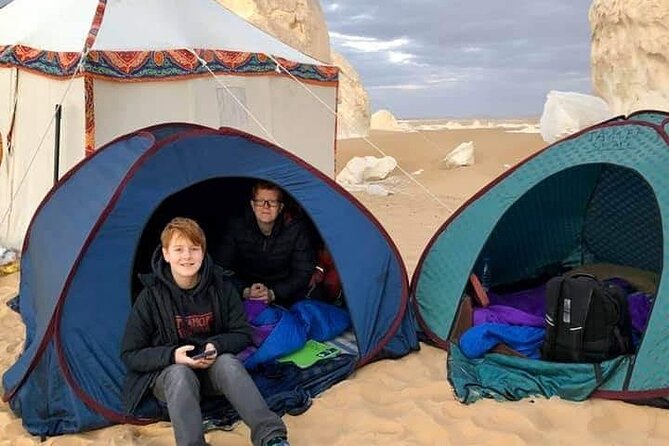
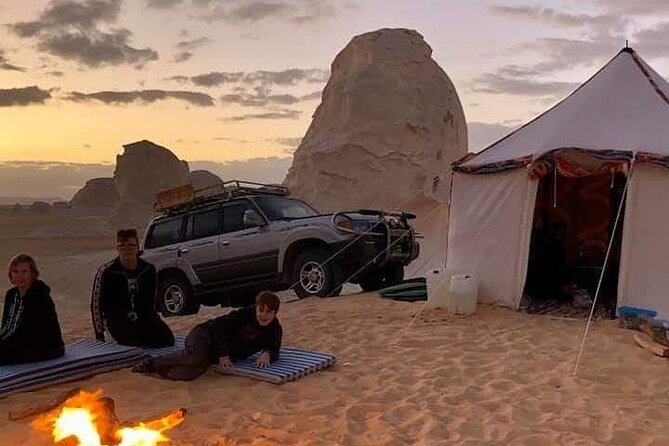
Then the trip moves into the White Desert area, and this is the part that turns the safari into a story you’ll tell later. The route goes to the new white desert first, then you camp for the night.
Why this overnight matters:
- During the day, you’re busy noticing rock shapes and dune textures.
- At night, the sky becomes the main event.
Deserts are known for strong stargazing because of typically low light pollution and clearer skies. And on this kind of overnight, you get the bonus of being close to the camp fire routine—hot mint tea, dinner, and a more relaxed pace after the long driving.
From the experience details, camp life is a highlight. People mention hot mint tea around the campfire under starry sky, plus dinner that’s genuinely satisfying (not just “something to eat so we can move on”). One review-style detail I’d treat as real-world planning: desert facilities can be basic, and privacy might involve stepping behind rocks for bathroom breaks. In other words, come prepared to keep things simple.
Also, don’t miss the evening vibe. There’s mention of local music instruments and singing, which can be a nice “culture meets camp” moment that isn’t staged like a show. It helps the night feel less like camping for the sake of it and more like camping because you’re actually enjoying the place.


Day 2 Morning in the Old White Desert: Wadi El Khiam and the Acacia Tree
After breakfast, you move from the new White Desert to the old white desert. This shift is useful because the “white desert” experience isn’t one single scene—it’s multiple zones with different rock character and dune geometry.
A key stop is wadi El Khiam, plus the old Acacia tree. This kind of landmark works well because it gives you scale and orientation. Without a tree, desert scenes can blend together. With it, you can suddenly map your brain: sand here, rock there, and that tree is your anchor point.
This is the part of the tour where the walking can feel more like exploration than endurance. You’re not doing huge hikes described in the data, but you will move enough to appreciate how the rock shapes sit in the sand and how wind-carved forms stand out.
And you’ll keep seeing the sculpted formations that people easily recognize.
Wind-Carved Stones: Mushroom, Horse, Chicken, Ice Cream
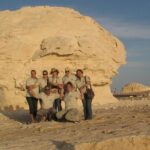
The final sightseeing time on Day 2 includes stones formed by wind effects that resemble shapes like mushroom, horse, chicken, and ice cream. This is one of those “you’ll know it when you see it” moments. Even if the forms aren’t perfect in every angle, your brain will connect the dots quickly—and that makes it fun.
The best way to enjoy these stops is to take a few steps, then stop and look again. From one spot they might feel like random rock shapes. From another angle, the silhouette sharpens and the shape name actually fits.
After that, you return toward Bahariya Oasis. That’s when the trip stops being a sequence of scenes and turns into transit again—longer in feel, but at least you’re heading back with the “I did it” feeling fully loaded.
Price and Value: What You’re Actually Paying For
At $516.13 per person for a roughly 2-day experience, this trip isn’t cheap, but it’s also not out of whack for what you get out in the Western Desert.
Here’s the value math, using only what’s stated in the package details:
- Private tours (not just a shared group bus)
- Private English-speaking tour guide
- Entrance fees included for the sites listed in the route
- Meals mentioned in the itinerary
- Bottle water during trips
- Air-conditioned modern vehicle transfers
- Accommodation in the area (and the route includes desert camping for the overnight night)
When you price desert safaris, the real cost isn’t just the “driver.” It’s the time, the guide, the logistics, and the fact that you’re paying for access to remote areas where everything takes more effort.
What you should note in your own budget:
- Entry visa to Egypt isn’t included.
- Personal spending and optional activities aren’t included.
- Tipping isn’t included.
If you’re comparing options, the big question isn’t whether you can find a cheaper ride. It’s whether you want a guided route that handles the day’s many stops smoothly while you’re focused on the formations, the camp routine, and the starry sky.
Who This Safari Fits Best (And Who Might Want Something Else)
This is a great fit if you want:
- A packed, high-impact Western Desert experience in only two days
- Private guiding with English support
- The overnight desert camp experience (tea by fire, dinner, and nighttime sky)
It may feel less ideal if you:
- Hate early wake-ups (the 7:00 am start is real)
- Prefer very slow travel with long downtime between stops
- Need high comfort standards for overnight desert basics (you’ll want to accept the reality of desert camping)
For couples and small friend groups, private guiding can feel like a perfect match: you move as a unit, get your timing adjusted, and don’t have strangers constantly cutting into your view line.
For families, it can work—most travelers can participate per the info—but the main factor will be whether everyone is okay with long drives and uneven terrain around natural formations.
Should You Book the Tamer Safari Black and White Desert Overnight?
If you want the Western Desert highlights in one trip—Black Desert volcanic hills, Crystal Mountains quartz, Valley of Agabat limestone towers, and a genuine White Desert overnight camp—this is an easy yes to consider. The strongest reason to book is that the experience is built around the big moments: guiding that keeps you moving well, campfire tea and dinner, and rock formations you’ll remember by name.
I’d only hesitate if early starts and a full schedule make you cranky, or if you’re expecting a fully hotel-style overnight. If you can handle a busy day and basic desert camping realities, you’re in the right place.
FAQ
What time does the tour start?
The start time is 7:00 am.
Is pickup included?
Pickup is offered, and there is a meet-and-greet service at the airport, with transfers by air-conditioned vehicle.
How long is the experience?
The duration is 2 days (approx.).
Is this tour private?
Yes. It’s listed as a private tour/activity, with only your group participating.
What language is the guide?
The tour includes a private English-speaking tour guide.
Are entrance fees included?
Yes. Entrance fees to the mentioned sites are included.
Does the tour include meals?
Yes. Meals mentioned in the itinerary are included.
Is there an overnight stay?
Yes. The route includes a night spent camping in the desert, and the package also lists accommodation in good hotels in the area.
What is not included in the price?
Not included are entry visa to Egypt, personal spending, optional activities, and tipping.
Can I cancel for a full refund?
Yes. Cancellation is free up to 24 hours in advance for a full refund.