REVIEW · CAIRO
Discover The Historical Mosques In Cairo
Book on Viator →Operated by Emo Tours Egypt · Bookable on Viator
Cairo’s mosques turn into a history lesson fast. This private tour strings together major sites—from Al-Azhar’s Fatimid roots to the Citadel and later Ottoman-era monuments—with an expert guide who makes the architecture make sense, not just look pretty. I like the hotel pickup and drop-off that keeps the day smooth, and I really like that entry fees are included so you can focus on the visit. One consideration: some stops are active places of worship, so access can pause around prayer times.
This is built as a steady 6-hour loop through central Cairo, with a private group and a modern A/C vehicle to handle the in-between time. In the best moments, the guide connects names, dates, and building choices so you leave seeing patterns instead of a random list of buildings. It’s also a spiritual pace at times—quiet, respectful, and calming—so it suits people who want something deeper than the usual monuments-and-pics schedule.
If you want Cairo’s Islamic side with clear structure and no fuss, this one fits. And if you’re traveling with family, the “all transfers included” setup helps keep kids (and adults) from getting stuck in logistics.
In This Review
- Key highlights you’ll feel during the tour
- A Cairo mosque timeline you can walk through in one morning
- Price and value: what $45 covers (and what you save)
- How the 6-hour flow stays easy: pickup, pacing, and a private group
- Al-Azhar Mosque: the 970 founding that shaped Cairo
- Sultan Hassan Mosque-Madrasa: massive scale in a tight downtown setting
- Cairo Citadel: Saladin’s fortress and 700 years of rule
- Mosque of Amr ibn al-As: the first major mosque in Egypt
- Muhammad Ali Mosque (Alabaster Mosque): the Ottoman-era finish
- Al-Rifa’i Mosque: a 19th-century counterpart across from Sultan Hassan
- What your guide actually adds: names, faith, and building meaning
- Who this tour is best for (and who might want something else)
- Booking this: the practical takeaway for your day in Cairo
- Should you book Discover The Historical Mosques in Cairo?
- FAQ
- How long is the tour?
- What does the price include?
- Is lunch included?
- Do I need to buy admission tickets on my own?
- Is transportation included?
- Is the tour private?
- Are bottled drinks provided?
- Which mosques and sites are included?
- Are there any known timing considerations at the mosques?
- What is the cancellation policy?
Key highlights you’ll feel during the tour
- Private A/C vehicle for transfers so the day stays comfortable
- Entry fees included across the main mosque stops
- Al-Azhar (built 970) for an early peak into Cairo’s role in learning
- Sultan Hassan (1356–1363) for scale and architectural ambition
- Cairo Citadel for the seat of power viewpoint over Cairo
- Bottled water included so you’re not hunting for hydration mid-day
A Cairo mosque timeline you can walk through in one morning
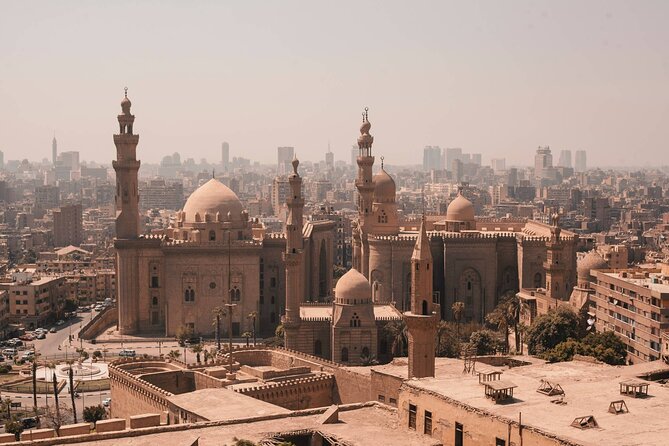
What I like about this tour plan is that it doesn’t treat mosques like isolated photo stops. You’re guided through a timeline of Cairo’s Islamic eras, in an order that helps your brain organize what you’re seeing.
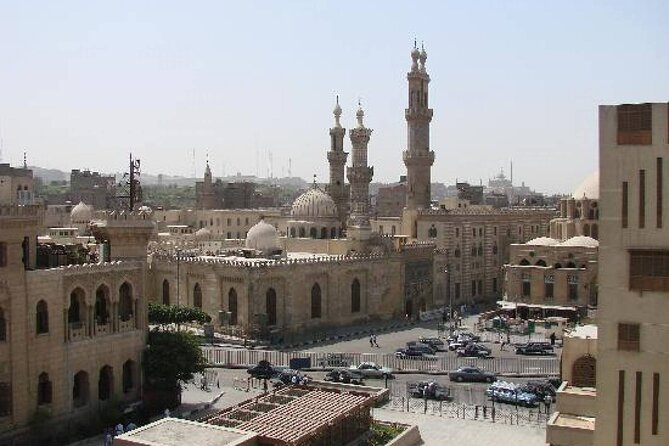
You start with Al-Azhar Mosque, commissioned for the Fatimid capital in 970, and known as one of Cairo’s earliest major landmarks of Islamic learning. Then you move into the Mamluk period with Sultan Hassan (built 1356 to 1363), and later you reach the Citadel area—where centuries of rulers used the same strategic hilltop. The last stops bring in Ottoman-era and 19th-century monumental styles, so the day ends with a different feel than it began.
That arc matters. If you’re new to Cairo, it’s easy to feel like every building is just “old.” This tour helps you see how power, education, and architecture changed over time.
You can also read our reviews of more historical tours in Cairo
Price and value: what $45 covers (and what you save)
At $45 per person for about 6 hours, the value is mostly about friction removed. You’re paying for a package: private A/C transfers, a tour guide, bottled water, and the entry fees. Those are exactly the pieces that usually add up when you try to DIY.
If you’re comparing to buying separate entry tickets and arranging transport on your own, this package reduces the annoying parts:
- You don’t have to figure out who gets you where, in what order, and for how long.
- You don’t have to negotiate admissions at each stop.
- You get a guide to translate what you’re seeing into something you can actually understand.
Also, the tour is booked often enough that there’s momentum behind it (on average, people book about 9 days in advance). If your schedule is tight, that usually means you can find a slot without overthinking it.
How the 6-hour flow stays easy: pickup, pacing, and a private group
This is not a long-day marathon. It’s organized as a structured circuit with hotel pickup and drop-off, plus private transfers by a latest-model A/C vehicle.
Because it’s private and “only your group will participate,” you aren’t stuck listening to a loud mix of languages and attention spans. That matters in religious spaces, where timing and quiet respect count.
The tour includes time at each main site—think around 1 hour at Al-Azhar, about 30 minutes at Sultan Hassan and a few other major mosques, and about 1 hour for the Citadel. That pacing is a good middle ground: enough time to notice details, not so much time that you feel stuck.
And yes, bottled water is included. It’s a small thing, but it keeps you from breaking the flow to buy something mid-route.
Al-Azhar Mosque: the 970 founding that shaped Cairo
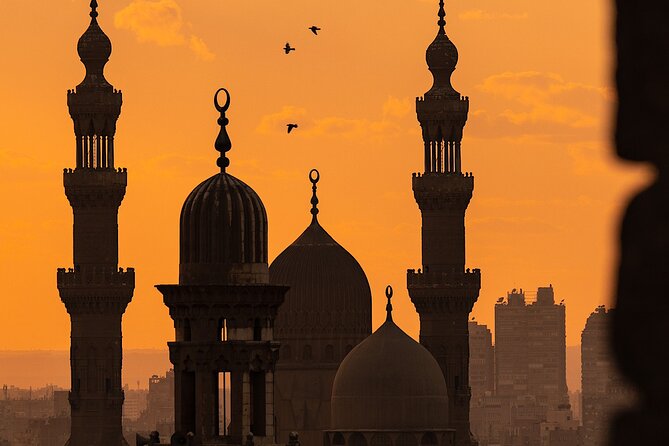
Al-Azhar Mosque is often called al-Jāmiʿ al-ʾAzhar, or simply al-Azhar in Egypt, and it’s strongly tied to Cairo’s Fatimid era. The mosque was commissioned by Al-Mu’izz li-Din Allah for the newly established capital city in 970, which makes it one of the earliest major anchors of Islamic Cairo.
What I like about starting here is that Al-Azhar gives you context for everything that comes later. You’re not just looking at a beautiful mosque; you’re seeing a building connected to the early growth of learning and religious authority in Cairo. The name itself is commonly associated with az-Zahrāʾ, a title connected to Fatimah, which adds a layer of meaning beyond the architecture.
Practical note: this stop runs about an hour, so you’ll have time to see both the bigger overview and more focused details without feeling rushed.
Sultan Hassan Mosque-Madrasa: massive scale in a tight downtown setting
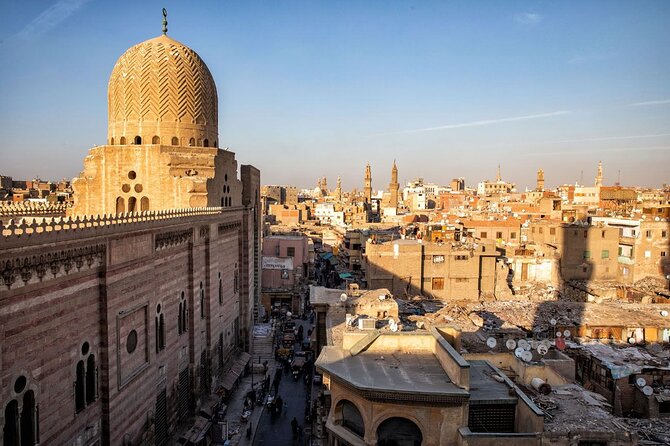
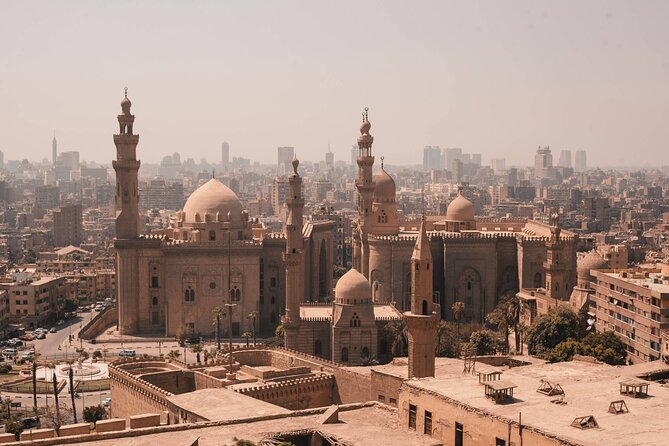
Next comes the Mosque and Madrasa of Sultan Hassan, one of Cairo’s most imposing monuments. It was built between 1356 and 1363 during the Bahri Mamluk period, commissioned by Sultan an-Nasir Hasan.
This one is about scale and design choices. The monument is described as monumental, with innovative architectural components for its time, and it’s still considered one of Cairo’s most impressive historic structures.
Why it works on a tour: you get a strong “wow” moment early enough that the rest of the day doesn’t feel repetitive. Also, a mosque-madrasa combo helps you remember that these weren’t only places of worship—they were places of education and social importance.
This stop is shorter (about 30 minutes), so I’d treat it like a focused visit. Go for understanding: look at the size first, then let the guide connect the dots.

Cairo Citadel: Saladin’s fortress and 700 years of rule
The Citadel of Cairo—also called the Citadel of Saladin—is a medieval Islamic-era fortification built by Salah ad-Din (Saladin) and expanded by later Egyptian rulers.
The big idea here is political control and strategy. The Citadel sits on a promontory near the Mokattam hills, and its position dominates Cairo’s skyline. For nearly 700 years—from the 13th to the 19th century—it served as the seat of government and residence of rulers.
This stop is about perspective. Even if mosques are the theme, you need this “power base” piece to understand why certain religious monuments ended up with certain levels of importance and investment. You’ll also find mosques and museums within the preserved site, so it’s not just one building you pass by.
Plan for about an hour here, which is enough to get your bearings and absorb the bigger story from the location.
Mosque of Amr ibn al-As: the first major mosque in Egypt
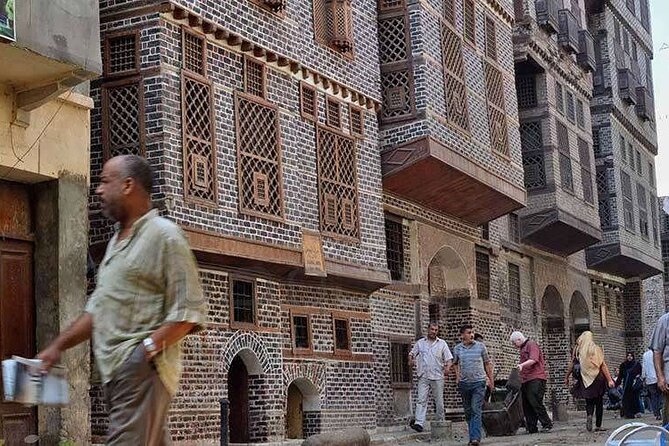
If you want a true anchor point for Islamic Cairo, the Mosque of Amr Ibn Al-As matters. It was built in 641–642 AD as the center of the newly founded capital of Egypt, Fustat.
According to the tour information, it’s considered the first mosque ever built in Egypt—and even the first in all of Africa. That’s a big claim, and it’s exactly why this stop is such a useful milestone on the timeline.
This mosque also reflects how old structures get rebuilt. Extensive reconstruction over the centuries means nothing of the original building remains, but the rebuilt mosque still serves as a prominent landmark in what’s now known as Old Cairo.
One practical consideration is right in the description: it’s an active mosque with a devout congregation. When prayers are not taking place, it’s open to visitors and tourists. So if timing is tight that day, you may find that the schedule depends on prayer moments.
Expect about 30 minutes. Use that time to focus on the landmark feel and the guide’s explanation of why the location matters—linked to the commander Amr ibn al-As.
Muhammad Ali Mosque (Alabaster Mosque): the Ottoman-era finish
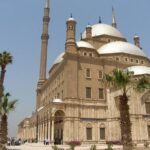
Then you reach the Mosque of Muhammad Ali, widely associated with the name Alabaster Mosque because its outer walls are covered by alabaster stone.
Even without getting lost in technical terms, you can feel the difference at this stop. Later monuments often look like they’re designed for grand visibility and lasting presence, and this one fits that idea.
This stop is about 30 minutes, so it’s best treated as a visual highlight paired with interpretation from the guide—what changed stylistically and why this era wanted a monumental look.
If you love the story of “how styles evolve,” this is a good checkpoint on the route.
Al-Rifa’i Mosque: a 19th-century counterpart across from Sultan Hassan
Al-Rifa’i Mosque comes after Sultan Hassan, and it’s positioned opposite the older Mosque-Madrassa. The tour notes that the building was conceived as a complement to Sultan Hassan, part of a larger 19th-century campaign by Egyptian rulers to connect themselves with earlier Islamic glory and modernize the city.
That’s why the placement matters. Facing the older monument creates a conversation across time: older scale and tradition on one side, later monumental ambition on the other.
This stop is about 30 minutes, so keep your mindset simple—look at the framing of the two monuments and let the guide explain the intention behind the pairing.
What your guide actually adds: names, faith, and building meaning
The guides are a major part of the experience, and names like Salua, Youssef, and Mahmoud Afifi show up in positive notes. The common thread is clarity: the guide doesn’t just point and describe, they explain historical significance and architectural choices in a way you can actually remember.
One extra detail from the on-the-ground experience: on some days, a guide like Youssef may add nearby churches and even a synagogue if there’s time and they’re close. That’s not guaranteed in every case, but it shows the tour approach can flex when there’s room.
If you care about more than architecture—if you care about how multiple faith communities lived side by side in Cairo—having a guide who can contextualize that makes the day feel less like a checklist.
Who this tour is best for (and who might want something else)
This tour is ideal if you:
- Want a guided, chronological walkthrough of major Islamic Cairo sites
- Prefer private comfort with hotel pickup and drop-off
- Like your history connected to real buildings, not just dates on a page
- Travel with family and want a structured plan that avoids guesswork
You might consider a different style if you:
- Want long unstructured time inside each site, with no schedule pressure
- Are sensitive to changes caused by prayer times at active mosques
Given the time limits per stop, it’s a good “see the key monuments, understand them, move on” kind of tour.
Booking this: the practical takeaway for your day in Cairo
If you’re deciding between a DIY day and a guided circuit, I’d choose the guided version for this particular theme. Mosques in Cairo aren’t just landmarks. They’re living religious spaces, and understanding what you’re looking at makes a big difference.
Also, the tour includes the entry fees up front, so you avoid the common “surprise costs” feeling that can happen with multi-stop itineraries.
Bring whatever you normally use for comfort in Cairo—especially if you’re sensitive to sun or heat. Bottled water is provided, but you still control your own comfort level.
Should you book Discover The Historical Mosques in Cairo?
Yes, if you want Cairo’s Islamic architecture with an organized plan, private transport, and the key stops covered without the usual hassle. The best part is the combination of entry fees included, hotel pickup/drop-off, and a guide who helps the buildings connect to the wider story of power and learning in Cairo.
Skip it or look for another option if you’re expecting lots of free time per site, or if your ideal day is purely photo-based with minimal explanation. Active mosques can also shift access depending on prayers, so it’s better if you’re flexible and respectful of the schedule.
If your goal is to leave Cairo with a clearer mental map—Fatimid learning, Mamluk grandeur, citadel power, and later monumental expressions—this tour is a smart way to do it in about half a day.
FAQ
How long is the tour?
The tour lasts about 6 hours.
What does the price include?
Entry fees, hotel pickup and drop-off, private A/C transfers, a tour guide, and bottled water are included. The price is listed as $45.00 per person.
Is lunch included?
No. Lunch at a local restaurant (koshari) is optional and not included.
Do I need to buy admission tickets on my own?
No. Admission tickets are included for the mosque and site stops listed.
Is transportation included?
Yes. You get transfers by private A/C equipped, latest model vehicles.
Is the tour private?
Yes. This is described as a private tour/activity, so only your group participates.
Are bottled drinks provided?
Yes. Bottled water is included during the tour.
Which mosques and sites are included?
The tour includes Al-Azhar Mosque, the Mosque and Madrasa of Sultan Hassan, Cairo Citadel, Mosque of Amr ibn al-As, Mosque of Muhammad Ali, and Al-Rifa’i Mosque.
Are there any known timing considerations at the mosques?
Mosque of Amr ibn al-As is described as an active mosque with prayers. It is open to visitors when prayers are not taking place.
What is the cancellation policy?
Free cancellation is available up to 24 hours in advance for a full refund.