REVIEW · CAIRO
Private Day Tour To Giza Pyramids, Memphis and Sakkara
Book on Viator →Operated by Egypt Tours Online · Bookable on Viator
Three ancient stops, one well-planned day. This private tour strings together Giza’s pyramid world, Memphis, and Saqqara with an Egyptology-trained guide and hotel-to-site transportation that keeps the day moving.
What I like most is the way it handles logistics for you with hotel pickup and drop-off, plus the storytelling focus that comes from the guide’s Egyptology education.
One thing to weigh: the schedule includes timed stops at craft and product places, and a few reviews hint that some guides can spend more time shopping than you might want, especially at Giza.
In This Review
- Key highlights before you go
- How an 8-hour private loop hits Giza, Memphis, and Saqqara
- Why this routing works
- Hotel pickup and driver time: the real luxury in Cairo
- A small timing reality
- Giza Pyramid Complex: the Great Pyramid, Khafre, Menkaure, and what to watch for
- Stop-by-stop: how to use your time
- What can go wrong at Giza
- Great Sphinx and the view logic at the plateau
- A practical way to enjoy it
- Memphis and its Necropolis: why this city still matters
- What to expect in an hour
- Saqqara: Step Pyramid of Zoser plus Unas, Teti, and the Mastaba of Ti
- The Step Pyramid of Zoser (about 1 hour)
- Pyramid of Unas (about 30 minutes)
- Pyramid of Teti (about 30 minutes)
- Mastaba of Ti (about 30 minutes)
- The built-in craft stops: fun if you want them, a distraction if you don’t
- Price and value: what the $8 headline really buys you
- Guides that can make the day: names to look for
- Who this tour fits best (and who should rethink it)
- If you’re a history purist
- Should you book this private Giza–Memphis–Saqqara day trip?
- FAQ
- FAQ
- What time does the day tour start?
- How long is the private tour?
- Are entry fees included for the pyramids and other sites?
- Is lunch included?
- Does the tour include stops for shopping or crafts?
- Can I get a full refund if I cancel?
Key highlights before you go
- Hotel pickup and drop-off from Cairo or Giza so you start with less hassle and more sight time.
- Egyptology-style guiding that helps you connect the pyramids, Sphinx, and Old Kingdom sites into one story.
- A practical Giza plan with time at the main complex, then quick-but-focused looks at Khufu, Khafre, Menkaure, and the Sphinx.
- Memphis + Saqqara in one sweep, which is great if you only have a short window in Cairo.
- Optional shopping stops built in (perfume/cotton, papyrus making, and rug weaving) that can cut into time if you want maximum ruins time.
- Strong value on paper, but entry fees and any inside-pyramid access are extra.
How an 8-hour private loop hits Giza, Memphis, and Saqqara
This is the kind of day trip that makes sense when Cairo time is tight. You leave at 8:00 am and run about 8 hours, visiting three major archaeological zones that most people either cram together on their own or skip because it feels too complicated.
The big advantage is that the trip is private, meaning it’s just your group. That matters at Giza and Saqqara, where you’ll want different things: some people want the camera moments, others want to understand why each pyramid sits where it does and what it was for.
You can also read our reviews of more private tours in Cairo

Why this routing works
Doing Giza first gives you the most iconic views while the day is still young. Then the pace shifts from giant Old Kingdom monuments to Memphis, and finally to Saqqara’s evolving pyramid story. It’s a nice “from famous to deeper cuts” rhythm if you like seeing how ideas changed over time.
Hotel pickup and driver time: the real luxury in Cairo
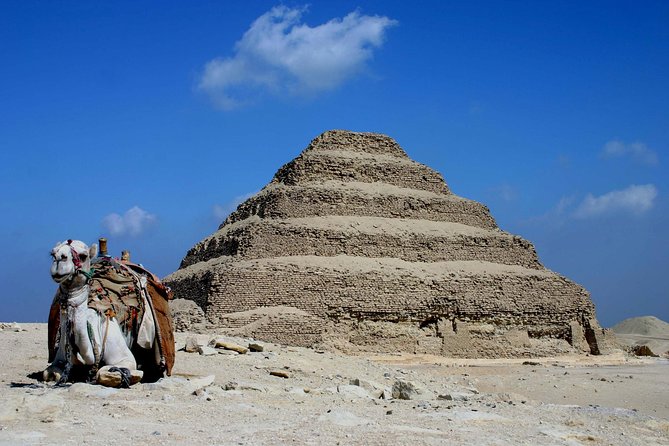
Cairo traffic can turn a simple day into a headache. Here, you get hotel pickup and drop-off and provided transportation so you can focus on the day instead of the commute.
Pickup is offered from either Cairo or Giza, which is helpful if you’re staying outside the busiest areas. You’ll also get bottle water during the trip, and that small comfort adds up when you’re out for most of the day.
A small timing reality
The day is packed by design: you’re out from the morning until after the Saqqara portion. That can be great, but it also means you’ll want to keep your own needs simple—water, sunscreen, and a plan for bathroom breaks—so the guide can keep moving.
Giza Pyramid Complex: the Great Pyramid, Khafre, Menkaure, and what to watch for
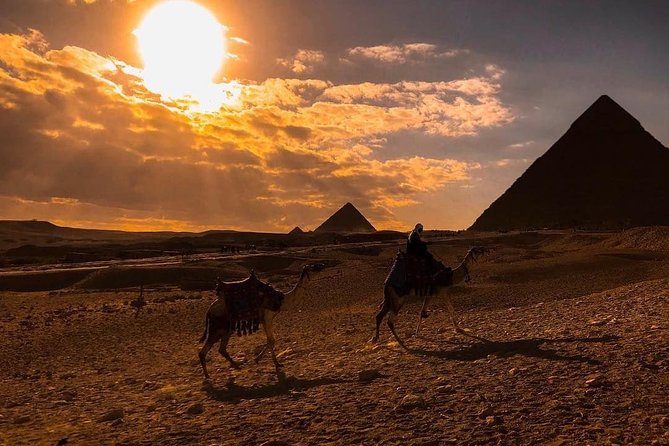
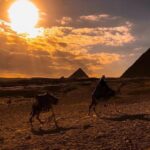
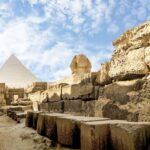
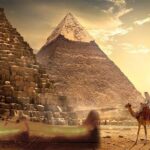
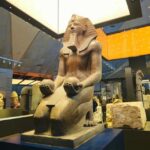
The Giza portion starts at the Giza Pyramid Complex, also called the Giza Necropolis, which sits on the Giza Plateau. This area includes the Great Pyramid of Giza, the Pyramid of Khafre, the Pyramid of Menkaure, and the Great Sphinx of Giza, along with related pyramid complexes, cemeteries, and even remains of a workers’ village.
It’s built during the Fourth Dynasty of the Old Kingdom, so your guide will typically frame what you’re seeing as part of a whole system—not just three big monuments.


Stop-by-stop: how to use your time
You’re given enough structure to see the highlights without wandering in circles:
- Giza Pyramid Complex (about 2 hours)
This is your main window. I’d treat it like your base session: look outward first, then zero in. It’s the best time to understand how the Great Pyramid, Khafre’s pyramid, and Menkaure’s pyramid relate to each other—and where the Sphinx fits into the wider layout.
- Great Pyramid of Cheops (Khufu) (about 30 minutes)
You get a focused look at Khufu’s complex, including the note that its valley temple is now buried beneath the modern village of Nazlet el-Samman. Even if you can’t see everything close-up, it helps to know what’s underfoot.
- Khafre’s Pyramid (about 30 minutes)
Khafre’s complex is described as including a valley temple and other structures. The details about statues found in a well (mentioned as having been found by Mariette in 1860) are the kind of info that makes your photos more than just photos.
- Menkaure Pyramid (about 30 minutes)
Menkaure’s complex includes valley and mortuary temples and later additions like a smaller ante-temple. This is where a guide’s explanations really help: you start noticing that these aren’t identical boxes stacked in the desert—they’re evolving royal projects.
- Gizeh Plateau (about 30 minutes)
This is the broader “stage” view. The plateau is part of the UNESCO Pyramid Fields area, and it’s elevated about 60 meters above sea level. It’s short, but it’s useful if you want to understand why the setting is so dramatic.
What can go wrong at Giza
Your biggest potential disappointment isn’t the pyramids—it’s time allocation. Several experiences point to a common issue on these day trips: some guides spend too long at stops designed for sales.
At Giza specifically, if your priority is ruins time, ask early for a slower pace at the monuments. One guide can absolutely make or break this part of the day.
Great Sphinx and the view logic at the plateau
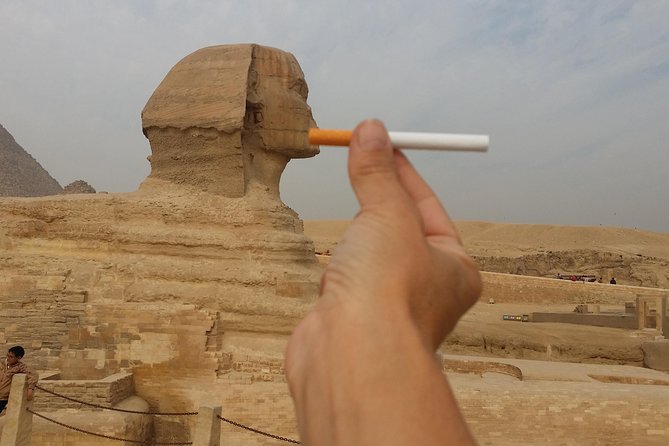
The Great Sphinx stop is listed at about 30 minutes, and the Sphinx temple area is noted as free. That’s good news because it reduces one source of surprise cost.
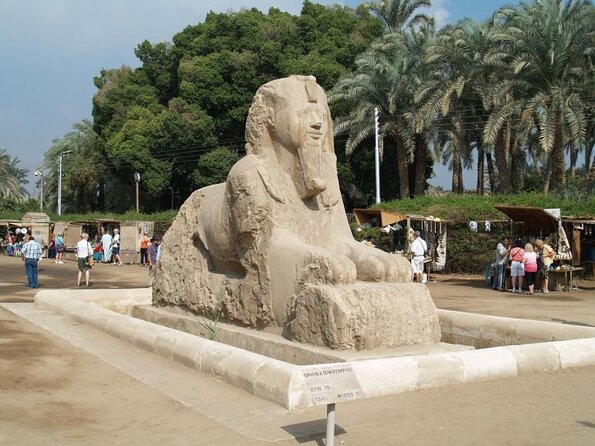
The key bit for understanding what you’re looking at: the Sphinx is dated to the reign of king Khafre, and later rulers dedicated or added structures in different periods. So when you look at it, you’re seeing an Old Kingdom monument that attracted attention for centuries afterward.
A practical way to enjoy it
In a short time, your eyes need a job. I’d focus on three things: the face proportions, the surrounding temple idea, and the wider desert setting. With the plateau context in your head, the Sphinx stops feeling random.
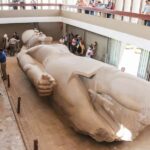
Memphis and its Necropolis: why this city still matters
Next comes Memphis, and you get about 1 hour. Even though it’s not the same scale as Giza, this stop helps connect the dots. Memphis matters because it’s tied to the role of the city and its surrounding necropolis—so you don’t just leave with three pyramids and a Sphinx picture.
The tour notes that you’ll visit Memphis City, and the time box means you won’t be there all day. But it’s a solid “place it on the map” stop, especially if you’re pairing it with Saqqara later.
What to expect in an hour
Plan for quick orientation: where this fits in Egypt’s larger story, what you’re seeing relative to the burial landscape around it, and how royal building and culture changed over time. If your guide is strong here, you’ll get a sense of the human geography behind the stones.
Saqqara: Step Pyramid of Zoser plus Unas, Teti, and the Mastaba of Ti
Saqqara is where the day starts to feel more like an archaeological lesson. You’ll visit multiple sites—some with pyramids, some with mastabas—so you can see the evolution from simpler forms toward the more recognizable pyramid shape.
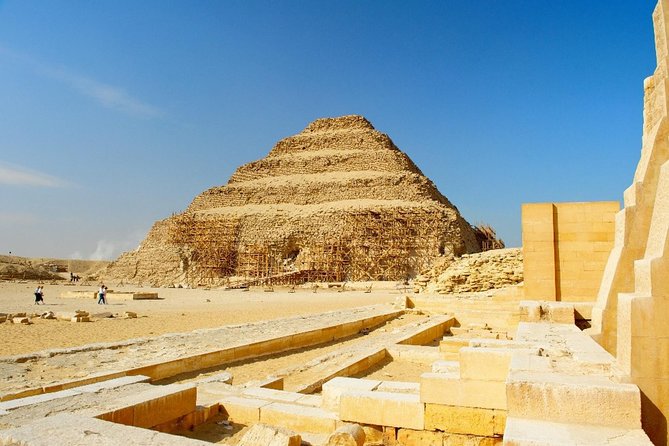
The Step Pyramid of Zoser (about 1 hour)
This is the highlight chunk at the end of your day: the Step Pyramid, built for king Zoser. It’s described as an important part of how pyramids evolved, moving from simpler mastabas toward the later “true pyramid” form.
If you want one takeaway from the Saqqara part, it’s this: Saqqara isn’t just another stop. It’s a key moment in architectural development.
Pyramid of Unas (about 30 minutes)
You also stop at the Pyramid of Unas for about 30 minutes. The description emphasizes the idea of exploring the chambers and corridors, which is exactly what you want to do if your guide can explain what Unas represented in the broader Old Kingdom timeline.
Pyramid of Teti (about 30 minutes)
The Pyramid of Teti gets another 30-minute block. The focus here is on exploring the pyramid’s internal spaces and the historical significance. Even if your time is limited, a guide can help you notice what’s different about each ruler’s complex.
Mastaba of Ti (about 30 minutes)
The Mastaba of Ti is a great contrast stop: it’s not just a royal pyramid. It’s one of the important archaeological sites of Saqqara and includes two serdabs. The tomb walls show scenes of everyday life, and it’s noted as having been discovered by Auguste Mariette.
This is the kind of detail that turns a quick visit into something memorable because it shows people, not only kings.
The built-in craft stops: fun if you want them, a distraction if you don’t
One of the most helpful parts of the tour details is that it spells out the shopping element. You’ll make about 20-minute stops at places such as:
- Paradise Perfumes & Flower Cotton (natural oils and soft Egyptian cotton)
- Key of Life Papyrus (papyrus making and traditional artwork)
- Handmade Carpets (hand-weaving rugs)
I don’t think these stops are automatically bad. If you like watching craft processes—like papyrus making—you can get something educational out of it. Cotton and perfume can also be interesting as a cultural snapshot.
But here’s the balancing act: if you’re serious about spending every minute at the monuments, the sales-style pacing can steal your focus. One pattern that shows up in experiences is guides being more product-focused than history-focused, especially around Giza. If that’s your concern, say so gently at the start. A private setup gives you more leverage than a big group bus.
Price and value: what the $8 headline really buys you
The listed price is $8.00 per person, but the important part is what it does and does not include.
- Included: hotel pickup and drop-off, private tour, and bottle water
- Not included: entry fees (and inside any of the pyramids), plus lunch if you want it
- Also noted: entry fees cover basic area only, which means you should expect extra costs if you want more access
So is it a steal? For the experience of long-distance transport, a private day structure, and organized guiding, it can be excellent value—especially if your main goal is to see multiple UNESCO-level sites in one push.
But don’t let the low headline price trick you into thinking everything is covered. Plan for monument tickets and any “inside” access you care about. Also remember: if you want an Egyptology-style guide, the tour describes that as part of the experience, but the guide can show as optional in the pricing breakdown. Clarify what you’re paying for before you go.
Guides that can make the day: names to look for
One of the best signs for a trip like this is consistent guide quality. Names mentioned include Mohammad, Nahed, Salwa, Ahmed, Gabri (Italian-language guide noted), and Mahmoud. Drivers such as Waheed are also credited for making the day feel easy and well run.
When you read those kinds of comments, the practical takeaway is this: request a guide known for clear explanations and a calm pace if you can. In a day where time is tight, the guide’s style matters as much as the sites.
Who this tour fits best (and who should rethink it)
This tour fits best if you want a guided hit list with transportation and a private pace, and you don’t want the stress of planning the routing yourself across Giza, Memphis, and Saqqara.
It’s also a strong choice if you care about structure: the pyramids are time-boxed, Memphis is short, and Saqqara gives you the evolution angle via Zoser’s Step Pyramid and more specific Old Kingdom sites like Unas, Teti, and Ti.
If you’re a history purist
If your only goal is deep archaeological time at each site, you might feel rushed. The schedule includes multiple short stops, plus factory-style craft visits. In that case, you’ll want to manage your expectations or choose a format with longer time at fewer sites.
Should you book this private Giza–Memphis–Saqqara day trip?
I’d book it if you want the big landmarks without the Cairo planning headache. The private hotel pickup, the Egyptology-style guidance, and the day’s routing make it a good solution for short stays. The timing is also friendly if you want to see all three zones without hopping tours.
I’d hesitate if you know you hate shopping stops or you need long, quiet ruins time. In that case, ask for a history-first pace at Giza and Saqqara, and decide in advance whether papyrus making, cotton/perfume, and rug weaving are “nice to have” or time thieves for you.
If you can get your guide to keep the monument time front and center, this is the kind of day that turns Cairo into a real ancient Egypt sampler—minus the stress.
FAQ
FAQ
What time does the day tour start?
It starts at 8:00 am.
How long is the private tour?
The duration is about 8 hours.
Are entry fees included for the pyramids and other sites?
No. Entry fees are not included and access inside any of the pyramids is also not included. The notes say entry fees cover basic area only.
Is lunch included?
Lunch is listed as optional, so it’s not included. You can have lunch at places like koshari if you choose.
Does the tour include stops for shopping or crafts?
Yes. The schedule includes around 20-minute stops at places such as Paradise Perfumes & Flower Cotton, Key of Life Papyrus, and Handmade Carpets.
Can I get a full refund if I cancel?
Yes. You can cancel for a full refund if you cancel at least 24 hours before the experience’s start time.