REVIEW · CAIRO
Giza Pyramids, Sphinx and Egyptian Museum tour
Book on Viator →Operated by Egypt Day Tours · Bookable on Viator
Giza in one day beats the usual Cairo shuffle, and this tour is built around smart timing and real expert context. I like that you get hotel pickup plus a guided route, so you spend less time figuring out logistics and more time seeing the Great Pyramid of Giza. One thing to keep in mind: admission tickets are not included, so factor that cost into your day.
What I really enjoy is the pacing that matches what you’re looking at. You start indoors at the Museum of Egyptian Antiquities, then move outside to the Sphinx and pyramids, which helps everything click: artifacts first, monuments second. If you’re the type who loves explanations as you walk, you’ll feel well looked after by the Egyptologist guide—and the best-known local guides in this style (like Hesham and Amir Fawzy) are often praised for staying on schedule and adjusting to the group.
The main consideration is that you’ll be on your feet for several hours. With sun exposure, security lines, and photo stops, it’s not a sit-behind-the-window kind of outing. Comfortable shoes and a steady pace matter.
In This Review
- Key things to know before you go
- Why pairing Giza Pyramids with the Egyptian Museum makes sense
- Hotel pickup and the Egypt Day Tours day plan (what to expect)
- Museum of Egyptian Antiquities: where the day’s clues begin
- From Sphinx to Valley Temple: seeing Khafra’s monument with context
- Giza Pyramids: how the story clicks when you see them up close
- Time on your feet, sun, and what to pack for this 7–8 hour day
- Price and value: is $50 per person a smart deal?
- Who this tour suits best (and who should consider other options)
- Should you book this Giza and Egyptian Museum tour?
- FAQ
- How long is the Giza Pyramids, Sphinx and Egyptian Museum tour?
- Is hotel pickup and drop-off included?
- Are admission tickets included for the museum and the sites?
- What will I see at the Egyptian Museum?
- What stops are included at Giza?
- Is there an Egyptologist guide?
- Is this tour private or shared with other groups?
- What is the dress code?
- What is the cancellation policy?
- Do I need to reconfirm pickup?
Key things to know before you go
- Egypt Museum first so the Tutankhamun highlights make instant sense before you hit the Giza plateau
- Qualified Egyptologist guide with on-the-ground commentary at each major stop
- Air-conditioned minivan with round-trip hotel pickup and drop-off from Cairo
- Great Sphinx + Valley Temple included, then an easy-to-use panorama photo area
- Mobile ticket convenience, plus group-only participation for your group
- Admission not included, so you’ll budget separately for museum and site entry
Why pairing Giza Pyramids with the Egyptian Museum makes sense

Cairo can feel like information overload. This combo helps you avoid the common problem: seeing the pyramids first, then trying to decode artifacts later. Starting with the Egyptian Museum of Cairo gives you a foundation you can carry to Giza. When you finally look up at the pyramids, you’re not just admiring giant architecture—you’re connecting it to what pharaohs valued, built for, and preserved.
You also get a smooth flow from indoor objects to outdoor monuments. The Egyptian Museum’s displays are designed to teach by showing. Later, the Sphinx and pyramids become illustrations you can see in real scale. That switch from glass cases to stone is a big part of why this tour feels satisfying rather than rushed.
And because you’re with a guide, you get help turning big names into clear stories. You’ll hear how pyramids were built and what they were meant to hold. You’ll also get context for the Sphinx and the Valley Temple, which often get skipped on shorter tours.
You can also read our reviews of more museum experiences in Cairo


Hotel pickup and the Egypt Day Tours day plan (what to expect)

This runs as a private tour/activity for your group, with round-trip transportation in an air-conditioned modern minivan. That matters in Cairo, where moving across the city can eat up energy fast. Having pickup also helps if you’re staying in a hotel where getting to sights on your own means extra waiting and bargaining.
The day is listed as about 7 to 8 hours, which is a realistic full-day window for museum time plus Giza time. You’ll want to treat it like a planned outing, not a hop-on-hop-off stop. I recommend you think about your day in blocks: museum time, outdoor time, then photo time.
One practical note: pickup may require reconfirmation after booking. Your voucher should tell you exactly what to confirm and when. If you hate last-minute surprises, set a reminder right after you book so you don’t miss the pickup confirmation step.
Museum of Egyptian Antiquities: where the day’s clues begin
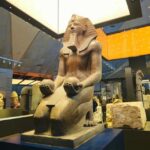
Your first major stop is the Museum of Egyptian Antiquities. This museum is huge in collection size—around 120,000 artifacts—and that scale alone is a reason to go with a guide. Without one, it’s easy to wander for hours and still leave without the key connections.
What you’re likely to care about most here is how the museum turns ancient Egypt into a set of vivid, touchable stories. The highlights include the big-name Tutankhamun objects. In particular, you’ll have the chance to see Tutankhamun’s golden death mask, which is often the emotional peak of the entire visit.
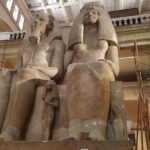
You’ll also see material that expands your understanding beyond one pharaoh. The museum houses an extensive collection of sarcophagi from different dynasties, and those pieces help you compare wealth, status, and burial practices across time. It’s not just spectacle—it’s evidence you can use to build a sense of how Egyptian society worked.
Some specific objects you should keep an eye out for during your visit:
- Narmer Palette, which connects early dynastic history to changing power
- Figurine of Khufu, linking directly to one of the pyramid builders
- Merneptah Stele, another name-heavy artifact that gives you historical anchors
- Grave Mask of King Amenemope
- Mummy mask of Psusennes I
The museum stop is listed at about 3 hours, which is enough time to see the museum’s most meaningful highlights without feeling like you’re sprinting. Still, 3 hours can feel fast if you’re drawn to everything. If you want the best payoff, plan to let the guide set the pace rather than trying to read every label.
If you get a guide with strong rapport, you may also get helpful side suggestions for the area, including quick local food breaks near the route. That’s the kind of thing that turns the day from sightseeing into real Cairo texture—without turning it into a messy detour.
From Sphinx to Valley Temple: seeing Khafra’s monument with context
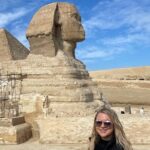
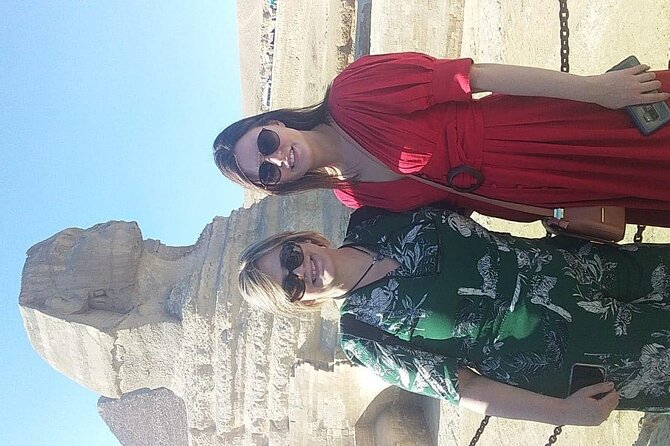
After the museum, the focus shifts to stone. The next stop is the Great Sphinx, associated with Khafra. The Sphinx is a huge architectural statue carved from stone, and the guide commentary is a big part of what makes it land.
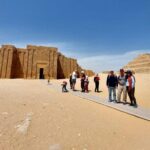
You’ll also visit the Valley Temple. This addition helps, because it frames the Sphinx in the larger pyramid complex story. Without that context, the Sphinx can feel like a standalone icon. With the temple context, it’s easier to understand why this area mattered so much.
Timing is short here—listed for about a minute in one place for the stop—but in practice your experience will be shaped by security checks, walking time, and how long you spend at the Sphinx. The more important part is what happens after: you’ll head to the pyramids panorama area for photo time, with pyramids and Sphinx in the background.
Bring your camera (and/or phone charger if you use a lot of flash photography). The panorama area is your chance to frame big views without constantly repositioning in the busiest zones. It’s a practical gift to your future self: photos that match what you just learned.
Giza Pyramids: how the story clicks when you see them up close
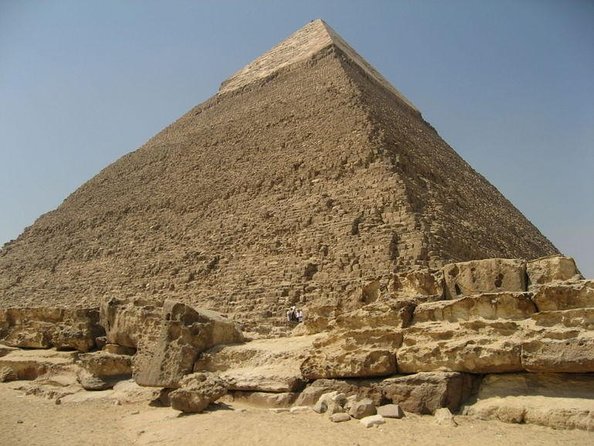
The final big site block is the Pyramids of Giza. This is the oldest of the ancient seven wonders and the only one still standing in the modern world. The guide will explain construction in terms you can picture with simple techniques, which is key. Giant objects are hard to understand unless someone translates them into human-scale steps.
You’ll learn what pyramids were mainly built to do: house the remains of deceased pharaohs. That theme is crucial. You’re not just looking at tomb-shaped stone mountains; you’re looking at structures that were designed for burial and for the afterlife beliefs of royal Egypt.
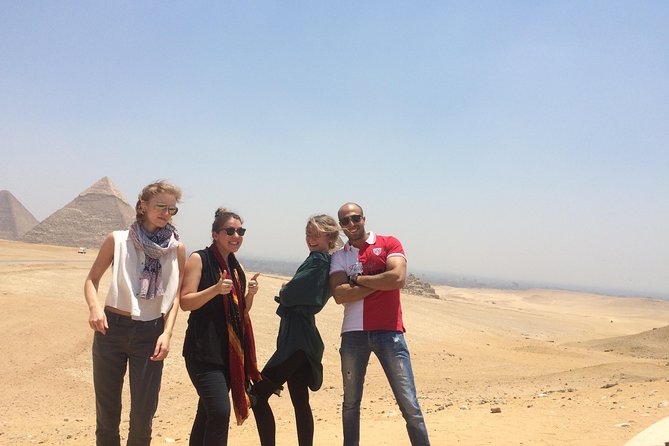
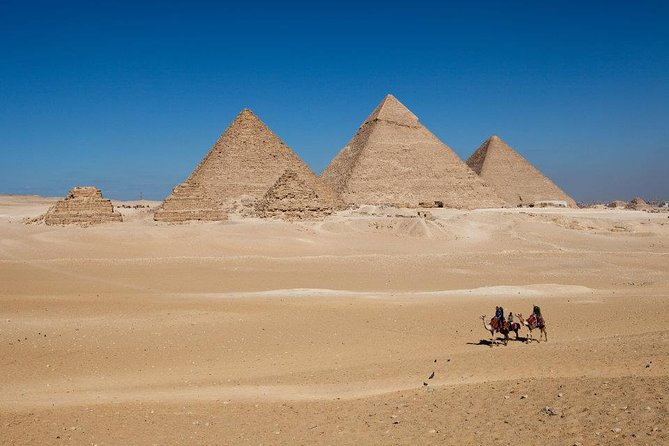
You’ll also get time to explore the pyramids site deeper with your guide. Exact access can vary depending on crowd flow and site rules, but the value of a guided walk is consistent: you’ll know what you’re seeing and why it mattered. Then you’ll shift to a panoramic view of all three pyramids, which is the classic payoff shot.
If you’re a detail person, this is where your museum knowledge starts working. You’ll recognize the kind of names and themes you heard earlier, and you’ll start connecting objects to monuments. That’s the best kind of travel learning: it doesn’t feel like homework—it feels like a light turning on.


Time on your feet, sun, and what to pack for this 7–8 hour day
This is an all-day outing, even if the stops look brief on paper. Between walking, waiting at entry points, and moving between viewpoints, you should plan for significant time outdoors at Giza.
Here’s what helps most:
- Comfortable shoes you can walk in for hours
- A camera (the panorama shots are part of the experience)
- Sun protection (hat or cap and sunscreen), since you’ll spend time outside
- A light smart casual outfit layer you can tolerate in heat
The tour dress code is listed as smart casual, so you don’t need to overthink it. Just avoid anything you’ll feel trapped in while standing in the sun. Also, don’t count on long indoor breaks after you leave the museum—you’ll be outdoors for the main monument views.
Price and value: is $50 per person a smart deal?
At $50 per person, this tour sits in a budget-friendly zone for a full-day Cairo day that includes an Egyptologist guide and hotel pickup. The real question isn’t only the sticker price; it’s what you’re getting without spending extra time arranging it yourself.
You’re paying for three things that are hard to DIY smoothly:
- Guided interpretation at multiple major sites
- Air-conditioned transport and round-trip pickup
- A structured flow (museum first, then monuments)
The one financial catch is that admission tickets are not included. That’s common on many tours, but you need to treat it as a cost you’ll pay separately. Still, even with added entry fees, you can end up with good value if you compare it to the time and effort you’d spend coordinating transport and guide guidance on your own.
A final value point: it’s described as booked fairly ahead on average, which suggests this is a popular itinerary. If you know your travel dates, earlier booking can help you lock in a time that fits your schedule.
Who this tour suits best (and who should consider other options)
This fits you best if:
- You want the pyramids plus museum in one day without wasting hours planning
- You like learning with a guide rather than reading everything on your own
- You care about seeing the most famous objects like Tutankhamun’s mask and then relating them to Giza
It may be less ideal if:
- You hate long outdoor walking and sun
- You want lots of free roaming with no structure (this is a guided day)
- You’re expecting admission tickets to be included in the base price
Because it’s private for your group, it can work well for couples and small groups who want a cleaner experience than a chaotic public rush. You’ll still be in shared public spaces at the sites, but the day’s rhythm is controlled for your group.
Should you book this Giza and Egyptian Museum tour?
If your goal is a full Cairo day where you come away with understanding, not just photos, I think this is a solid choice. The strongest reason to book is the order: you see museum artifacts first, then you go to the Sphinx and pyramids with context in your head. That makes the whole day more satisfying.
Book it if you want:
- Hotel pickup and reliable transport
- Guided explanations that connect what you see
- A practical plan that covers the major Giza icons and key museum highlights
If you’d rather spend a half-day only at Giza, or you’re trying to keep costs as low as possible, then you might compare against alternatives that bundle or fully itemize ticket prices. But for most people, the guide time plus door-to-door convenience at $50 per person is a fair way to do the classics.
FAQ
How long is the Giza Pyramids, Sphinx and Egyptian Museum tour?
It’s listed as about 7 to 8 hours total.
Is hotel pickup and drop-off included?
Yes. Round-trip pickup and drop-off from your Cairo hotel are included.
Are admission tickets included for the museum and the sites?
No. Admission tickets are not included, so you’ll need to purchase them separately.
What will I see at the Egyptian Museum?
You’ll visit the Museum of Egyptian Antiquities and see major highlights such as Tutankhamun’s golden death mask, plus other named artifacts and sarcophagi.
What stops are included at Giza?
You’ll see the Great Sphinx, visit the Valley Temple, and go to a pyramids panorama area for photos with the pyramids and Sphinx in the background.
Is there an Egyptologist guide?
Yes. The tour includes a qualified Egyptologist guide.
Is this tour private or shared with other groups?
It’s described as private for your group, so only your group will participate.
What is the dress code?
Smart casual is recommended.
What is the cancellation policy?
Free cancellation is available, and you can cancel up to 24 hours in advance for a full refund.
Do I need to reconfirm pickup?
Yes. Pickup reconfirmation is required upon booking, and the voucher should include the details.