REVIEW · CAIRO
Overnight Trip to Luxor from Cairo including Flight
Book on Viator →Operated by EMO TOURS EGYPT · Bookable on Viator
Waking up at 3:00am is worth it. This overnight Luxor trip is built to get you from Cairo to Egypt’s ancient heart fast, with round-trip flights, a private guide, and a tight plan that hits the biggest names. I like that it feels organized from the moment you’re picked up, and I like that you get evening access to Luxor Temple for a calmer, more atmospheric look. One thing to consider: it’s a packed schedule with an early departure, so if you want slow travel or lots of downtime, this may feel like a sprint.
What makes it work for your trip is the combination of logistics and focus. You’re not piecing together transport, booking sights, and figuring out which order makes sense across the Nile—your guide keeps the day moving. And the price can look fair when you realize how many major sites are included in just two days, with meals built in.
The main drawback is simple: time. You’ll see a lot, but you won’t have the kind of lingering, off-the-beaten-path flexibility that a longer stay in Luxor gives you.
In This Review
- Key things I’d plan around
- From Cairo by flight to Luxor’s main temples
- Luxor Temple at night: your calmer first look
- Hatshepsut at Deir el-Bahari: a temple built for drama
- Karnak Temple: when scale stops being an idea
- Colossi of Memnon: short stop, big presence
- Valley of the Kings: tombs for the power elite
- Optional King Tutankhamen upgrade: the headline add-on
- Day 2 on the west bank: Medinet Habu and the queens valley
- What’s included, and why that matters at $390
- Timing, comfort, and the 2-day reality check
- Who should book this overnight Luxor trip
- Should you book? My practical take
- FAQ
- What time does the trip start?
- How long is the Luxor overnight trip?
- Do you include flights from Cairo?
- Is pickup from my hotel included?
- What meals are included?
- Are hotel accommodations included?
- Are entrance tickets included?
- Is a tour guide provided?
- Do I need to bring a passport photo for booking?
- What happens if weather is bad?
Key things I’d plan around
- 3:00am start from Cairo, so bring a real plan for getting sleep the night before
- Evening Luxor Temple access, when lighting and atmosphere help these carvings feel more alive
- East-to-west bank switch, with Karnak and Hatshepsut on one side, then Valley of the Kings and queens tomb country on the other
- Admission listed as free for each included stop, which reduces surprise spending at the sites
- Optional King Tut tomb upgrade, if you want that extra headline moment
- Private group setup, meaning you’re not squeezed into constant re-grouping with strangers
From Cairo by flight to Luxor’s main temples
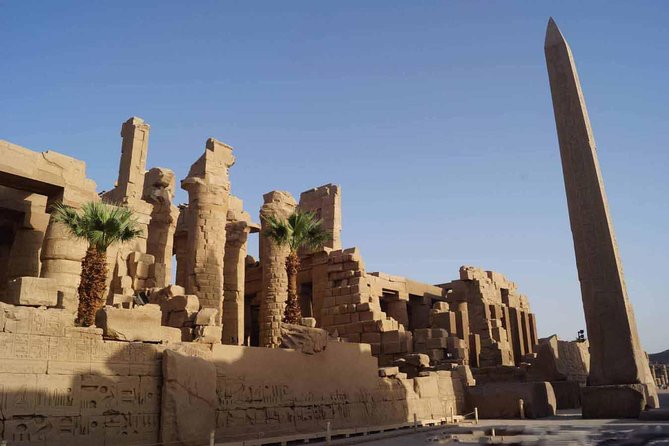
Luxor is the kind of place that usually scares people into planning paralysis. From Cairo, it’s far enough that you’d either lose a full day to transport or end up missing the best hits. This trip cuts that fear: you fly in and out, then spend your short time with a guide moving you between the east and west banks.
The pacing matters. Day 1 leans toward the east bank highlights and the big temple complexes, then you finish with major west bank monuments. Day 2 continues on the west bank with the mortuary temple at Medinet Habu and then the Valley of the Queens. If you’re the type who wants the greatest hits without turning your vacation into admin work, this is designed for you.
You can also read our reviews of more tours and experiences in Cairo.


Luxor Temple at night: your calmer first look
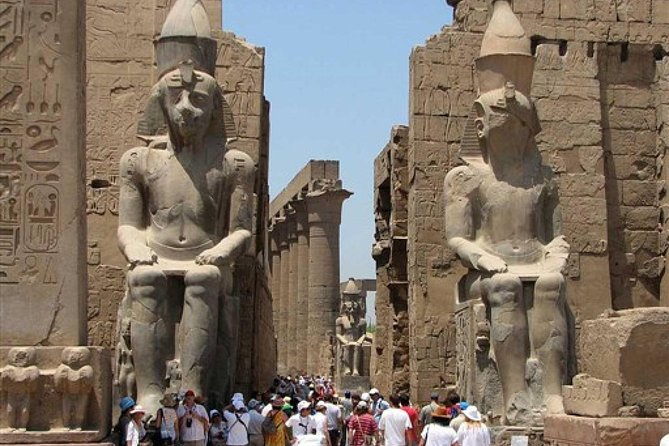
Your first stop is Luxor Temple, a major Ancient Egyptian temple complex on the east bank of the Nile. It’s tied to Thebes (ancient Luxor) and was built around 1400 BCE, with the temple name connected to the idea of a southern sanctuary.
What I like about this stop on your schedule is timing. You get evening access to Luxor Temple, which matters because temples feel different after the heat. You tend to get a more intimate read of the carvings and processional spaces, and you can photograph without the harshest midday glare.
A practical note: temples are spread out and there’s a lot to look at. If your brain likes structure, spend your first minutes orienting yourself to the main axes before you go hunting for specific columns or walls.
Hatshepsut at Deir el-Bahari: a temple built for drama
Next you head to the Temple of Hatshepsut at Deir el Bahari. This mortuary temple is famous for being carved into a cliffside setting and for being dedicated to both Amun and Hatshepsut. It’s also commonly described by its Ancient Egyptian name, Djeser-Djeseru, the Holy of Holies.
This is one of those places where the architecture does half the storytelling. The terraced layout and the siting under cliffs make it feel like the temple is part of the landscape, even though it’s really about human planning—steps, angles, sightlines.
What you might find less fun is the sheer popularity of the site in general. On this tour you’re not choosing the timing, but the fact that it’s included in an efficient program helps you move through without turning it into a long wait-and-guess day.
Karnak Temple: when scale stops being an idea
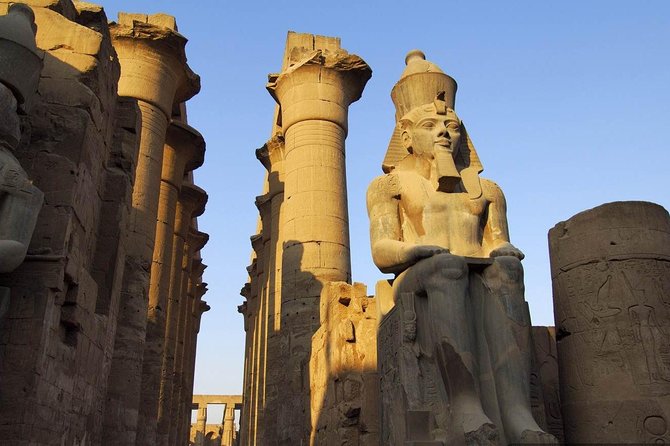
Then comes Karnak Temple Complex, the sprawling worship center tied to Amun and the Theban Triad. Construction stretched across eras, from the Middle Kingdom beginnings through the New Kingdom and even the Ptolemaic period. The result is a complex mix of pylons, chapels, temples, and sacred spaces that never fully resolves into a single “main thing.” That’s part of its power.
This stop usually rewards two types of visitors:
- You like large-scale ruins and want to see how power projects itself in stone
- You like walking through layered history, even if you can’t memorize every reign
Your guide can help you interpret what you’re seeing without drowning you in names. Still, give yourself room to get overwhelmed by details. Karnak is not a quick look-and-move place.
Colossi of Memnon: short stop, big presence
The Colossi of Memnon are two massive statues of Pharaoh Amenhotep III, standing in the Theban Necropolis area west of the Nile. They’re quick—about a half hour is listed—but they’re worth that kind of slot because they work as a visual reset.
Think of them like punctuation. Karnak and Hatshepsut pull you into temple complexity. The Colossi pull you back into sheer monument size: a couple of figures that anchor your sense of time before you go deeper into tomb country.
If you care about photo angles, come ready to walk around the statues. Even in a short window, you can find a few viewpoints that don’t feel repetitive.



Valley of the Kings: tombs for the power elite
After that, you move to the Valley of the Kings, a New Kingdom burial area across nearly five centuries of royal tomb carving. It’s on the west bank, opposite Thebes, and the valley is often described as the Valley of the Gates of the Kings.
This stop is a major reason Luxor feels like a unique trip compared to other Egyptian destinations. These are not city temples where you’ll just wander through columns. These are the places created for the afterlife of pharaohs and elite nobles.
Expect a mix of things: some tombs are visually dramatic, but what makes this area special is the concept of hidden chambers carved into rock. With a short timeframe, you’ll want to listen to your guide about the layout and significance so it doesn’t become just another valley of entrances.
Optional King Tutankhamen upgrade: the headline add-on
One highlight in the overall offering is the chance to upgrade to visit the tomb of King Tutankhamen. This is the moment many people want: it’s the famous boy king whose mummy drew worldwide attention.
From a planning standpoint, upgrades are easiest to justify when the base plan already gives you a lot. Here, you’re already hitting the big temple icons. So if King Tut is your top priority, this upgrade can be the extra memory you’re most likely to talk about later.
The only consideration is that upgrades can affect timing. If you’re the kind of traveler who hates schedule compression, you might weigh whether you’d rather spend that time walking other sites more slowly.
Day 2 on the west bank: Medinet Habu and the queens valley
Day 2 keeps you on the west bank, and that’s smart. Luxor Temple and Karnak sit on the east bank, while the burial zones and mortuary temples are concentrated on the west. You’ll already have that brain map from Day 1, so the second day feels like continuing a theme instead of starting over.
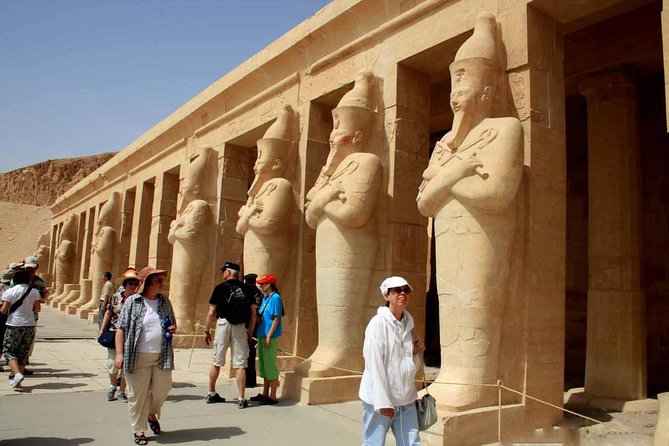
The first stop is the Mortuary Temple of Ramesses III at Medinet Habu. The location is associated with Ramesses III, near the Theban Hills, and it’s the kind of site that rewards a slower pace with your eyes. Even if you only have a couple hours, it’s a good place to notice how mortuary temples relate to their surroundings and how they were designed to be ritual spaces long after the building phase.
Then you head to the Valley of the Queens, known in Ancient Egypt as Ta-Set-Neferu, the place of beauty. This is where many wives of pharaohs were buried, and it sits close enough to the workers’ area that it makes sense as part of the whole Thebes machine of building and burial.
The Valley of the Queens is described in terms of multiple valleys and tomb groups, with the main wadi holding most tombs and subsidiary valleys adding more. With limited time, the key is to think of it as a burial landscape system, not just a single location. Your guide can help you translate the setting so you don’t feel like you’re looking at random entrances.
What’s included, and why that matters at $390
The price is $390.00 per person, and at first glance it can feel like a lot if you only compare it to the cost of a few entry fees. The value comes from what’s bundled:
- Round-trip flights from Cairo
- Hotel and meals are part of the design, though the booking info also lists hotel as optional, so you should check what you’re selecting
- Breakfast and lunches are included
- A tour guide accompanies you to each site
- Hotel pickup and drop-off are offered
That bundle is where time savings turn into money savings. If you tried to do this on your own, you’d still need flights, hotel coordination, and a plan that respects how far the west bank is from the east bank in both geography and energy.
Also, admission is listed as free for each stop in the schedule you’re shown. Even if conditions vary by date, that signals a deal structure that reduces the need to budget for tickets on the spot.
What about group discounts? The tour describes group discounts, and it also notes a private tour/activity where only your group participates. Practically, that tends to mean you’re not stuck in a huge crowd tour mode, but you may still benefit from pricing set up for groups.
Timing, comfort, and the 2-day reality check
Start time is listed as 3:00am, and that’s the first big reality check. Getting up early is one thing; doing it on an overnight trip with flights and a full day of sights is another. I’d treat the night before like part of the trip, not like a normal evening.
Comfort tips that actually help on this type of plan:
- Wear shoes you can walk in for temple floors and uneven paths
- Bring a light layer for morning and air-conditioned spaces
- Plan to hydrate, since temple days in Luxor can be tiring fast
The other reality check is that this is a 2-day, high-coverage program. You’ll hit the major sites: Luxor Temple, Karnak, Hatshepsut, Colossi of Memnon, Valley of the Kings, Medinet Habu, and the Valley of the Queens. If that feels like the right tradeoff for you, you’ll come away with a clear Luxor snapshot.
Who should book this overnight Luxor trip
I think this works best if you fit one of these:
- You’re in Cairo now and want Luxor without spending extra days planning
- You like guided structure because you want meaning, not just photos
- You’re okay with early starts in exchange for not wasting a day to transit
It may not be your best match if:
- You hate tight schedules and want long unscripted time
- You want a deeper Egyptology focus where you spend half a day on one site
- You’re traveling with someone who struggles with early mornings and lots of walking
Should you book? My practical take
If your goal is Luxor highlights in an efficient overnight, this is an easy yes. The biggest reasons are the logistics: flight included, pickup handled, a guide for interpretation, and a schedule that hits both banks without you doing the math.
I’d only hesitate if you’re sensitive to early wake-ups or you’re the type who wants to linger for hours per monument. In that case, you might consider staying longer in Luxor so you can slow down and repeat your favorite spaces.
If you do book, consider whether the King Tutankhamen tomb upgrade fits your priorities. With the rest of the program already full, that optional add-on is often the deciding factor between a good trip and a standout memory.
FAQ
What time does the trip start?
The start time is listed as 3:00am.
How long is the Luxor overnight trip?
It’s listed as 2 days (approximately).
Do you include flights from Cairo?
Yes. The trip includes round-trip flight tickets from Cairo.
Is pickup from my hotel included?
Yes, hotel pickup and drop-off are included.
What meals are included?
Breakfast and lunch are included, plus lunch at a local restaurant during each day tour.
Are hotel accommodations included?
The tour description mentions hotel, but the booking info lists hotel as optional. Check your selected option for your date.
Are entrance tickets included?
Admission is listed as free for the stops included on the schedule.
Is a tour guide provided?
Yes. A tour guide is included and accompanies you to each location.
Do I need to bring a passport photo for booking?
Yes. The note says you need a copy photo from your passport, and you should update it during the booking process.
What happens if weather is bad?
The experience requires good weather. If it’s canceled due to poor weather, you’ll be offered a different date or a full refund.